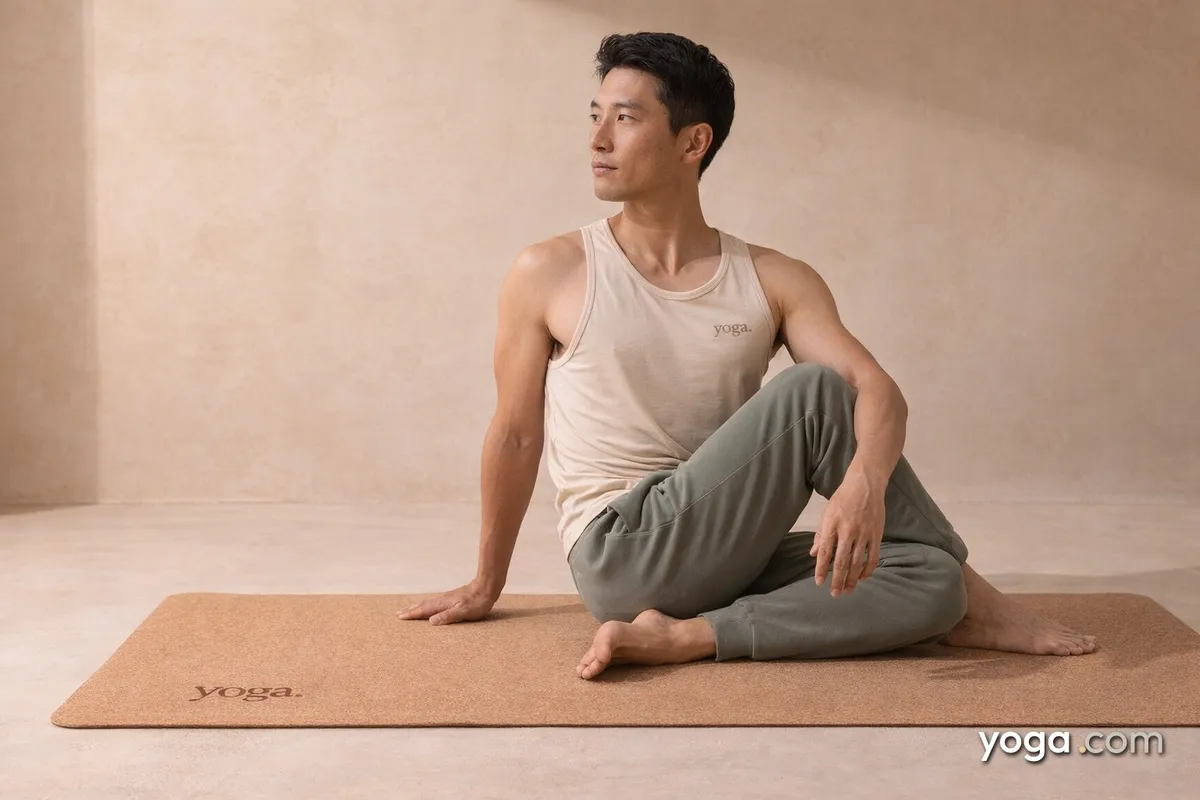
Right Twist with Right Leg Bent is a seated spinal rotation that places the right foot on the floor outside the left thigh while the spine spirals to the right. Its Sanskrit name is Ardha Matsyendrāsana (right side), which translates as "Half Lord of the Fishes Pose" - a tribute to the sage Matsyendra, said to have overheard the secrets of yoga while sitting in this very shape. Practiced at an intermediate level, it typically appears toward the middle or end of a seated sequence, after the hips and spine are already warm.
At a Glance
- Level: Intermediate
- Type: Twist
- Targets: Thoracic and lumbar spine, hips and glutes, shoulder girdle, obliques
- Good for: Increasing spinal rotational range of motion, lengthening the outer right hip, building torso stability
How to Do Right Twist with Right Leg Bent
- Sit on the floor with both legs extended. Ground evenly through both sitting bones, sitting on a folded blanket if needed to keep the pelvis upright.
- Bend the right knee and plant the right foot flat on the floor just outside the left thigh, right shin roughly vertical. Keep the left leg extended and active, left foot flexed.
- On an inhale, lengthen your spine tall - imagine the crown of your head rising toward the ceiling.
- On an exhale, rotate your torso to the right. Bring your left upper arm to the outside of your right knee, or wrap the left elbow around the right knee if the elbow clears it comfortably.
- Place your right hand on the floor behind your right hip, fingertips pointing away from you, to support the upward length of the spine.
- With each inhale, re-lengthen the spine; with each exhale, deepen the rotation slightly. Turn your gaze over your right shoulder without straining the neck.
- Hold for 5-8 breaths, keeping both sitting bones grounded and the chest broad.
- To come out, release the gaze first, then unwind the torso on an inhale, and straighten both legs back to center before practicing the left side.
Benefits
- Rotates and mobilizes the thoracic and lumbar vertebrae, increasing spinal rotational range of motion.
- Stretches the external rotators and glutes of the right hip.
- Strengthens the erector spinae and obliques as they work to maintain an upright torso against gravity.
- Lengthens the muscles along the left side of the torso, including the lateral obliques and quadratus lumborum.
- Builds shoulder and upper-back stability through the sustained position of the arms.
- Engages and tones the muscles surrounding the spine, supporting better postural awareness.
Common Mistakes and Alignment Cues
- Collapsing the spine to deepen the twist: Prioritize length over depth - root down through the sitting bones and lift through the crown before rotating further.
- Right sitting bone lifting off the floor: Press both sitting bones evenly into the mat; if the right lifts, place a folded blanket under it to restore balance.
- Using the arm to wrench the knee inward: The left arm at the knee is a lever for leverage, not a grip - keep steady pressure rather than pulling.
- Neck rotating independently of the torso: Let the gaze follow the rotation of the whole chest; turn the head only as far as the thoracic spine has moved.
- Right hand sinking into the floor and rounding the upper back: Press firmly through the right fingertips to lift the right side of the rib cage, keeping the back ribs broad.
Modifications and Props
- Blanket under sitting bones: If your pelvis tilts backward or one hip lifts, sit on one or two folded blankets to encourage a neutral lumbar curve.
- Block behind the right hip: Place a block at any height behind your right hip instead of the floor to reduce wrist strain and add extra lift to the torso.
- Left foot stays at the hip instead of crossing over: Keep the left knee bent with the left foot near the right hip (a simple half-cross-legged base) if planting the right foot outside the left thigh compresses the knee.
- Wall support: Sit facing a wall an arm's length away; as you twist right, press the left palm flat against the wall to gauge torso rotation without straining the shoulder.
Cautions
- Approach carefully if you have a recent or acute disc herniation or spinal injury - deep rotation can increase intradiscal pressure.
- Be conservative with the depth of twist if you have sacroiliac joint sensitivity; keep the pelvis level and avoid forcing the rotation at the base of the spine.
- Those with knee discomfort should check that the right knee is tracking in line with the right foot and is not torqued sideways under the weight of the pose.
- During pregnancy, practice only with qualified guidance, as deep abdominal compression is not appropriate in later trimesters.
If you're working with an injury or a medical condition, check with a qualified professional before practicing.
Related Poses
- Left Twist with Left Leg Bent - the direct counterpart; always practice both sides.
- Rotation Pose with Legs to the Right - a gentler preparatory twist that warms the spine before moving to the seated upright version.
- Sage Twist (Right) - a close variation with a different arm position, offering the next progression in the same pose family.
- Bend to Left Leg with Rotation - combines forward folding with rotation, making it a complementary counter-shape for the hip and hamstring.
Looking for a sequence context? This pose fits well in A Gentle Yoga Routine for Tired, Low-Energy Days, or try it as part of A 10-Move Chair Yoga Sequence for a Midday Reset (adapted seated on a chair).