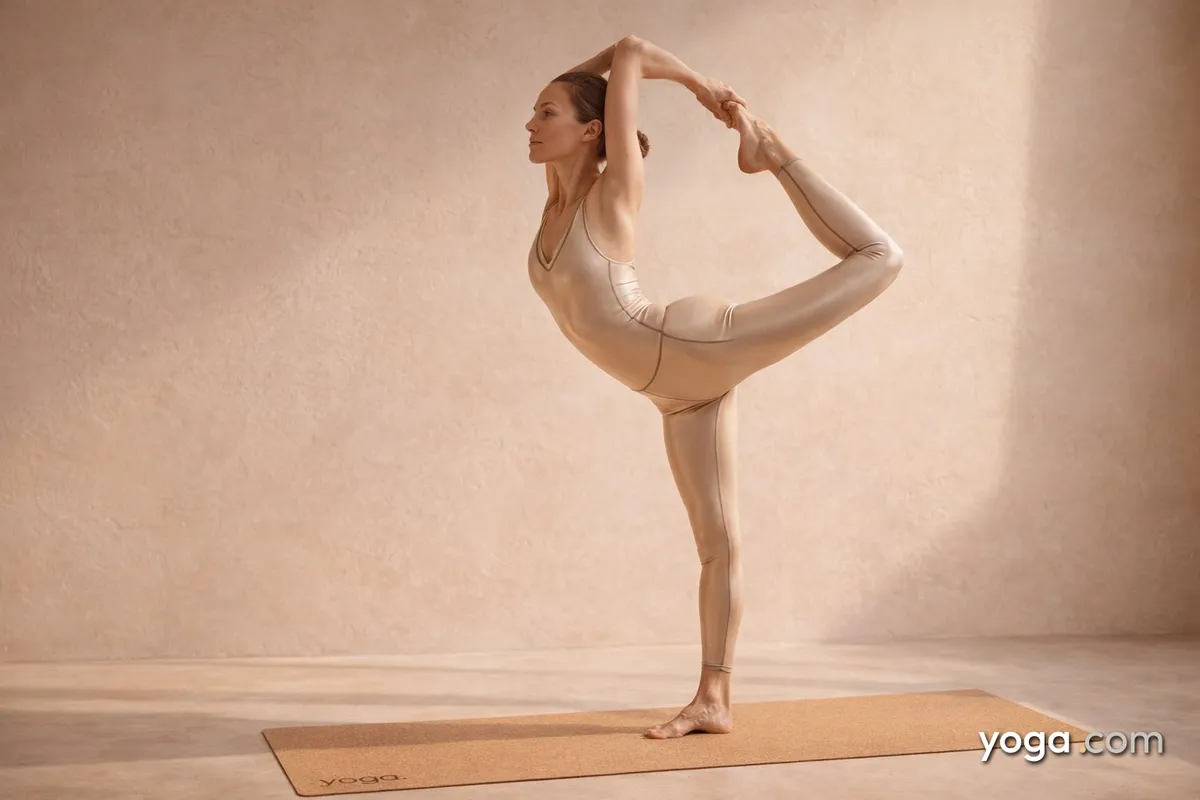
Standing Lord of Dance Pose with Right Foot Near the Head is an extreme standing backbend and balance that takes the classic Naṭarājāsana (right foot near head) - literally "pose of Natarāja, the dancing form of Shiva" - to its deepest expression by drawing the right foot up toward the crown of the skull. It belongs near the peak of an advanced practice, calling on thorough preparation across the spine, shoulders, hips, and standing leg before you attempt it.
At a Glance
- Level: Advanced
- Type: Balance
- Targets: Lumbar and thoracic spine (deep extension), hip flexors and quadriceps of the raised leg, shoulder girdle and chest, standing-leg stabilizers
- Good for: Developing single-leg balance and proprioception, building active spinal extension strength, increasing hip flexor and quadriceps length
How to Do Standing Lord of Dance Pose with Right Foot Near the Head
- Root in Mountain Pose. Stand tall at the top of your mat, feet hip-distance apart, weight evenly distributed. Breathe steadily and bring your gaze to a fixed drishti point at eye level.
- Shift onto the left foot. Press firmly through all four corners of the left foot, engage the left quadricep and glute, and draw the lower belly in and up to stabilize the pelvis.
- Lift the right leg. Bend the right knee and reach back with your right hand to grip the inner arch of the right foot (thumb pointing down, fingers wrapped over the top of the foot). Begin to kick the right foot back and up, initiating from the right hip flexor stretching, not from collapsing the lower back.
- Extend the left arm forward and up. Reach the left arm straight ahead at shoulder height to counterbalance, or raise it overhead, palm facing in. Keep the torso upright before introducing backbend depth.
- Deepen the backbend progressively. Continue pressing the right foot actively into the hand while lifting through the sternum. Allow the thoracic spine to extend rather than hinging only at the lumbar. Draw both shoulder blades toward each other.
- Bring the right foot toward the head. As the chest opens and the shoulder of the gripping arm rotates, guide the right foot upward and forward. The elbow points skyward. Maintain active engagement in the standing leg throughout - micro-bend the left knee if you feel the joint locking.
- Hold and breathe. Keep the gaze steady, the throat soft, and the breath even for three to five breaths. The right foot approaches or touches the crown of the head; work within your current range rather than forcing contact.
- Come out with control. Slowly lower the right foot, release the grip, and return to standing. Pause in Mountain Pose for a breath before moving to a counter-pose such as a forward fold.
Benefits
- Stretches the hip flexors, quadriceps, and anterior shoulder of the raised-leg side through a large range of motion
- Strengthens the glutes, hamstrings, and ankle stabilizers of the standing leg under single-leg load
- Builds active thoracic and lumbar extension strength while lengthening the anterior chest and intercostals
- Improves proprioception, neuromuscular coordination, and concentration required for extended single-leg balance
- Develops shoulder external rotation and overhead mobility needed for the deep grip
Common Mistakes and Alignment Cues
- Hinging only at the lumbar: Distribute the backbend through the entire spine - visualize lengthening from the tailbone to the crown rather than crunching the lower back.
- Collapsing the standing-leg hip outward: Keep the left hip stacked over the left ankle; draw the outer left hip in to maintain a level pelvis.
- Gripping the foot passively: Press the right foot actively into the hand as if trying to straighten the knee - this co-contraction protects the knee and deepens the extension.
- Letting the gaze wander: Fix your drishti before lifting the foot; losing your focal point is almost always what breaks the balance first.
- Rushing depth: Ease into the full expression over many breaths and many sessions - the foot-near-head position requires consistent warm-up, not momentum.
Modifications and Props
- Strap: Loop a strap around the right foot and hold both ends overhead. This extends your reach so you can work toward the deep backbend without straining the shoulder joint before it is ready.
- Wall support: Stand an arm's length from a wall and rest the fingertips of the extended left hand against it. This frees your attention for spinal extension without worrying about balance.
- Standard Natarajasana first: Practice the conventional Lord of the Dance Pose - foot at hip height, torso moderately inclined - until you can hold it steadily for eight breaths before working toward the head-height variation.
- Partner assist: Have a teacher or experienced partner support the raised ankle, guiding the foot toward the head while you focus on opening the chest and maintaining standing-leg alignment.
Cautions
- Avoid this pose if you have an acute lower back injury, lumbar disc issues, or sacroiliac instability - the degree of spinal extension places significant load on these structures.
- Use caution with shoulder impingement, rotator cuff injuries, or limited shoulder external rotation; the overhead grip can aggravate these conditions.
- If you experience knee discomfort on the raised leg, reduce the depth of the backbend and ensure you are pressing the foot actively into the hand rather than passively allowing the knee to hyperextend.
- Practitioners with inner-ear conditions, vertigo, or balance disorders should work at the wall or skip the pose until those issues have resolved.
If you're working with an injury or a medical condition, check with a qualified professional before practicing.
Related Poses
- Lord of the Dance Pose (Left) - the companion directional variation to balance both sides of the body
- Advanced Extended Left Hand to Big Toe Pose - develops the standing balance, hamstring opening, and shoulder mobility this pose demands
- Tree Pose on Right Foot - a foundational one-legged balance that trains the standing-leg stability needed here
- Mountain Pose - the grounding starting and returning point that bookends every standing-balance practice
For more standing and balance practice in accessible contexts, see A Gentle Yoga Routine for Tired, Low-Energy Days and A 10-Move Chair Yoga Sequence for a Midday Reset.