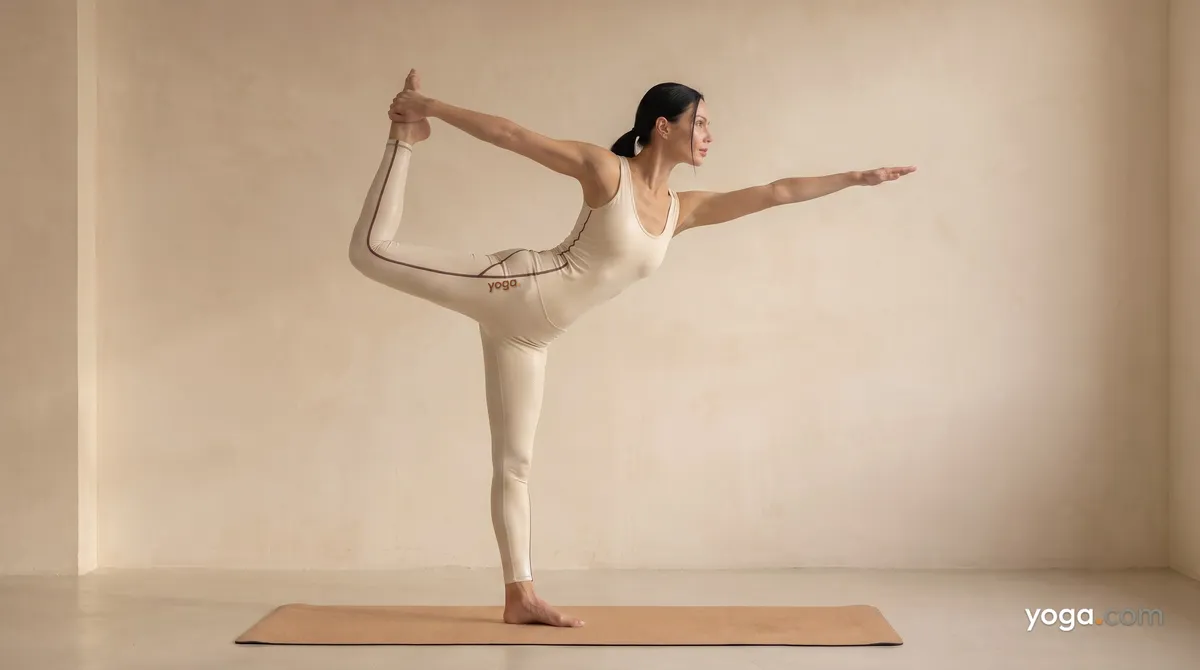
Lord of the Dance Pose, Naṭarājāsana (right side) - literally "pose of Nataraj," the dancing form of Shiva - is a standing backbend and balance that asks your right leg to kick back and up while your torso tips forward and your arm stretches overhead. It belongs to the advanced tier of the balance family, and it typically appears near the peak of a standing sequence once the hips, shoulders, and spine are thoroughly warmed.
At a Glance
- Level: Advanced
- Type: Balance
- Targets: Standing-leg hip and ankle stability, kicking-leg hip flexors and quadriceps, thoracic spine, shoulder girdle
- Good for: Building single-leg balance, improving spinal extension range of motion, developing shoulder and chest mobility
How to Do Lord of the Dance Pose (Right)
- Start in Mountain Pose. Stand with your feet hip-width apart, weight even through both feet. Root down through the left foot - this is your standing leg for the right-side variation.
- Bend the right knee. Shift your weight onto the left foot. Bend the right knee and bring the right heel toward the right buttock. Reach back with your right hand and grip the inner arch of the right foot, thumb pointing down, fingers wrapping over the top.
- Establish your standing-leg foundation. Micro-bend the left knee, press firmly through all four corners of the left foot, and engage the left quadriceps and glutes to stabilize the pelvis. Fix your gaze on a still point at eye level.
- Raise the left arm. Inhale and sweep the left arm straight up alongside your left ear, palm facing in. Keep the shoulder drawing away from the ear - length, not tension.
- Tip forward and kick back simultaneously. As you exhale, hinge the torso forward from the hip (not the waist) while actively pressing the right foot into your right hand. These two actions - forward tilt and backward kick - must stay balanced; let the leg drive the lift rather than pulling the foot with your hand alone.
- Open the chest and spine. Continue pressing the right foot back and up, allowing the thoracic spine to extend. Draw the right shoulder blade toward the spine. The reaching left arm and the kicking right leg create one long diagonal line. Keep the right knee tracking straight behind the hip, not splaying to the side.
- Hold and breathe. Stay for five to eight steady breaths. Keep the left hip level - resist letting it hike toward the lifted leg. Gaze softly forward or slightly upward if the neck is comfortable.
- Come out with control. On an exhale, slowly lower the torso back to upright while releasing the right foot. Lower the right foot to the floor with control and return to Mountain Pose before switching sides.
Benefits
- Strengthens the standing-leg ankle, knee, and hip stabilizers
- Stretches the hip flexors and quadriceps of the lifted leg
- Builds thoracic spine extension and counteracts rounded-upper-back posture
- Develops shoulder and chest mobility through the overhead reaching arm
- Trains single-leg proprioception and neuromuscular coordination
- Engages the deep core muscles to maintain a stable pelvis under asymmetrical load
Common Mistakes and Alignment Cues
- Mistake: Gripping the foot from the outside, externally rotating the hip. Cue: Hold the inner arch with the right thumb pointing down so the right knee stays directly behind the hip, not splaying out to the side.
- Mistake: Collapsing into a deep lumbar arch instead of extending through the thoracic spine. Cue: Lengthen the tailbone down slightly and initiate the backbend from the mid-back; let the lift come from the kicking leg, not from compressing the lower back.
- Mistake: Letting the standing hip hike up toward the lifted leg. Cue: Actively draw the left hip down and level; think of stacking both hip points in the same horizontal plane.
- Mistake: Rushing the kick so the torso pitches forward uncontrolled. Cue: Match the speed of the kick to the speed of the forward tilt - they should be equal and opposing, creating a stable, suspended arc.
- Mistake: Holding the breath and tensing the face and jaw. Cue: Soften the face, keep the gaze steady, and let the exhale ground you into the standing foot.
Modifications and Props
- Strap around the right foot: If you cannot reach the foot comfortably, loop a yoga strap around the top of the right foot and hold both ends. This gives you length to work with as shoulder and quadriceps flexibility develops.
- Hand on a wall: Place the left fingertips on a wall in front of you instead of reaching overhead. This frees you to focus on the kick and hip alignment before adding the balance challenge of the overhead arm.
- Less forward tilt: Keep the torso nearly upright while you build strength in the standing leg, lifting the right knee and foot only a few inches behind the hip. Progress the forward tilt gradually over many sessions.
- Block under the standing foot: Placing a block under the left foot raises the floor slightly and can help practitioners who find it difficult to ground through a flat foot while the torso tips forward.
Cautions
- Lower back sensitivity: The pose demands significant lumbar and thoracic extension. Move into the backbend gradually and stop if you feel compression or sharp sensation in the lower back.
- Knee issues: Deep flexion of the kicking-leg knee and the load on the standing-leg knee both require stable, pain-free joints. Avoid forcing the grip if the kicking knee protests.
- Shoulder or rotator-cuff concerns: Reaching the arm overhead with the shoulder in extension can place stress on an unstable shoulder. Keep the reaching arm lower or skip it entirely if you feel any pinching.
- Balance challenges: Practice near a wall any time dizziness or instability is present, and come out of the pose slowly to avoid sudden weight shifts.
If you're working with an injury or a medical condition, check with a qualified professional before practicing.
Related Poses
- Mountain Pose - the grounded starting point; return here to reset between sides.
- Tree Pose on Right Foot - a foundational single-leg balance that builds the standing-leg stability this pose demands.
- Lord of the Dance Pose (Left) - the counterpart; always practice both sides in the same session.
- Standing Lord of Dance Pose with Right Foot Near the Head - the next progression when full backbend range and shoulder flexibility are established.
Looking for a broader standing practice? See A Gentle Yoga Routine for Tired, Low-Energy Days or explore accessible movement in A 10-Move Chair Yoga Sequence for a Midday Reset.