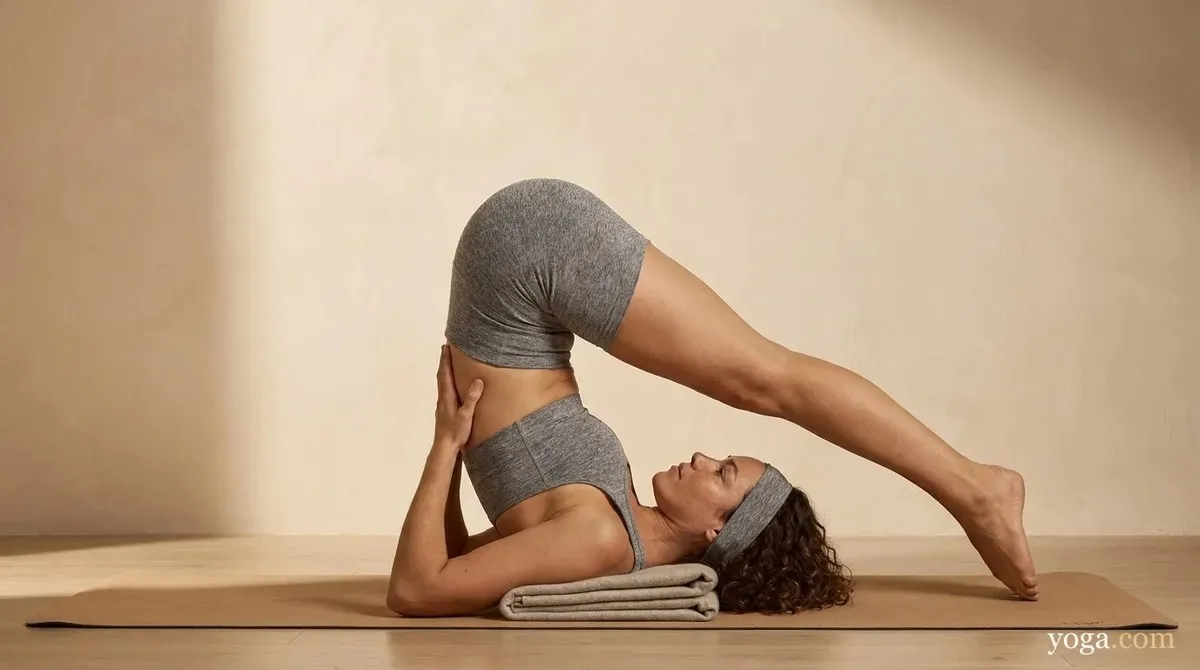
Supported Plow Pose (Sālamba Halāsana - literally "supported plow pose," from sa, with; ālamba, support; and hala, plow) is a gentle inversion that places a folded blanket or bolster beneath the shoulders to protect the cervical spine. It belongs to the same family as full Plow Pose but keeps the neck in a safer, more neutral position, making it an accessible entry point into supine inversions. Practice it near the end of a session, after the spine is warm, as a transition toward Śavāsana.
At a Glance
- Level: Beginner
- Type: Inversion
- Targets: Cervical and thoracic spine, hamstrings, shoulders, upper back
- Good for: Lengthening the posterior chain, building introductory inversion confidence, calming the nervous system toward the end of practice
How to Do Supported Plow Pose
- Fold two or three firm blankets into a tidy rectangle about four inches high and place them on your mat so the folded edge faces the front of your mat; you will lie with your shoulders on this edge and your head on the bare floor.
- Lie on your back with your shoulders resting on the blanket, two to three inches in from the folded edge, and your head resting flat on the mat; the raised shoulders allow your neck to float free of the floor - this is the key benefit of the prop, and placing the shoulders off the blanket entirely removes that protection.
- Bend your knees, press your feet into the floor, and on an exhale use your core to lift your hips, rolling your spine up and over so your legs travel overhead.
- Straighten your legs toward the floor behind your head; rest your toes on the floor if they reach, or let them hover if the hamstrings are tight - either is fine at this stage.
- Interlace your fingers on the mat beneath your torso and press the outer edges of your arms down to help broaden the upper back; alternatively, keep your palms flat on the blanket for more stability.
- Hold your hips directly over your shoulders rather than letting them sag toward your face; engage your quadriceps so the kneecaps lift and the legs stay active.
- Remain for 5-10 breaths, keeping the throat soft and the gaze steady at the ceiling or the tip of the nose - avoid turning your head.
- To come out, bend your knees, place your hands on your lower back for support, and slowly unroll your spine one vertebra at a time back onto the blankets; rest in Corpse Pose for several breaths before sitting up.
Benefits
- Stretches the hamstrings and calves through an active lengthening of the entire posterior leg line.
- Mobilizes the thoracic spine and the muscles between the shoulder blades.
- Builds foundational awareness of spinal articulation needed for deeper inversions.
- Strengthens the core muscles that control the spinal roll in and out of the pose.
- The prop position offloads compression from the cervical vertebrae compared to unsupported Plow Pose.
Common Mistakes and Alignment Cues
- Letting the hips pike far past the shoulders: Draw the hips back so they stack over the shoulders, creating a straighter line from hip to heel.
- Collapsing the upper back and rounding excessively: Press the tops of the arms firmly into the blanket and broaden the collarbones to maintain width across the chest.
- Turning or craning the head: Settle the gaze before entering the pose and keep it fixed there; any rotation while weight-bearing on the neck risks strain.
- Holding the breath: The abdomen is compressed, so breathing will feel different - breathe slowly into the sides of the ribcage rather than forcing the belly to expand.
- Shoulders sliding off the blanket: Reposition before the next attempt so the tops of the shoulders sit clearly on the folded edge, creating the lift that decompresses the neck.
Modifications and Props
- Chair for the feet: If the toes don't reach the floor, place a chair behind you and rest your feet on the seat - this removes the strain of unsupported hovering and allows the pose to be held longer.
- Higher blanket stack: Adding a fourth blanket increases the shoulder lift, giving the neck more clearance and making the pose accessible for students with tighter hamstrings or a less flexible thoracic spine.
- Strap around the thighs: Loop a strap around the lower thighs (not the knees) to keep the legs parallel and reduce the effort of holding them together overhead.
- Knees bent: Keep a generous bend in both knees if the hamstrings pull strongly; this takes priority over straight legs at every level of practice.
Cautions
- Avoid this pose if you have a current neck injury or any acute cervical disc issue - even with blanket support, the position places the neck in a loaded flexion range.
- Skip or modify during menstruation; many traditions recommend avoiding inversions at this time, and you are the best judge of what feels appropriate for your body.
- Use extra care - or skip entirely - if you have glaucoma, high blood pressure that is not well managed, or detached retina, as inversions alter intracranial and intraocular pressure.
- Students who are pregnant should avoid this pose from the second trimester onward.
- If you're working with an injury or a medical condition, check with a qualified professional before practicing.
Related Poses
- Bridge Pose - a warm-up that introduces spinal extension and prepares the shoulders for bearing weight.
- Plow Pose - the unsupported progression once the blanket variation feels steady.
- Ear Pressure Pose - a natural continuation from Plow, deepening the spinal flexion with knees drawn to ears.
- Corpse Pose - the essential counter-pose; always rest here after any inversion before sitting up.
Find Supported Plow Pose woven into sequences like A Gentle Yoga Routine for Tired, Low-Energy Days; for a seated alternative on days when floor inversions feel like too much, explore A 10-Move Chair Yoga Sequence for a Midday Reset.