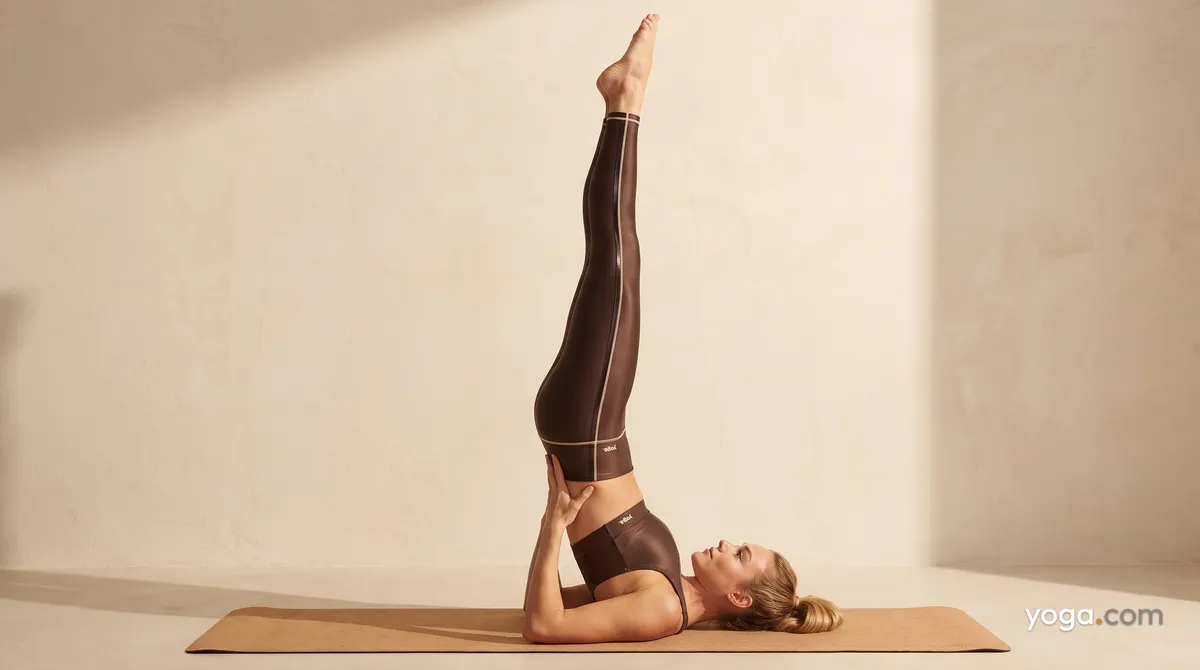
Supported Shoulderstand (Sālamba Sarvāṅgāsana - literally "supported all-limbs pose") is the classical inversion in which the body balances vertically on the tops of the shoulders, with the hands pressing into the mid-back for support. Considered one of yoga's foundational poses, it typically appears toward the close of a practice, after the body has warmed through standing and seated work.
At a Glance
- Level: Intermediate
- Type: Inversion
- Targets: Cervical and thoracic spine, shoulders and upper arms, core, legs
- Good for: Building shoulder stability, lengthening the posterior chain, developing body awareness in an inverted position
How to Do Supported Shoulderstand
- Set up the foundation. Fold one or two firm blankets into a neat rectangle (about 30 cm × 60 cm) and place them at the top of your mat. The folded edges face away from you. Lie on your back so your shoulders rest on the blankets and the back of your head is on the mat - your neck is free of the blanket's edge.
- Prepare the legs. Bend your knees, draw your feet hip-width to the floor, and press your arms alongside your body.
- Swing the hips up. On an exhale, press your palms into the mat and use your abdominal muscles to roll the hips off the floor, bringing your knees toward your face.
- Bring the hands to the back. Bend your elbows and walk your hands up your back, fingertips pointing toward the ceiling, so the heels of your hands support either side of the spine - not the kidneys. Draw your elbows toward each other.
- Extend the legs to vertical. Straighten both legs together toward the ceiling, pressing through the balls of your feet. Stack your ankles over your hips, hips over your shoulders. Your gaze is soft, directed at the ceiling or the space between your toes - do not turn your head.
- Refine the posture. Firm your outer thighs inward, keep your chin away from your sternum by a small natural space (do not force the chin down), and breathe steadily. Hold for 5-20 breaths, building duration gradually over weeks of practice.
- Come out carefully. Bend your knees toward your chest and slowly roll the spine back down to the mat one vertebra at a time, using your hands as a brake. Lower your hips to the blankets, then slide off them to rest flat.
- Counter the pose. Rest in Corpse Pose for several breaths, then move to a gentle backbend such as Bridge Pose before continuing.
Benefits
- Strengthens the posterior shoulder muscles and upper arms as they bear weight isometrically.
- Stretches the front of the chest and the muscles along the upper spine.
- Engages and tones the abdominal and spinal stabilizers needed to hold the vertical position.
- Lengthens the back of the legs (hamstrings and calves) as the feet press toward the ceiling.
- Develops proprioceptive awareness and balance in an inverted orientation.
- Encourages a long, even breath pattern through the expanded chest position.
Common Mistakes and Alignment Cues
- Mistake: Hands placed too low on the back. Cue: Walk your hands higher, toward the upper back and shoulder blades, so the elbows actively bear your weight rather than the lumbar spine.
- Mistake: Elbows splaying wide. Cue: Press the inner edges of your upper arms into the blanket and draw your elbows toward each other - this creates a stable shelf for the torso.
- Mistake: Hips drifting behind the shoulders. Cue: Stack your hip points directly above your shoulders; lift through the inner thighs to keep the legs vertical rather than angled away.
- Mistake: Turning the head while in the pose. Cue: Fix your gaze on one spot on the ceiling before you come up and keep it there for the entire hold - rotating the neck under load strains the cervical spine.
- Mistake: Neck pressed hard into the floor. Cue: The blankets create a small natural curve in the neck; do not flatten it by tucking the chin aggressively. A finger's-width of space under the neck is normal.
Modifications and Props
- One or two folded blankets under the shoulders (recommended for all practitioners): This protects the cervical spine by allowing the neck a natural curve while the shoulders are raised. Use this setup every time.
- Half shoulderstand at the wall: Place your blanket about 30 cm from the wall. Lie down, raise your hips, and rest the soles of your feet against the wall at a 45-60° angle. This reduces load on the neck while you build the necessary shoulder and core strength.
- Chair-supported variation: Place a folded blanket on the seat of a metal folding chair. Lie with your shoulders on the floor, drape your legs over the chair seat, and use your hands on the chair legs for light support. The hips are elevated without the full weight-bearing demand on the shoulders.
- Strap around the upper arms: Loop a yoga strap just above the elbows at shoulder-width to help keep the elbows from splaying, freeing your attention to focus on lifting and alignment.
Cautions
- Neck and cervical spine: Always use folded blankets to protect the neck. Anyone with a cervical disc issue, recent neck injury, or significant neck tension should approach this pose with care or choose a supported alternative.
- Glaucoma and elevated eye pressure: Full inversions increase intraocular pressure; practice with guidance if this is a concern.
- Pregnancy: Avoid learning this inversion during pregnancy; those already established in the pose should consult a qualified prenatal teacher.
- Blood pressure: Exercise caution if blood pressure is currently elevated; come out of the pose at the first sign of pressure in the head or face.
If you're working with an injury or a medical condition, check with a qualified professional before practicing.
Related Poses
- Bridge Pose - a grounding preparation that opens the chest and activates the posterior shoulders before going vertical.
- Plow Pose - a natural progression from Shoulderstand, deepening the shoulder stretch and spinal flexion.
- Ear Pressure Pose - a closely related variation folding from Plow, often practiced in sequence.
- Corpse Pose - the essential counter-pose; always rest here after inversions to allow the nervous system to settle.
Looking for a broader context? See how inversions and restorative postures fit into A Gentle Yoga Routine for Tired, Low-Energy Days, or explore accessible alternatives in A 10-Move Chair Yoga Sequence for a Midday Reset.