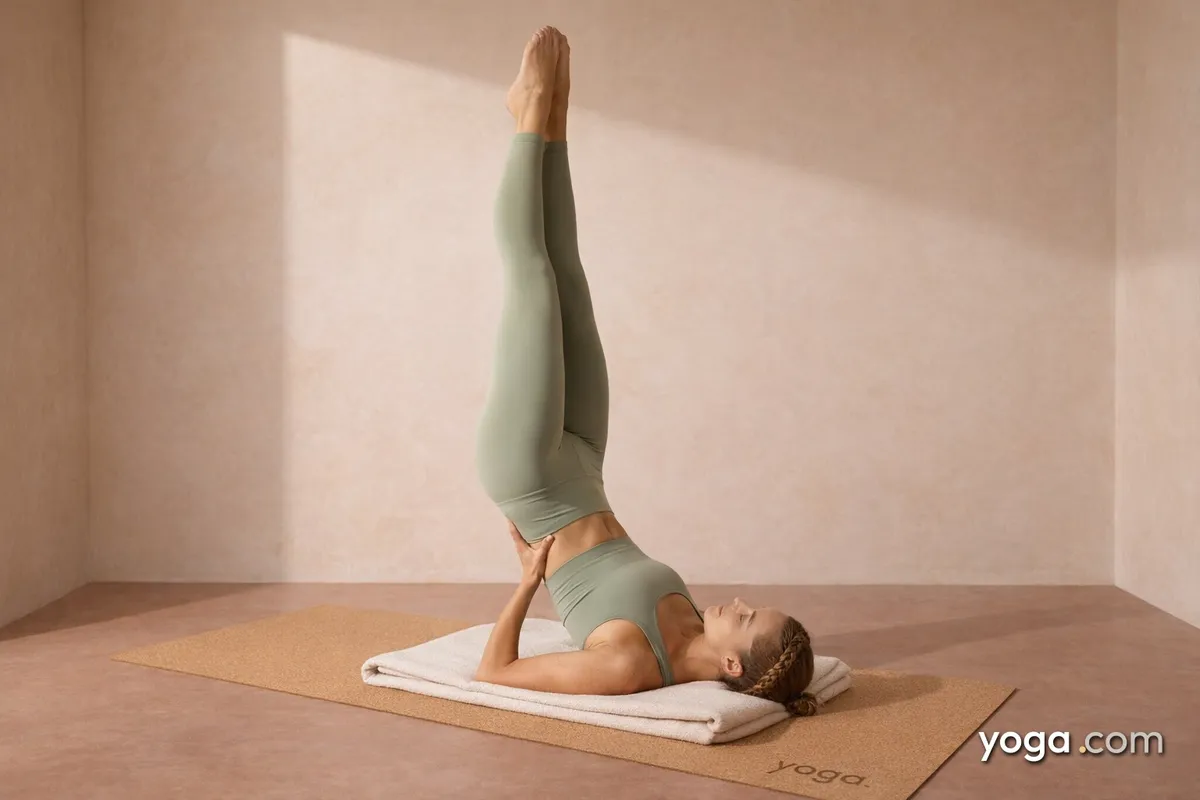
Easy Supported Shoulderstand is a gentler entry into the classical inversion family, known in Sanskrit as Sālamba Sarvāṅgāsana (easy variation) - literally "supported whole-body pose" - where the weight rests firmly on the shoulders, upper arms, and a folded blanket rather than demanding the full vertical line of the traditional form. By raising the hips with props and allowing a mild bend in the hips and knees if needed, this version makes the benefits of inverting accessible to newer practitioners. It typically appears near the end of a practice, after the body is warm and the nervous system is ready to settle.
At a Glance
- Level: Beginner
- Type: Inversion
- Targets: Cervical and thoracic spine, shoulders and upper arms, core, legs
- Good for: Building shoulder stability, strengthening the posterior chain, developing body awareness in inversions
How to Do Easy Supported Shoulderstand
- Stack two or three firm folded blankets into a neat rectangle and place them near the wall. Lie back so your shoulders rest on the blanket edge and your head is on the floor below it - the blanket lift protects your neck by keeping it in a natural curve rather than compressing it.
- Bend your knees, plant your feet flat on the floor, and draw your arms alongside your body with palms pressing down.
- On an exhale, press into your palms and swing your hips up and over, bringing your knees toward your forehead. Immediately bend your elbows and place your hands on your mid-back, fingers pointing toward the ceiling, to form a cradle for your torso.
- Walk your hands higher up your back - toward the shoulder blades - to support your spine and encourage lift rather than collapse.
- Straighten your legs toward the ceiling if comfortable, feet relaxed or toes gently pointed. If full extension feels strained, keep a soft bend in the knees with feet hip-width apart - this is the "easy" aspect of the variation.
- Draw your elbows toward each other behind you and press them firmly into the blanket to widen across your collarbones. Gaze softly at the ceiling or your toes; keep your head still and your jaw soft.
- Hold for 5-15 breaths, keeping your breath steady and your neck relaxed.
- To come out, bend your knees toward your chest, lower your hands to the floor, and slowly roll your spine down vertebra by vertebra onto the blankets. Rest in Corpse Pose for several breaths before moving.
Benefits
- Unloads the back of the neck by keeping it in a natural curve, relieving compression from the cervical spine and relaxing the upper trapezius.
- Builds isometric strength in the triceps, posterior deltoids, and mid-back muscles that support the shoulder girdle.
- Engages and tones the abdominal and lumbar stabilizers as they maintain the lifted position.
- Lengthens the hamstrings and calves when the legs extend toward vertical.
- Introduces the body to the spatial orientation of inversions in a prop-supported, lower-risk context.
- Encourages diaphragmatic breathing against mild gravitational resistance, deepening breath awareness.
Common Mistakes and Alignment Cues
- Mistake: Resting weight on the back of the neck. Cue: Feel the weight distributed across both shoulders and upper arms equally; if your neck feels pressed, add another blanket or lower your hips slightly.
- Mistake: Elbows splaying wide. Cue: Actively draw your elbows toward each other on the blanket - this widens your chest and gives your hands a stable platform to support your back.
- Mistake: Hands low on the lower back, causing the hips to sag. Cue: Walk your hands toward your shoulder blades so your torso stays lifted; sagging compresses the lumbar spine.
- Mistake: Turning the head to the side while in the pose. Cue: Decide on your gaze before entering the pose and keep it there - rotating the neck under load strains the cervical vertebrae.
- Mistake: Holding the breath or gripping the face and throat. Cue: Soften your jaw, relax your tongue, and let each exhale lengthen naturally; the pose should feel effortful but not strained.
Modifications and Props
- Higher blanket stack: Adding a fourth blanket gives more height, reduces the angle the neck must work at, and is recommended for practitioners with tighter shoulders or a stiff thoracic spine.
- Feet to the wall: Place the blankets close enough to the wall that you can rest the soles of your feet flat on it at a comfortable height - this removes the balance challenge entirely and lets you focus on shoulder and back engagement.
- Bent-knee variation: Keep both knees bent and feet hip-width apart throughout the hold. This shortens the lever arm of the legs, making the core demand more manageable and the overall shape more stable.
- Strap around the upper arms: Loop a strap just above the elbows, set to shoulder width, so it holds your elbows in alignment without constant muscular effort - useful when arm fatigue causes form to break down.
Cautions
- Avoid this pose if you have a neck injury, herniated cervical disc, or acute neck pain - the cervical spine bears indirect but real compressive force.
- Those with unmanaged high blood pressure, glaucoma, or detached retina should not practice inversions without medical clearance.
- Do not practice during menstruation if your tradition or body signals caution; many teachers recommend skipping inversions at this time.
- If you feel tingling, numbness, or pressure in your neck or head at any point, come out of the pose slowly and rest.
If you're working with an injury or a medical condition, check with a qualified professional before practicing.
Related Poses
- Bridge Pose - an accessible back-body strengthener that prepares the shoulders and spine for the demands of shoulderstand.
- Easy Plow Pose - a natural counter-extension from shoulderstand that stretches the posterior spine and hamstrings.
- Plow Pose - the next progression from shoulderstand, deepening the spinal flexion and hamstring stretch.
- Corpse Pose - the essential counter-pose and integration rest after any inversion practice.
For context in a broader sequence, see A Gentle Yoga Routine for Tired, Low-Energy Days and A 10-Move Chair Yoga Sequence for a Midday Reset.