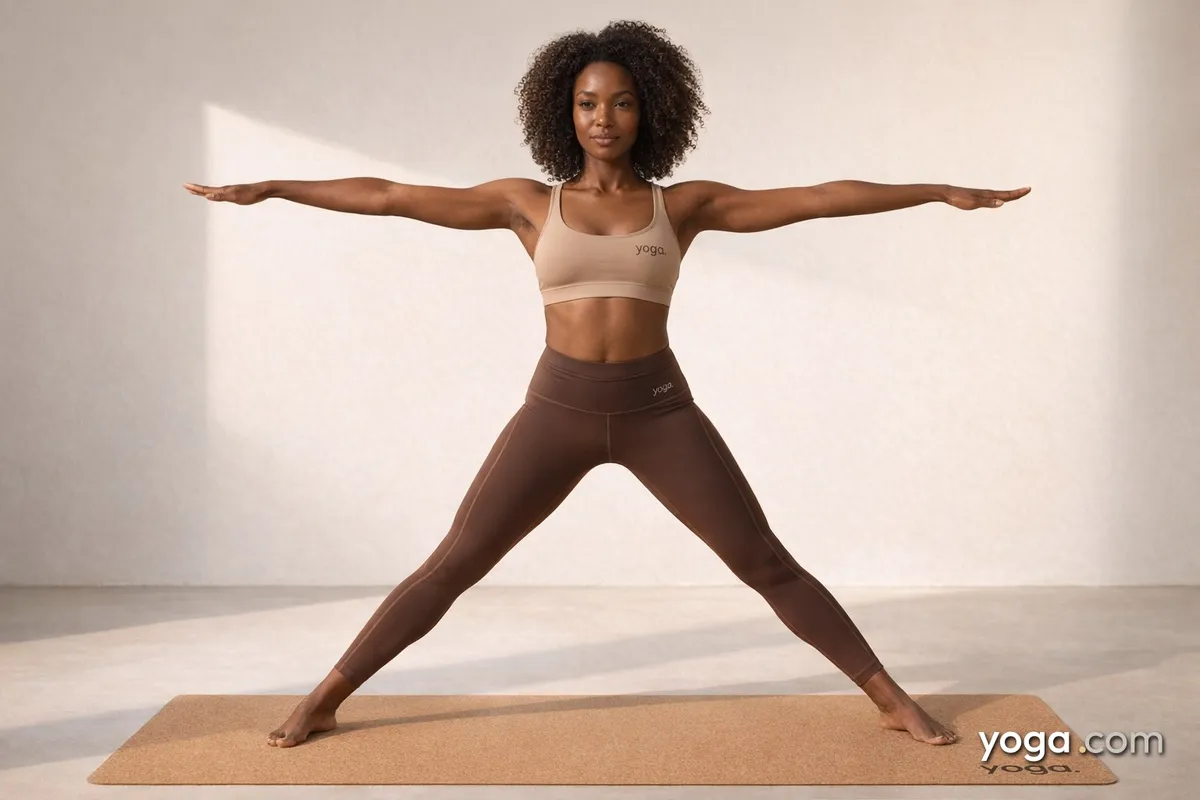
Extended Arms and Legs Pose (Utthita Hastapādāsana - literally "extended hand and foot pose") is a wide-stance standing posture that teaches you to reach actively in four directions at once from a stable, grounded center. Simple in shape but demanding in awareness, it appears in many sequences as a transitional base for Triangle, Warrior, and other wide-legged families. Because the alignment principles are fundamental, it is an excellent early pose for beginners and a reliable reset for more experienced practitioners.
At a Glance
- Level: Beginner
- Type: Standing
- Targets: Inner thighs and groin, shoulders and upper back, core stabilizers, ankles and feet
- Good for: Building full-body postural awareness, developing active shoulder stability, training even weight distribution through both feet
How to Do Extended Arms and Legs Pose
- Begin in Mountain Pose (Tadasana) at the top of your mat, feet together, arms at your sides, and gaze forward at a steady point.
- Step or lightly jump your feet apart approximately three to four feet - wide enough that your ankles are roughly beneath your wrists when you extend your arms. Both feet are parallel, toes pointing forward.
- Press all four corners of each foot into the floor. Firm your thighs and lift the kneecaps slightly without locking the knees. Keep the legs straight and strong.
- On an inhale, raise both arms out to shoulder height, palms facing down. Extend actively through the fingertips so the arms form one long line from hand to hand, parallel to the floor.
- Lengthen through the crown of the head; keep the chin level and the gaze straight ahead or softly toward the horizon. Draw the low belly gently in and up to support the lumbar spine.
- Hold for five to eight breaths, continuing to reach outward through the hands and downward through the feet simultaneously - as if energy is radiating from your center in four directions.
- To come out, lower your arms on an exhale, then step or lightly jump your feet back together into Mountain Pose.
Benefits
- Stretches the inner thighs and groin muscles through the wide stance.
- Builds isometric strength in the shoulder girdle and upper back by sustaining horizontal arm extension.
- Strengthens the quadriceps and trains active engagement of the leg muscles without joint compression.
- Improves proprioception and balance by distributing weight evenly across a wide base.
- Lengthens the lateral trunk as you reach through opposite hands, creating space along the side body.
- Establishes the foundational foot-and-leg action used in Triangle, Warrior, and Extended Side Angle poses.
Common Mistakes and Alignment Cues
- Feet too narrow or too wide: Check that your ankles sit approximately under your wrists when arms are extended - this ratio keeps the stance effective and safe for the hips.
- Toes turning out: Keep both feet parallel. Internally rotating the thighs slightly helps hold this without straining the knees.
- Arms drooping below shoulder height: Lift through the outer edges of the hands and imagine pressing the palms lightly away from each other; this re-engages the shoulders.
- Locking the knees: Maintain a micro-softness in the joints while keeping the leg muscles firmly active - "firm but not frozen."
- Ribs jutting forward: Draw the front ribs gently toward each other and engage the core so the spine stays neutral rather than arching.
Modifications and Props
- Narrower stance: If your inner groin or hips feel strained, reduce the width of your step until you find a range that allows your legs to stay straight and strong.
- Wall support: Stand with your back a few inches from a wall and let the shoulder blades lightly brush it as you extend the arms - this gives instant feedback for posture and prevents the chest from collapsing forward.
- Blocks under hands: If shoulder fatigue limits arm height, place a block in each hand at a slight downward angle; the light weight encourages shoulder engagement without strain.
- Chair variation: Seated in a chair with feet flat and hip-width apart, extend both arms to the sides at shoulder height; this preserves the upper-body action for practitioners who cannot stand for extended periods.
Cautions
- Hip or groin discomfort: Reduce the width of the stance gradually until the inner thighs feel a stretch rather than a sharp pull.
- Shoulder or rotator cuff issues: Keep the arms lower than shoulder height or rest the hands on the hips while still practicing the leg and foot actions.
- Low back sensitivity: Engage the core throughout and avoid letting the pelvis tip forward; if discomfort persists, shorten the stance.
- Balance concerns: Practice near a wall or the back of a sturdy chair so you can steady yourself as needed.
If you're working with an injury or a medical condition, check with a qualified professional before practicing.
Related Poses
- Mountain Pose - the standing foundation this pose grows directly out of; practice it first to establish grounding and posture.
- Mountain Pose with Upward Stretch - builds the active arm extension you carry into this pose.
- Right Triangle Pose - a natural next step that uses this exact foot stance with the addition of a lateral reach and side-body stretch.
- Warrior Pose with Right Leg Forward, Left Leg Straight - shares the wide-leg base and extended arms, adding hip opening and a bent front knee for progression.
Put this pose to work in a full practice: see A Gentle Yoga Routine for Tired, Low-Energy Days and A 10-Move Chair Yoga Sequence for a Midday Reset.