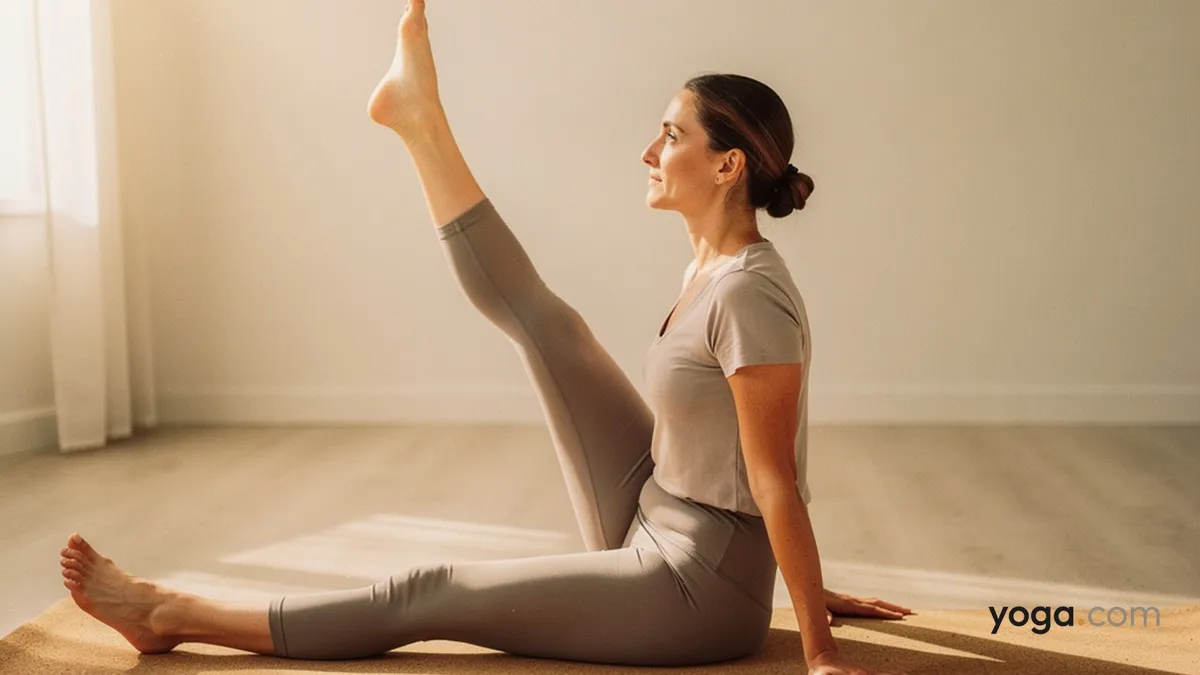
Staff Pose with Right Leg Up is a seated asymmetrical variation that builds on the foundational stability of Daṇḍāsana (right leg up) — from the Sanskrit daṇḍa (staff or stick) and āsana (posture) — with the right leg raised off the floor while the left leg remains extended and grounded. It sits naturally in the middle of a seated sequence, bridging simple base poses and more demanding single-leg stretches.
At a Glance
Level: BeginnerType: SeatedTargets: Hamstrings (right), hip flexors, core, spinal extensorsGood for: Building seated postural awareness, strengthening the hip flexors, developing single-leg balance from the floorHow to Do Staff Pose with Right Leg Up
Sit on your mat with both legs extended straight in front of you, feet together, hands pressing firmly into the floor beside your hips — this is the base of classical Daṇḍāsana.Root your left sitting bone evenly into the floor and engage your left leg: flex the left foot, press the back of the left knee down, and firm the left thigh.On an inhale, lengthen your spine tall, stacking your shoulders over your hips and lifting the crown of your head toward the ceiling.Engage your core — draw the low belly gently in and up — to protect the lumbar spine as you prepare to lift.On your next inhale, slowly raise your right leg off the floor, keeping it straight and the right foot flexed (toes pointing toward your face). Lift from the front of the right hip, not by tilting your pelvis back.Raise the right leg to a height where your spine can stay long — anywhere from a few inches off the floor to a 45-degree angle is appropriate. Avoid letting the lower back round to buy extra height.Hold for 3–5 steady breaths, keeping both sitting bones as even as possible, gaze soft and forward or at the raised right foot.To come out, slowly lower the right leg on an exhale, returning both feet to the floor in Daṇḍāsana. Pause, then repeat on the left side to balance the practice.Benefits
Stretches the hamstrings and calf of the raised right leg isometrically through active extension.Strengthens the right hip flexors (particularly the iliopsoas and rectus femoris) under load.Builds endurance in the spinal extensors, training upright posture against gravity.Engages the transverse abdominis and obliques to stabilize the pelvis asymmetrically.Develops proprioceptive awareness of pelvic neutrality and even weight distribution through the sitting bones.Common Mistakes and Alignment Cues
Rounding the lower back to lift the leg higher: Lower the leg until your spine is genuinely upright, then work on height gradually over time.The pelvis tilting toward the raised leg: Press both sitting bones down equally; imagine your pelvis as a bowl you don't want to spill.The right knee bending: Activate the right quadricep firmly to straighten the knee fully, and flex the foot to reinforce the extension.Collapsing through the shoulders: Keep the hands pressing into the floor and the collarbones broad; draw the shoulder blades gently together and down.Holding the breath: Leg lifting is effort — breathe continuously and let the exhale soften any gripping in the jaw or neck.Modifications and Props
Tight hamstrings / rounded back: Sit on a folded blanket or a foam block to tilt the pelvis slightly forward, making it easier to maintain a long spine.Difficulty holding the leg up: Loop a strap around the raised right foot and hold the strap with both hands, using the strap to support the leg's weight while you build hip flexor strength.Wrist sensitivity: Make fists with your hands or place the fingertips on the floor rather than flat palms to reduce wrist extension load.Wall support: Sit with your back lightly touching a wall to provide feedback for spinal alignment and prevent leaning back as the leg lifts.Cautions
Hamstring strain or tear: Avoid raising the leg to a range that pulls sharply at the back of the knee or sit bone; keep the movement pain-free and controlled.Lower back pain: Do not allow the lumbar spine to round or compress; use a blanket under the hips and keep the leg low until core control improves.Hip flexor injury: Active leg lifting places direct demand on the iliopsoas; work within a comfortable, short range and avoid forcing height.Recent abdominal surgery: The core engagement required here may be contraindicated during early recovery; use caution and move gently.If you're working with an injury or a medical condition, check with a qualified professional before practicing.
Related Poses
Bound Angle Pose — a gentle seated preparation that opens the hips before extending the legs.Half Boat Pose — the natural next step, building greater hip flexor and core strength with both legs lifted.High Boat Pose — a more demanding progression once single-leg stability is established.Downward-Facing Dog Pose — a complementary counter-pose that lengthens the hamstrings and decompresses the spine after seated work.Work this pose into a flowing seated practice with guidance from A Gentle Yoga Routine for Tired, Low-Energy Days, or explore how seated postures translate to accessible movement in A 10-Move Chair Yoga Sequence for a Midday Reset.