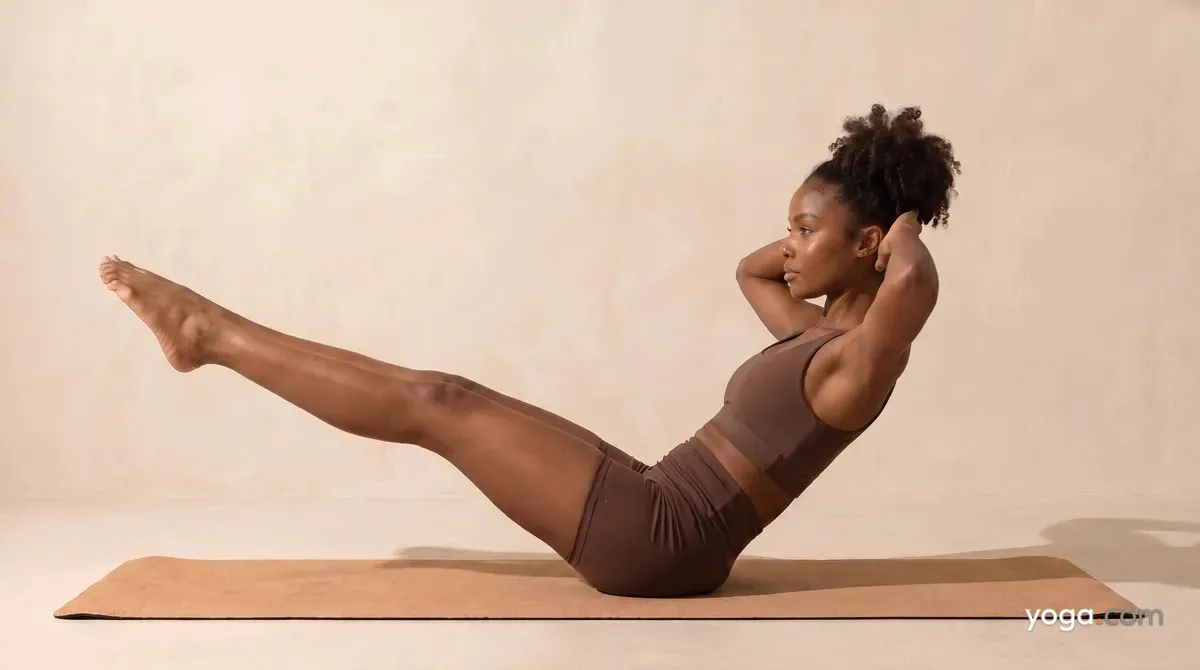
Half Boat Pose (Ardha Nāvāsana - literally "half ship pose") is a seated core and hip-flexor challenge that positions the body in a low V-shape, with legs and torso hovering close to the floor. It sits a step below its sibling, High Boat Pose, making it an honest test of deep abdominal endurance. Use it in the middle of a core sequence or as a working stage before you build toward the fuller expression of the pose.
At a Glance
- Level: Intermediate
- Type: Seated
- Targets: Deep abdominals (transverse abdominis), hip flexors, spinal extensors, quadriceps
- Good for: Building core stability, strengthening the hip flexors through range, improving postural endurance
How to Do Half Boat Pose
- Start seated. Sit on your mat with your knees bent, feet flat on the floor, and hands resting behind your thighs. Lengthen your spine and draw your lower belly gently in and up.
- Lean back slightly. Tilt your pelvis just enough so your sit bones are your base - roughly a 45-degree angle between your torso and the floor. Keep the spine long; avoid rounding the low back.
- Lift your feet. Keeping your knees bent, raise your feet until your shins are roughly parallel to the floor. Flex your feet and press through your heels.
- Lower the legs toward 30-40 degrees. Slowly straighten and lower your legs until they hover about 30-40 degrees off the floor - lower than High Boat Pose, higher than the mat. The torso lowers correspondingly so the body forms a wide, shallow V.
- Extend your arms. Reach both arms forward, parallel to the floor, palms facing each other or turned inward. If your lower back rounds under the effort, keep hands beside your thighs for support.
- Set your gaze. Look forward and slightly upward toward your toes, keeping the neck long. Breathe steadily - do not hold your breath.
- Hold for 5-10 breaths. Maintain the lift of the chest and the engagement of the deep belly throughout.
- Come out with control. On an exhale, bend your knees, lower your feet to the mat, and sit upright. Place your hands behind you if needed and take 2-3 breaths before repeating or transitioning to a counter-pose such as Bridge Pose.
Benefits
- Strengthens the transverse abdominis and rectus abdominis through sustained isometric demand.
- Activates and lengthens the hip flexors under load, building both strength and control through that range of motion.
- Engages the spinal extensors to resist lumbar flexion, reinforcing upright postural tone.
- Tones the quadriceps as they work to maintain leg extension at a low angle.
- Trains neuromuscular coordination between the trunk and lower limbs.
Common Mistakes and Alignment Cues
- Rounding the lower back: If the lumbar spine collapses into a C-curve, the hip flexors and low back take over. Keep the sternum lifted and the chest open; raise your legs a few inches if needed to restore the natural curve.
- Holding the breath: Bracing stops the breath. Exhale fully on each out-breath and let the inhale arrive naturally - this keeps the deep core working rather than the superficial muscles gripping.
- Dropping the chin to the chest: The neck follows the strain elsewhere. Keep a relaxed, long neck and let your gaze stay forward rather than down toward the navel.
- Letting the legs sink too low too fast: Moving quickly loses control and loads the hip flexor attachments abruptly. Lower slowly over several breaths, stopping the moment the low back rounds.
- Shrugging the shoulders: Tension climbs into the traps when the core fatigues. Draw the shoulder blades down the back and keep space between ears and shoulders.
Modifications and Props
- Bent knees: Keep the knees bent at 90 degrees throughout rather than straightening the legs. This shortens the lever arm and makes the pose accessible while you build core endurance.
- Hands on the mat: Place your fingertips or palms on the floor beside your hips for light support. This offloads some demand and lets you focus on spinal alignment before going hands-free.
- Strap around the soles: Loop a yoga strap around the balls of your feet and hold the ends with straight arms. The strap helps you maintain leg height without gripping the hip flexors excessively.
- Yoga block under the sacrum: Sitting on the edge of a block placed at its lowest height slightly lifts the pelvis, making it easier to find and maintain the anterior tilt needed to keep the spine long.
Cautions
- Recent abdominal or hip surgery: Avoid this pose until you have clearance from your healthcare provider, as the sustained abdominal and hip-flexor loading is significant.
- Neck discomfort: If you feel strain in the neck when the arms are extended, keep your hands beside your thighs or rest them on a strap to reduce the demand on the upper body.
- Low back sensitivity: Work with the legs higher or knees bent, and stop immediately if you feel compression or sharp sensation in the lumbar spine.
- Pregnancy: Prone and supine core compression poses are generally contraindicated after the first trimester; consult a prenatal yoga specialist for alternatives.
If you're working with an injury or a medical condition, check with a qualified professional before practicing.
Related Poses
- High Boat Pose - the natural progression, with legs higher and the body in a taller V-shape.
- Bridge Pose - an effective counter-pose that opens the hip flexors and gently extends the spine after core work.
- Downward-Facing Dog Pose - useful as a transition or reset between sets, lengthening the spine and hamstrings.
- Cat Pose - a gentle spinal flexion warm-up that activates the abdominals before seated core poses.
Looking for ways to work this pose into a sequence? See A Gentle Yoga Routine for Tired, Low-Energy Days and A 10-Move Chair Yoga Sequence for a Midday Reset.