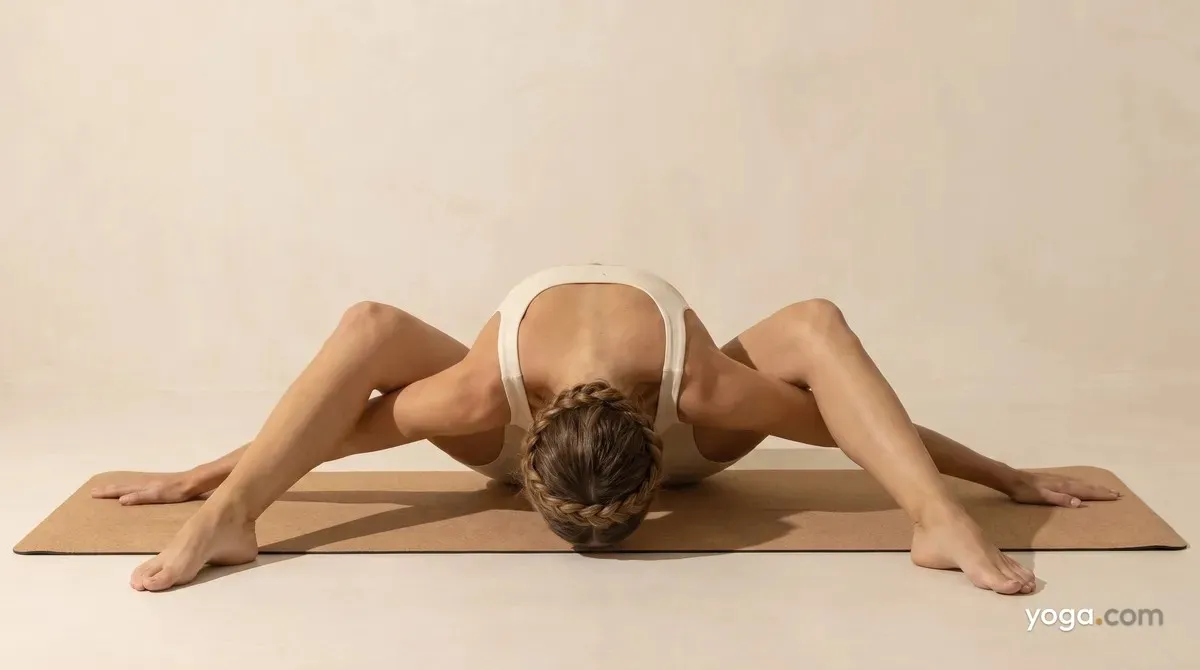
Tortoise Pose (Kūrmāsana - literally "tortoise" or "turtle") is a deep seated forward fold in which the torso descends between the legs while the arms extend outward beneath the thighs, mimicking a tortoise withdrawing into its shell. It belongs to the advanced seated category and typically appears near the peak of a practice, after the hips, hamstrings, and spine are thoroughly warm.
At a Glance
- Level: Advanced
- Type: Seated
- Targets: Hamstrings, inner groins, lower back, shoulders
- Good for: Deepening hip external rotation, lengthening the entire posterior chain, building shoulder and upper-back mobility
How to Do Tortoise Pose
- Start seated with legs wide. Sit on the floor with your legs extended well beyond shoulder-width apart - wide enough that your shoulders can slide under your knees. Flex your feet and press through your heels.
- Bend your knees slightly. Draw your feet a few inches closer to your hips so the knees are lifted enough to create space for your arms to pass underneath.
- Hinge forward from the hips. Exhale and tip your pelvis forward, lengthening your spine as you begin to lower your torso toward the floor between your legs.
- Thread your arms under your knees. Slide each arm, palm facing down, beneath the corresponding knee. Reach your arms out to the sides as far as possible, so the backs of your knees rest on your upper arms or shoulders.
- Lower your chest and chin toward the floor. Continue folding forward, pressing the backs of your legs down onto your arms. Allow your chest to descend as your arms extend wider. Your forehead or chin reaches toward the ground; gaze is soft, directed forward or downward.
- Straighten your legs as much as possible. Gradually extend your knees, pressing your thighs down onto your arms. You do not need fully straight legs - work within your range without forcing.
- Breathe and hold. Stay for 5-10 steady breaths, allowing the torso to release lower with each exhale. Keep the spine long rather than rounding aggressively from the mid-back.
- Come out carefully. Bend your knees, lift your chest, and slide your arms free. Sit upright and take a few breaths in Bound Angle Pose before moving on.
Benefits
- Stretches the hamstrings and inner groins through a long, sustained hold.
- Lengthens the entire posterior chain - calves, hamstrings, gluteal muscles, and spinal extensors.
- Increases hip external rotation range of motion.
- Mobilizes the thoracic spine and broadens the upper back as the arms extend laterally under load.
- Builds proprioceptive awareness of spinal alignment in a deep folded position.
Common Mistakes and Alignment Cues
- Rounding aggressively from the mid-back instead of hinging at the hips. Lead the fold with your sternum, not your forehead - length through the spine matters more than how low you get.
- Forcing the legs straight too soon. Straightening the knees before the torso is settled compresses the lower back. Lower the chest first, then gradually extend the legs.
- Holding the breath. Gripping through effort shortens the hold and increases strain. Breathe slowly and let each exhale soften the fold.
- Collapsing the arms rather than extending them. Reach actively through your fingertips to the sides - this keeps the shoulders engaged and protects the joints under the weight of the legs.
- Legs too close together. If the knees press against your neck or ears, widen your stance so the shoulders fit comfortably under or against the thighs.
Modifications and Props
- Folded blanket under the hips: Sitting on a firm folded blanket tilts the pelvis forward and makes the initial hinge more accessible if your lower back rounds immediately.
- Bent-knee variation: Keep a generous bend in the knees throughout the hold. This takes intensity off the hamstrings and lets you focus on the hip fold and arm placement.
- Strap around the feet: If your torso cannot reach low enough for your arms to slip under your knees, hold a strap looped around each foot while folding forward - this is an earlier preparatory stage rather than the full pose.
- Supported chest: Place a block or bolster lengthwise between your legs so your chest rests on it as you fold. This lets you relax the posterior chain without bearing all your weight on your arms.
Cautions
- Hamstring or groin injury: Avoid this pose if you have an acute hamstring or groin strain; the sustained deep stretch can aggravate torn tissue.
- Lower-back disc issues: The combined flexion and leg pressure on the arms creates significant force on the lumbar spine. Approach with caution and keep the spine as long as possible.
- Shoulder or rotator-cuff injury: Supporting the weight of the legs on the arms stresses the shoulder joint; skip or modify if you have an active shoulder injury.
- Sciatica: Deep hip flexion can aggravate sciatic symptoms in some people; back off if you feel sharp or shooting sensations in the leg.
If you're working with an injury or a medical condition, check with a qualified professional before practicing.
Related Poses
- Bound Angle Pose - opens the inner groins and hips as foundational preparation.
- Cow Face Pose (Left Leg and Right Arm Up) - deepens hip external rotation and prepares the connective tissue around the hips.
- Lotus Pose - a natural next progression requiring similar hip depth and flexibility.
- Bridge Pose - an effective counter-pose that extends the spine and opens the front body after deep forward folding.
If you're building a fuller practice, see A Gentle Yoga Routine for Tired, Low-Energy Days and A 10-Move Chair Yoga Sequence for a Midday Reset.