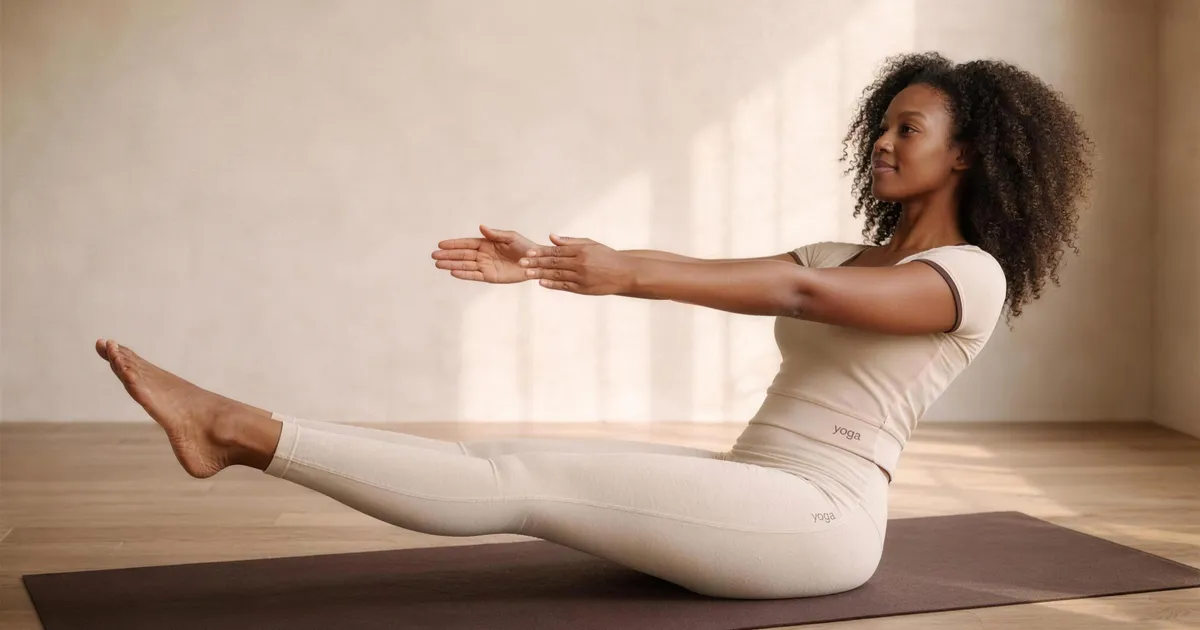
Low Boat Pose, or Ardha Nāvāsana ("ardha" meaning half, "nāva" meaning boat), is a seated core pose in which the body forms a shallow V-shape closer to the floor than its close relative, High Boat. Because the legs and torso hover lower, the hip flexors and deep abdominals work harder to maintain the position, making it a demanding intermediate shape. It typically appears in core-focused sequences or as a counter-pose within a Navasana cycle.
At a Glance
- Level: Intermediate
- Type: Seated
- Targets: Deep abdominals (transverse abdominis, rectus abdominis), hip flexors, lower back extensors, inner thighs
- Good for: Building anterior core endurance, developing hip-flexor strength, improving lumbar control under load
How to Do Low Boat Pose
- Start in High Boat (Navasana). Sit with your knees bent, shins parallel to the floor, and arms extended forward at shoulder height, palms facing each other.
- Root through your sitting bones. Press both sitting bones evenly into the mat and lengthen your spine so your lower back does not round. Engage the lower belly by drawing your navel gently toward your spine.
- Inhale to prepare. On an exhale, begin to lower your torso and legs simultaneously, keeping the V-shape of the body intact. Your legs extend toward straight (a slight bend in the knees is fine) and your torso lowers toward the floor.
- Find your hover. Stop when both the legs and the back of your shoulders are roughly 6-12 inches off the mat. Your body forms a long, low V-shape. Arms stay extended alongside your thighs, parallel to the floor.
- Hold and breathe. Keep the chin slightly tucked, gaze soft toward your toes. Breathe steadily - do not hold the breath. Stay for 5-10 full breaths.
- To come out: On an inhale, use your core to lift back up to High Boat, or lower all the way to the floor with control and rest in Corpse Pose for a breath or two.
Benefits
- Strengthens the rectus abdominis and transverse abdominis under sustained eccentric and isometric load.
- Builds endurance in the hip flexors (iliopsoas and rectus femoris) as they hold the legs at a low angle.
- Trains the erector spinae and multifidus to resist spinal flexion, improving lumbar stability.
- Engages the adductors when you press the inner thighs together, reinforcing midline awareness.
- Develops the concentration and breath control needed for longer held core work throughout a practice.
Common Mistakes and Alignment Cues
- Mistake: Lower back rounds toward the floor. Cue: Lift your sternum and lengthen the front of your torso. If you cannot keep the lumbar spine neutral, raise your legs higher or keep the knees bent.
- Mistake: Holding the breath. Cue: Exhale fully on each breath; if you cannot breathe smoothly, shorten the hold and come out.
- Mistake: Chin jutting up. Cue: Tuck the chin slightly so the back of the neck stays long - your gaze should travel toward your feet, not the ceiling.
- Mistake: Legs dropping too low and losing control. Cue: Lower only as far as you can maintain a stable pelvis. Stop before the lower back arches away from your engaged core.
- Mistake: Arms collapsing down to the floor. Cue: Keep the arms actively reaching forward alongside the thighs, parallel to the floor, to reinforce shoulder girdle engagement.
Modifications and Props
- Bent knees: Keep the knees generously bent throughout. This shortens the lever arm and reduces demand on the hip flexors and lower back.
- Hands behind thighs: Place your hands lightly on the backs of your thighs for gentle support. This lets you focus on spinal length before building full unsupported strength.
- Block between thighs: Squeezing a block between the inner thighs activates the adductors and helps stabilize the pelvis, making the pose feel more integrated.
- Strap around feet: Loop a strap around the soles of the feet and hold the ends while lowering. The strap offers a feedback anchor without fully unloading the core.
Cautions
- Recent abdominal surgery or diastasis recti: Avoid this pose or work with a specialist; the sustained intra-abdominal pressure is significant.
- Lower back sensitivity: If you feel compression or pain in the lumbar spine rather than muscular effort, come out of the pose and practice the bent-knee variation or work on High Boat first.
- Neck strain: Do not crank the head up to look at your feet; keep the neck long. If your neck fatigues, let the gaze be soft rather than actively fixing on a point.
- Hip flexor tightness: Tight hip flexors can tilt the pelvis anteriorly and increase lumbar compression; practice Hip Flexor stretches between sets.
If you're working with an injury or a medical condition, check with a qualified professional before practicing.
Related Poses
- High Boat Pose - the direct preparation and higher-leverage version of this shape; build strength here first.
- Half Boat Pose - a close variant that isolates one side, useful for developing asymmetrical core awareness.
- Bridge Pose - an excellent counter-pose that opens the hip flexors and anterior spine after the compression of Boat work.
- Downward-Facing Dog Pose - a natural transition pose to reset the spine and decompress the lower back between Boat repetitions.
For sequencing ideas, see A Gentle Yoga Routine for Tired, Low-Energy Days and A 10-Move Chair Yoga Sequence for a Midday Reset.