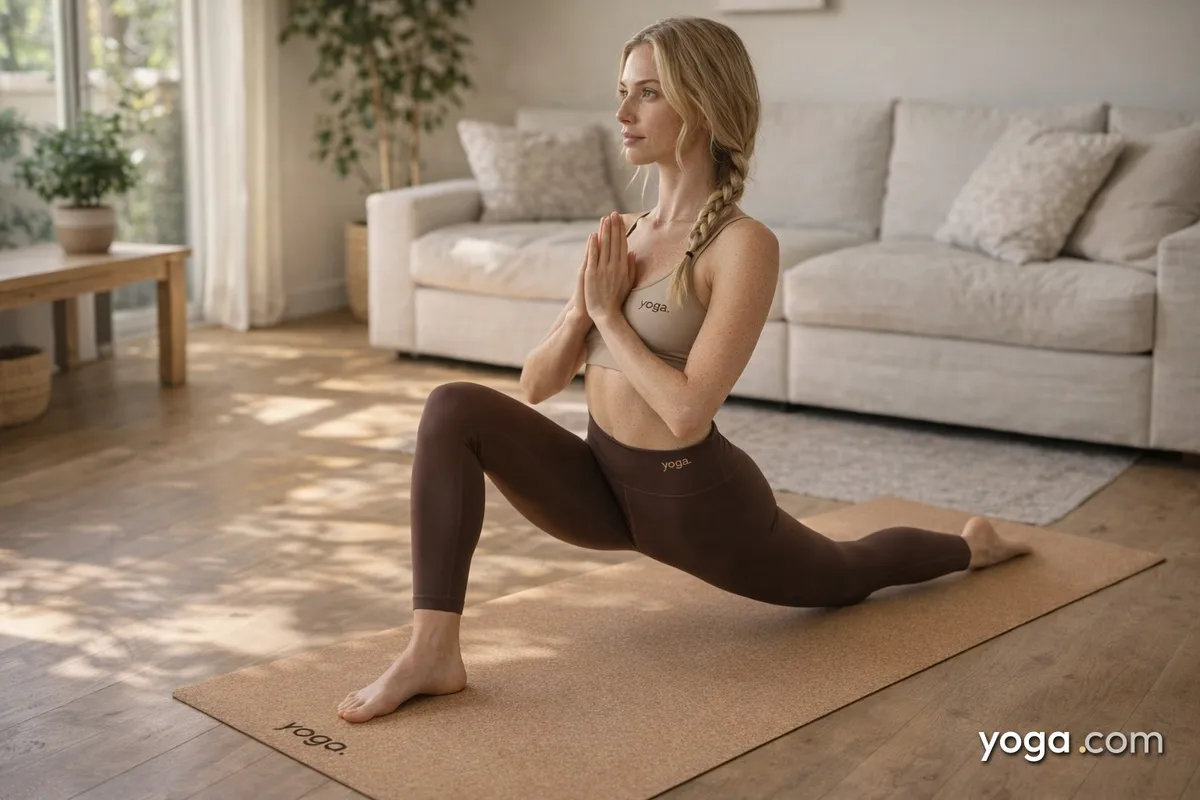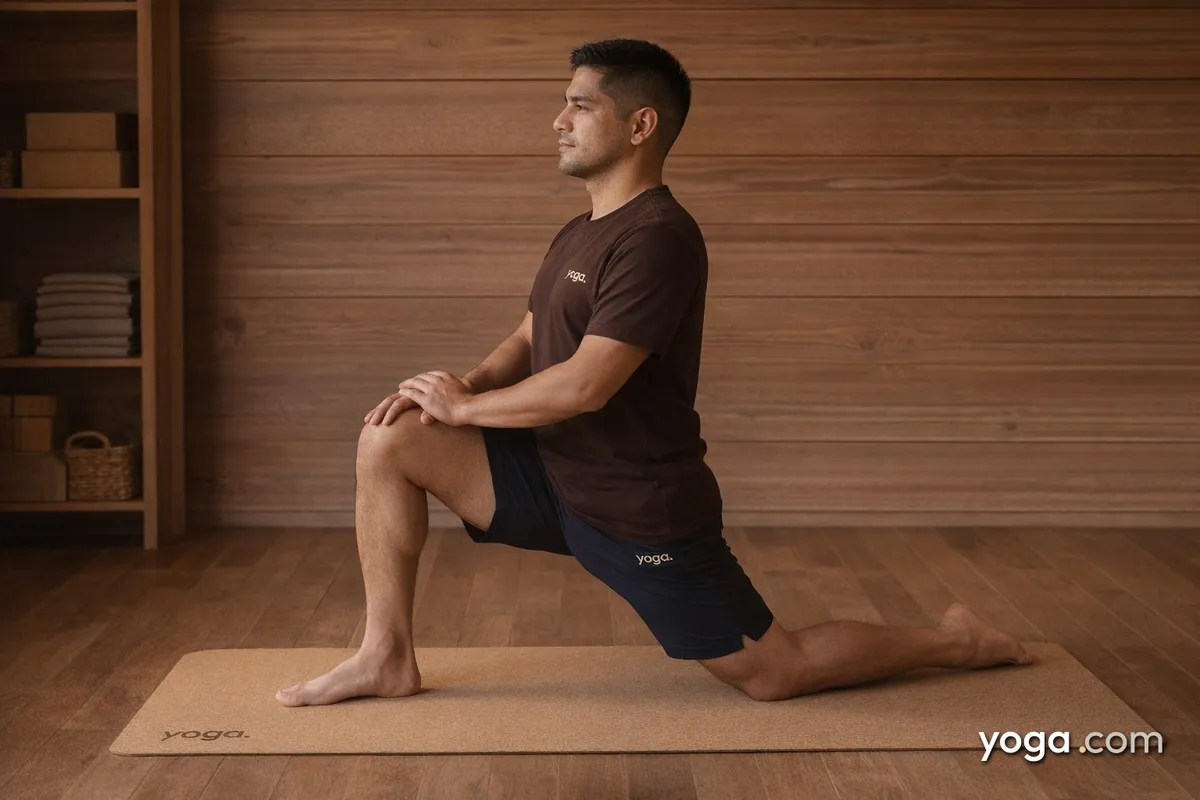
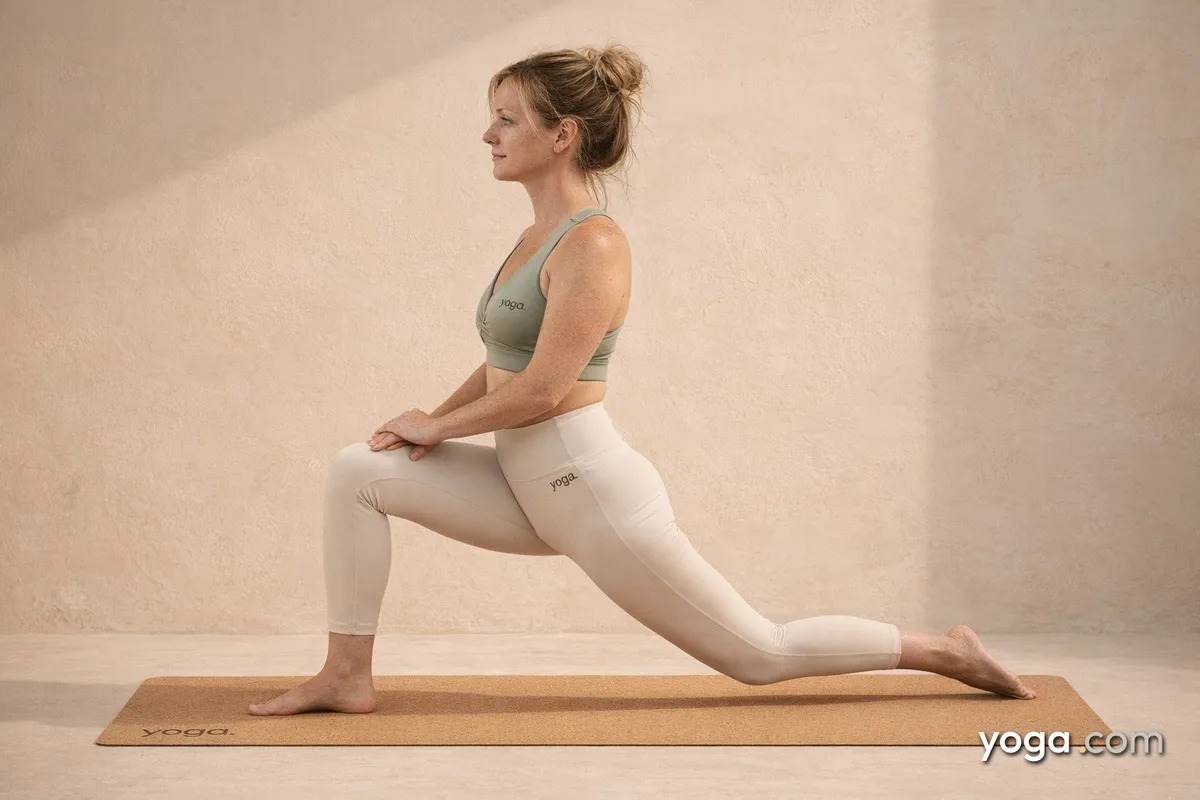
Low Lunge with Left Leg Forward is a grounded hip-opening pose that places the left foot at the front of your mat and the right knee on the floor. Its Sanskrit name, Añjaneyāsana (left leg forward), honors Anjana, the mother of Hanuman - a reminder of devotion and steadiness beneath effort. The pose appears frequently as a transition from Downward-Facing Dog, as a standing sequence opener, or as a deliberate hip flexor stretch on its own.
At a Glance
- Level: Beginner
- Type: Kneeling
- Targets: Hip flexors, quadriceps, groin (psoas and iliacus of the right side), ankle and calf of the left leg
- Good for: Building hip mobility, improving balance and leg strength, establishing a stable base for deeper lunge variations
How to Do Low Lunge with Left Leg Forward
- Begin in Downward-Facing Dog or on hands and knees in Table Pose. Place a folded blanket under your right knee if your mat provides little cushioning.
- Step your left foot forward between your hands, setting it flat on the mat with the left knee directly above the left ankle. Your left shin should be roughly vertical.
- Lower your right knee to the floor, sliding the right leg back until you feel a gentle stretch along the front of the right hip and thigh. The top of the right foot rests on the mat.
- Press down through your left foot and lift your torso upright. Bring your hands to your left thigh, to your hips, or raise both arms alongside your ears with palms facing each other.
- Draw your right hip forward and your left hip back so both hip points face the front of the mat evenly. Avoid letting the left knee collapse inward - keep it tracking over the second toe.
- Lengthen your tailbone toward the floor, lift the lower belly gently, and broaden across the collarbones. If arms are raised, soften the shoulders away from the ears.
- Hold for 5-8 breaths, keeping the breath smooth and the front thigh firm.
- To come out, lower your hands to the mat on either side of your left foot, step back to Downward-Facing Dog or Table Pose, and repeat on the second side.
Benefits
- Stretches the hip flexors and quadriceps of the back (right) leg, particularly the psoas and rectus femoris.
- Strengthens the quadriceps, glutes, and inner thigh of the front (left) leg.
- Improves mobility in the groin and the front of the right hip joint.
- Builds stability in the ankle and knee of the left leg under load.
- Lengthens and activates the muscles along the spine, encouraging upright posture.
- Develops coordination and single-leg proprioception as a foundation for standing balance work.
Common Mistakes and Alignment Cues
- Left knee drifting past the ankle: Check that the left shin is vertical; if the knee has crept forward, slide the left foot closer to the front edge of the mat.
- Hips twisting open to the left: Draw the left hip back and the right hip forward actively, so the pelvis stays square to the front of the mat.
- Overarching the lower back: Instead of thrusting the ribs forward, engage the lower belly lightly and lengthen the tailbone down before you lift the chest.
- Collapsing weight into the back knee: Distribute effort between the front foot and the back knee equally; think of pressing the back shin into the mat rather than sinking onto it.
- Shoulders creeping up when arms are raised: Externally rotate the upper arms, slide the shoulder blades down the back, and keep a little space between ears and shoulders.
Modifications and Props
- Tender knee: Fold your mat in half or place a blanket under the right knee for extra cushioning.
- Tight hip flexors or limited balance: Keep the hands on the left thigh or on two blocks set at their tallest height on either side of the front foot; this raises the floor and lets you focus on hip alignment before adding arm reach.
- Limited ankle flexibility in the front foot: Place a thin folded blanket under the left heel to give the ankle a small lift as mobility builds.
- Exploring a deeper stretch: Tuck the right toes under and lift the right knee slightly off the mat (a High Lunge shape) to intensify the hip flexor work on the right side.
Cautions
- Knee sensitivity: If you feel pinching or sharp pain in either knee, reduce the depth of the lunge or add padding beneath the back knee.
- Hip or groin strain: Ease out of the pose if you feel tugging rather than an even, workable stretch; avoid forcing the hip down.
- Recent ankle injury: The front ankle bears significant load here - proceed carefully and consider keeping hands on blocks for support.
- Pregnancy (second and third trimester): Widen the stance slightly for balance, use blocks under both hands, and avoid deep spinal backbending.
If you're working with an injury or a medical condition, check with a qualified professional before practicing.
Related Poses
- Table Pose - a neutral starting position to step into the lunge from
- Downward-Facing Dog Pose - the most common entry and exit point for Low Lunge in a flow
- Bridge Pose - a supine counter-pose that continues to open the hip flexors and strengthen the glutes
- Upward-Facing Dog Pose - a progression that deepens the hip flexor stretch and adds spinal extension
See Low Lunge in context: A Gentle Yoga Routine for Tired, Low-Energy Days and A 10-Move Chair Yoga Sequence for a Midday Reset.