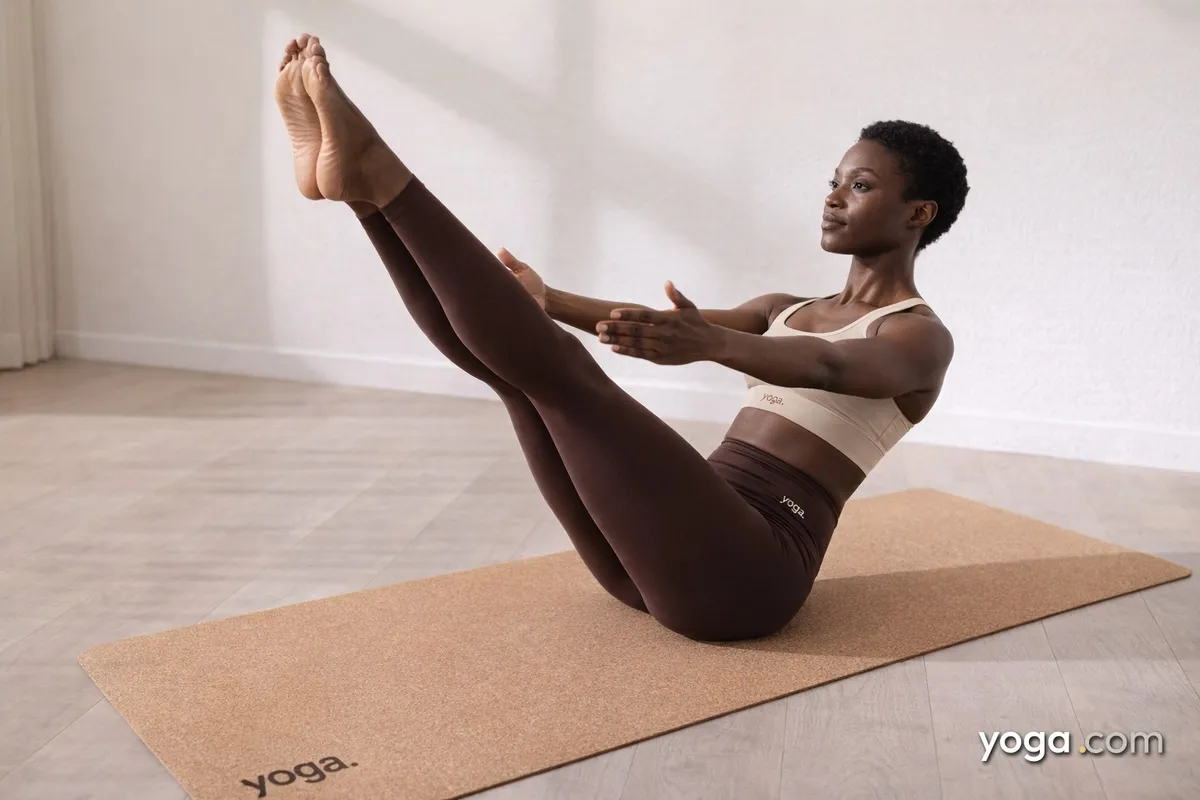
High Boat Pose - Paripūrṇa Nāvāsana, from the Sanskrit pūrṇa (full or complete) and nāva (boat) - is the full expression of the seated balancing pose in which you balance on your sitting bones with your legs and torso lifted to form a sharp V-shape. It sits in the middle and peak sections of a practice, often sequenced after standing poses have warmed the legs and before cooling forward folds begin. Think of it as the test of whether your core and hip flexors are genuinely awake.
At a Glance
- Level: Intermediate
- Type: Seated
- Targets: Hip flexors, deep abdominal muscles, spinal erectors, quadriceps
- Good for: Building core stability, strengthening the anterior hip, improving balance and postural control
How to Do High Boat Pose
- Start seated. Sit on your mat with your knees bent and feet flat on the floor, hip-width apart. Place your hands behind your thighs, fingers pointing toward your knees.
- Lift and lean. Press into your sitting bones, lengthen your spine, and lean your torso back to roughly 45 degrees - a long, straight line from your tailbone to the crown of your head. Avoid rounding your lower back.
- Float the feet. Exhale, engage your deep abdominals, and lift your feet until your shins are parallel to the floor. Keep gripping the backs of your thighs if you need support here.
- Extend the legs. When you feel stable, straighten your knees fully so your legs rise to roughly 45-60 degrees above the floor. Your body forms a firm V-shape, balanced on the sitting bones.
- Reach the arms. Release your hands and extend both arms forward, parallel to the floor and shoulder-width apart, palms facing each other. Spread your fingers wide.
- Refine and breathe. Lift the sternum away from the navel, draw the lower belly in and up, and keep the inner thighs squeezing toward each other. Gaze softly forward at your toes or just above them. Hold for 5-10 slow breaths.
- Come out safely. On an exhale, bend your knees and lower your feet to the floor. Sit upright and pause for a breath before moving on.
Benefits
- Strengthens the hip flexors and rectus femoris through active, loaded shortening
- Builds endurance in the transversus abdominis and obliques
- Strengthens the spinal erectors to maintain extension under load
- Develops quadriceps strength required to maintain full knee extension
- Trains proprioceptive balance on the sitting bones
- Builds shoulder and arm stability when the arms are extended and held isometrically
Common Mistakes and Alignment Cues
- Rounding the lower back: If your lumbar spine collapses into flexion, your legs are too high for your current strength. Lower the legs slightly and re-establish a lifted chest before straightening the knees.
- Gripping the neck and jaw: Soften your face and draw your shoulder blades down your back. Tension in the upper body means the core has stopped doing its share of the work.
- Letting the legs splay apart: Press the inner thighs together and flex your feet, which naturally helps recruit the inner leg line and keep the legs parallel.
- Holding the breath: Count your exhales aloud or silently. The pose can only be sustained with steady, full breathing - if you're holding your breath, ease off the height of your legs.
- Sinking into the hip flexors: Actively pull the front of your pelvis up toward your navel rather than just hanging from the top of the thighs; this keeps the work distributed rather than dumped into one muscle group.
Modifications and Props
- Bent knees (Half Boat): Keep the shins parallel to the floor rather than straightening the legs. This shortens the lever arm considerably and lets you focus on holding a lifted spine.
- Strap around the feet: Loop a strap around the balls of the feet and hold both ends. The strap gives you traction to help keep the chest open while you work toward straightening the legs.
- Fingertips on the floor: Rest the fingertips lightly beside your hips for feedback and minor support as you build the strength to hold the arms fully extended.
- Block between the inner thighs: Squeezing a block between your thighs activates the adductors and helps stabilize the pelvis, making it easier to maintain a neutral lumbar curve.
Cautions
- Low-back sensitivity: If you feel compression or sharp discomfort in the lumbar spine, bend the knees and work the modified version until the spinal erectors are stronger.
- Hip flexor strain: Proceed carefully if the front of the hip is tight or recovering from strain; ease out of the pose if you feel a pulling sensation deep in the groin.
- Neck issues: Keep the head in line with the spine rather than jutting the chin forward; if the neck fatigues or aches, release immediately.
- Pregnancy: Avoid deep abdominal compression after the first trimester.
If you're working with an injury or a medical condition, check with a qualified professional before practicing.
Related Poses
- Half Boat Pose - the essential preparation; build strength here before straightening the legs.
- Bridge Pose - a counter-pose that opens the hip flexors and anterior spine after the sustained contraction of Boat.
- Downward-Facing Dog Pose - a useful transition to reset the spine and lengthen the hamstrings between repetitions.
- Corpse Pose - close the sequence here; the nervous system benefits from full rest after sustained core work.
Looking for sequences where this pose fits naturally? See A Gentle Yoga Routine for Tired, Low-Energy Days and A 10-Move Chair Yoga Sequence for a Midday Reset.