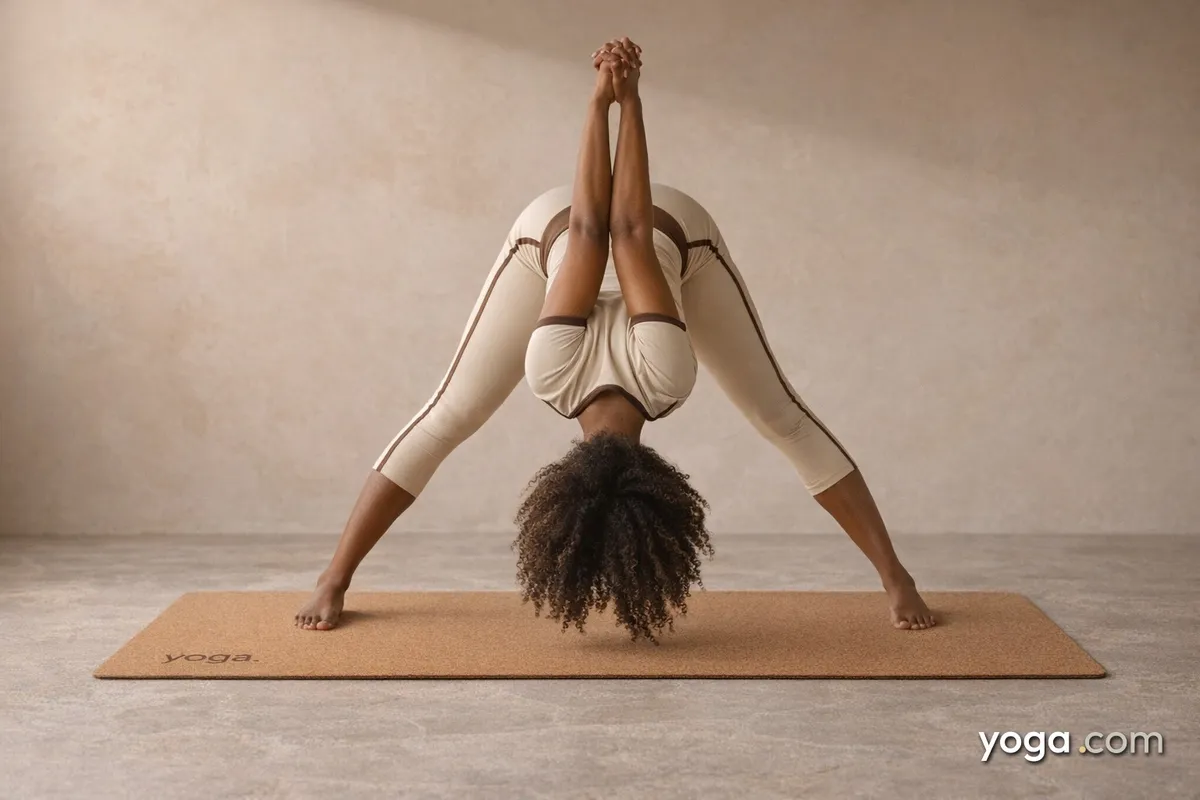
Wide-Legged Forward Bend with Hands Lock is a standing forward fold performed with the feet spread wide and the fingers interlaced behind the back, allowing the clasped arms to sweep overhead as the torso descends. Its Sanskrit name, Prasārita Pādottānāsana (hands locked), translates roughly as "spread-foot intense stretch with bound hands." The bound-arm variation deepens the opening across the chest and shoulders while maintaining all the demands of the wide-legged fold, making it a natural mid-sequence pose after standing work and before deeper inversions.
At a Glance
- Level: Intermediate
- Type: Forward Bend
- Targets: Hamstrings, inner thighs (adductors), posterior spine, shoulder girdle and chest
- Good for: Lengthening the posterior chain, building shoulder mobility, developing hip-hinge mechanics under load
How to Do Wide-Legged Forward Bend with Hands Lock
- Stand in Mountain Pose at the center of your mat. Step your feet 3.5-4.5 feet apart, toes pointing straight forward or very slightly in. Press all four corners of each foot into the floor and firm the thighs.
- Place your hands on your hips. Inhale to lengthen your spine, drawing the crown of your head upward and lifting your chest.
- Interlace your fingers behind your back, knuckles facing away from you. Squeeze your shoulder blades together gently and straighten your arms as much as your shoulder flexibility allows. If the hands won't meet comfortably, hold a strap between them.
- On an exhale, hinge forward from your hips - not your waist - keeping your spine long. Lead with your chest rather than rounding your upper back immediately.
- As your torso becomes roughly parallel to the floor, let gravity draw your clasped hands (and eventually your arms) away from your lower back and toward the floor or overhead. Keep squeezing the shoulder blades to maintain space in the chest.
- Lower the crown of your head toward the floor. Your weight should feel evenly distributed across both feet; press into the outer edges to prevent the arches from collapsing. Gaze is toward the floor or, if comfortable, toward your navel.
- Hold for 5-10 breaths, softening the back of the neck and releasing the grip of the jaw.
- To come out: release the hand lock and bring your hands back to your hips. On an inhale, press firmly through your feet, engage your thighs, and rise with a long spine. Step your feet together and return to Mountain Pose.
Benefits
- Stretches the hamstrings and calves through a wide, symmetrical hip-hinge pattern.
- Lengthens the adductors (inner thigh muscles) in a position of hip abduction.
- Strengthens the quadriceps and hip flexors as they work to stabilize the pelvis over wide-set feet.
- Opens the anterior shoulder and chest by drawing the clasped arms away from the torso against gravity.
- Builds spinal decompression habits - the inverted position allows the spine to lengthen passively with the assistance of gravity.
- Develops the shoulder external rotators and scapular retractors, which support shoulder-girdle stability.
Common Mistakes and Alignment Cues
- Rounding the lower back immediately on the way down. Hinge at the hips first; keep your spine neutral until you have reached roughly parallel, then let the fold deepen gradually.
- Letting the feet splay outward. Keep toes pointing forward or just slightly inward so the adductors and hamstrings are loaded evenly.
- Gripping the fingers so tightly that the shoulders hunch. Maintain length in the neck and keep the shoulder blades drawing together; the bind should open the chest, not compress it.
- Shifting weight into the heels. Press the balls of the feet actively downward to keep the weight balanced across the entire foot.
- Forcing the clasped hands toward the floor before the shoulders are ready. Let gravity do the work over time; muscling the arms down creates impingement rather than opening.
Modifications and Props
- Tight shoulders / hands won't clasp: Hold a strap, folded belt, or the cuffs of a long-sleeved shirt between your hands to bridge the gap and still get the shoulder-opening action.
- Tight hamstrings / lower back strain: Place yoga blocks under each hand (or one block under the crown of the head) so the torso can be supported while you focus on the hip hinge without rounding the spine.
- Balance difficulty: Perform the fold with your back against a wall - the wall contact helps you track whether you are shifting backward and gives proprioceptive feedback.
- Building toward the full expression: Practice the wide-legged fold first with hands on hips to establish the hip-hinge, then add the arm bind once the hamstrings and spine can handle the full descent comfortably.
Cautions
- Lower back sensitivity: Keep a micro-bend in the knees and focus on hinging from the hips to avoid compressing the lumbar spine. Come out of the pose if you feel pinching rather than stretching in the lower back.
- Hamstring injury: Avoid pulling aggressively into the depth of the fold. Work with bent knees and a shorter stance until the tissue has fully healed.
- Shoulder impingement or rotator-cuff issues: Skip the hand lock and practice with hands on hips or fingertips on blocks instead.
- Head below heart caution (glaucoma, high blood pressure, recent head/neck injury): Keep the head level with or above the hips, or skip the inverted portion entirely.
- If you're working with an injury or a medical condition, check with a qualified professional before practicing.
Related Poses
- Standing Forward Bend - a narrower-stance preparation that establishes the same hip-hinge mechanics.
- Intense Left Stretch with Hands Behind Back in Namaste - shares the bound-arm forward-fold family and trains single-leg depth.
- Wide-Angle Seated Forward Bend - the seated complement, targeting the adductors and hamstrings from a different base of support.
- Upward-Facing Dog Pose - an effective counter-pose that reverses the spinal direction and opens the chest after deep forward folding.
For practice context, see A Gentle Yoga Routine for Tired, Low-Energy Days and A 10-Move Chair Yoga Sequence for a Midday Reset.