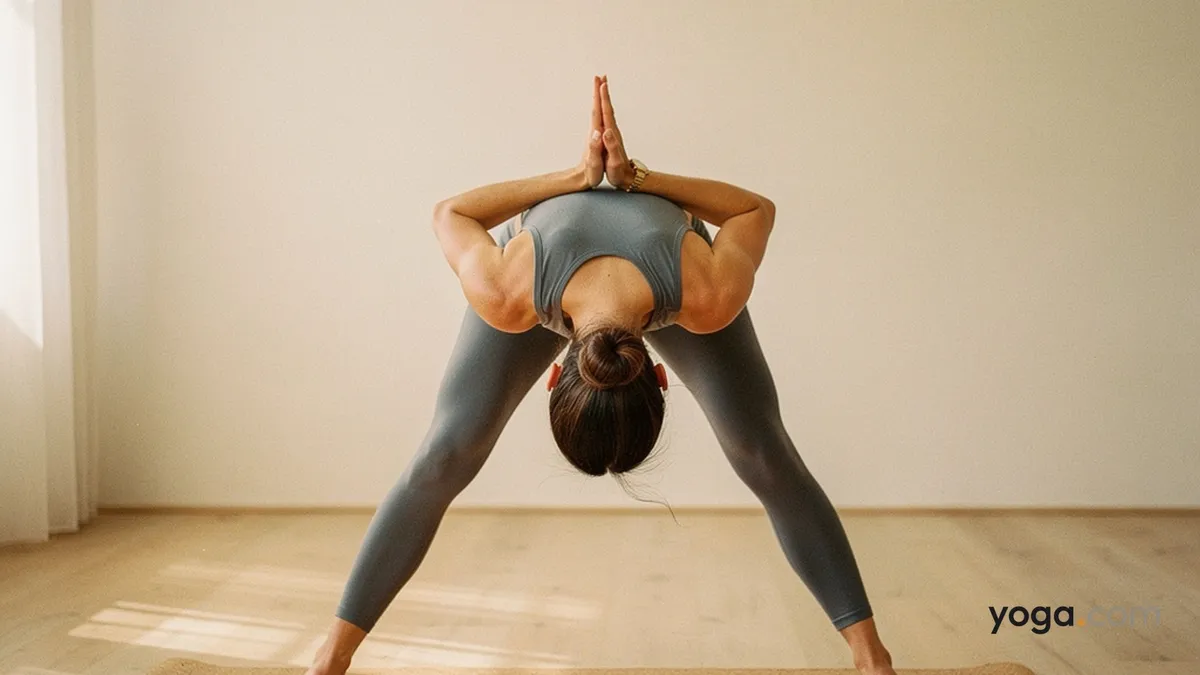
Wide Legged Forward Bend with Hands in Namaste is a standing forward fold that brings the palms together behind the back in reverse prayer as you hinge from the hips over a wide stance. Its Sanskrit name, Prasārita Pādottānāsana (hands in namaste), translates roughly as "spread-foot intense-stretch pose with hands in salutation." The added arm variation deepens the opening across the chest and shoulders while the fold lengthens the entire back line of the legs, making it a valuable transitional shape in standing sequences or as a preparation for deeper inversions.
At a Glance
Level: BeginnerType: Forward BendTargets: Hamstrings, inner thighs (adductors), thoracic spine, chest and shoulder girdleGood for: Building hip-hinge mechanics, increasing hamstring length, improving thoracic mobilityHow to Do Wide Legged Forward Bend with Hands in Namaste
Stand at the top of your mat and step your feet wide apart — roughly 3 to 4 feet — with the outer edges of your feet parallel to the long edges of the mat. Press all four corners of each foot into the floor and engage your quadriceps.Place your hands on your hips. On an inhale, lengthen through the crown of your head and lift the chest, creating space in the front body.Begin to bring your hands behind your back, fingertips pointing down at first. Rotate your wrists so the fingertips turn up toward the sky and press your palms together at the center of your upper back in reverse namaste (reverse prayer). If the palms don't meet, hold opposite elbows or wrists instead.On an exhale, hinge forward from the hips — not the waist — keeping the spine long as you fold. Lead with your chest rather than rounding immediately from the lower back.Allow the crown of your head to release toward or all the way to the floor. Draw your shoulder blades together and gently press your palms more firmly into one another to encourage the chest to broaden and the upper back to open.Hold for 5 to 8 breaths. Keep a micro-bend in the knees if the hamstrings feel strained, and let each exhale invite a little more length through the spine.To come out, re-engage your core, place your hands back on your hips, and on an inhale press through your feet to rise up with a flat back. Step or hop your feet together and return to Mountain Pose.Benefits
Stretches the hamstrings and calves along the entire back line of the legsLengthens the adductors (inner thigh muscles) through a wide-stance loadStrengthens the quadriceps and hip stabilizers as they support the wide stanceStretches the pectoral muscles and the front of the shoulders through the reverse prayer arm positionMobilizes the thoracic spine and promotes extension through the upper backBuilds hip-hinge awareness and spinal length that carries over into deeper standing and seated foldsCommon Mistakes and Alignment Cues
Rounding from the lower back immediately: Initiate the fold from the hip crease, not the lumbar spine. Think of sending the sitting bones up and back as you hinge forward.Feet turning out or in: Keep the outer edges of the feet parallel to the mat edges. Press down evenly through the heel, the ball of the big toe, and the ball of the little toe.Forcing the palms together and collapsing the shoulders forward: Only join the palms as far as your shoulder flexibility allows. Priority is keeping the shoulder blades drawing toward each other, not straining the wrist joints.Locking the knees: Maintain a soft, micro-bend in the knees to protect the joint and allow the pelvis to tilt forward more freely over the femurs.Weight shifting back into the heels: Press the balls of the feet actively into the floor so the weight stays centered between the heel and forefoot throughout the fold.Modifications and Props
Hands on blocks: If the palms-together position behind the back is inaccessible, skip the namaste and place your hands on blocks directly below your shoulders as you fold. This supports spinal length while the hamstrings and hips build flexibility over time.Holding opposite elbows: Bring your arms behind your back and hold your right elbow with your left hand and vice versa. This is a gentle alternative that still opens the chest and upper back.Narrower stance: If a 4-foot stance feels unstable, reduce the width until you can fold forward with a neutral pelvis and without the knees rolling inward.Head supported on a block: Place a block or bolster under the crown of your head to support the cervical spine and allow the neck to release fully without strain.Cautions
Lower back sensitivity: If you have acute lower back discomfort, keep a significant bend in the knees and avoid folding past the point where the pelvis stops tilting and the lumbar begins to round.Hamstring injury: Ease into the fold gradually and stay higher in the range of motion. Never pull aggressively into the stretch — let the breath create depth over time.Shoulder or wrist issues: Skip the reverse namaste arm variation entirely and rest your hands on your hips or on blocks instead.High blood pressure or head/neck concerns: Avoid letting the head hang fully below the heart for extended holds; keep the gaze forward or use a block under the crown of the head.If you're working with an injury or a medical condition, check with a qualified professional before practicing.
Related Poses
Mountain Pose — the neutral standing foundation you return to after the foldStanding Forward Bend — a parallel-stance forward fold that prepares and complements this wide-legged variationWide-Angle Seated Forward Bend — takes the same wide-leg hip opening to the floor, deepening adductor and hamstring lengthIntense Left Stretch with Hands Behind Back in Namaste — shares the reverse prayer arm position and builds toward single-leg foldingPut this pose to use in a full practice: A Gentle Yoga Routine for Tired, Low-Energy Days or reset your afternoon with A 10-Move Chair Yoga Sequence for a Midday Reset.