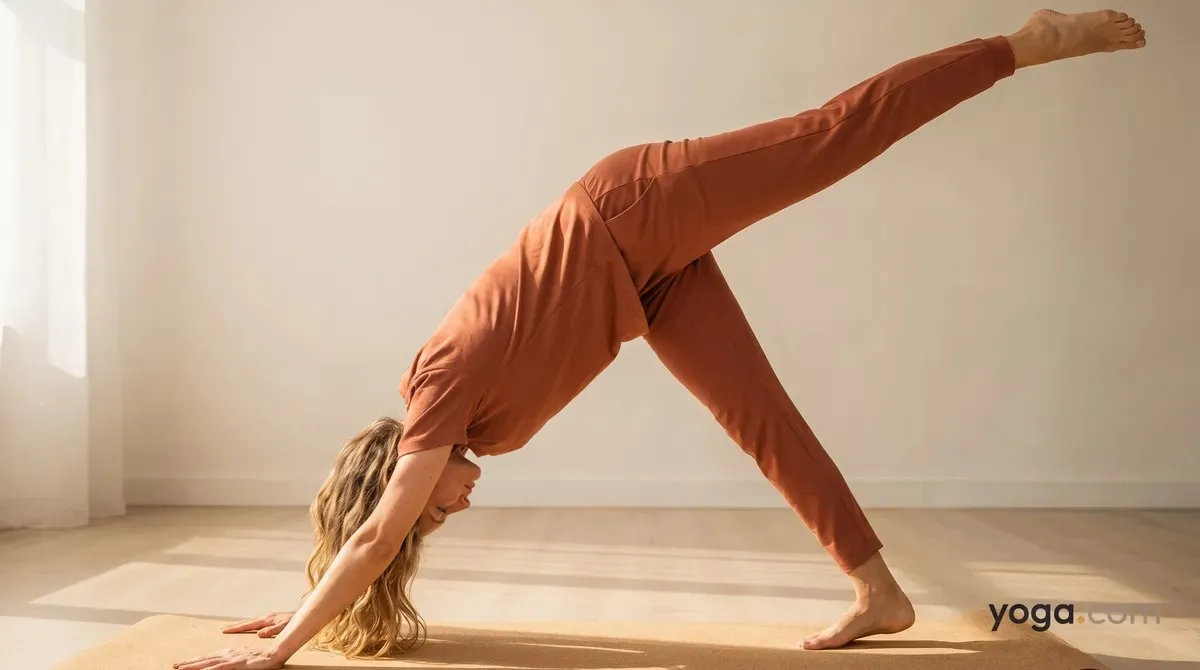
Downward-Facing Dog Pose with Left Leg Up is a single-leg variation of the foundational inverted V shape, known in Sanskrit as Eka Pāda Adho Mukha Śvānāsana - literally "downward-facing dog with the left leg lifted." The pose appears frequently in vinyasa sequences as a hip-opener transition, a balance challenge, and a preparation for standing poses on the left side. It combines the full-body lengthening of the base pose with the added demands of hip mobility, core stability, and single-leg grounding.
At a Glance
- Level: Intermediate
- Type: Inversion
- Targets: Hamstrings, hip flexors, shoulder girdle, core
- Good for: Building single-leg balance, lengthening the left hip flexor, strengthening the standing-leg hamstring
How to Do Downward-Facing Dog Pose with Left Leg Up
- Begin in Downward-Facing Dog: hands shoulder-width apart, feet hip-width apart, hips high, spine long. Spread your fingers wide and press evenly through all four corners of each palm.
- Root through your right foot, pressing the heel toward the mat and engaging the right hamstring and quadriceps to stabilize the standing leg.
- On an inhale, lift your left leg straight back and up, extending from the left hip rather than forcing height. Keep the left foot flexed or softly pointed - both are valid.
- Square your left hip toward the mat: draw the left outer hip down and resist any temptation to open the pelvis toward the left wall. Both hip points face the floor.
- Firm your left inner thigh upward (inward rotation) to reinforce the square hips. If the hip is squared, the lifted knee faces straight down toward the mat.
- Keep both arms straight, ears between the upper arms, and continue pressing the floor away so the spine stays elongated - the inversion quality of the base pose should not diminish.
- Breathe steadily for 3-5 breaths, maintaining length through the left side body from lifted heel to left fingertip.
- To come out, exhale and lower the left foot back to meet the right, returning to a full Downward-Facing Dog. Pedal through the heels for one breath before moving on.
Benefits
- Stretches the left hip flexors and iliopsoas in the lifted leg.
- Strengthens the hamstrings and gluteal muscles of the right (standing) leg under load.
- Builds shoulder stability and wrist-bearing capacity through sustained weight on both hands.
- Engages and trains the deep core muscles to maintain pelvic neutrality with an asymmetric load.
- Lengthens the left side of the spine and left latissimus dorsi as the arm remains extended.
- Prepares the body for one-legged standing poses such as Warrior I and Warrior III on the left side.
Common Mistakes and Alignment Cues
- Mistake: Opening the lifted hip outward. Cue: Rotate the left inner thigh toward the ceiling and draw the left outer hip down until the knee points straight at the floor.
- Mistake: Collapsing into the right shoulder. Cue: Press equally through both palms - particularly the index finger mound of each hand - to distribute weight evenly across the shoulder girdle.
- Mistake: Bending the standing-leg knee. Cue: Firm the right quadriceps and press the right heel toward the mat; a slight bend is fine if the hamstring is tight, but avoid a soft, passive knee.
- Mistake: Lifting the leg so high the lower back compresses. Cue: Lower the leg to a height at which the spine stays long and neutral - hip height or below is often sufficient.
- Mistake: Holding the breath. Cue: Soften the jaw and continue a steady, even exhale to help the pelvis settle and the hamstrings release.
Modifications and Props
- Blocks under the hands: Place a block under each hand at the lowest height to shorten the distance to the floor, making it easier to keep the spine long and the standing heel grounded.
- Wall support: Practice with the hands on the wall at hip height (a standing L-shape) before adding the leg lift - this reduces wrist load while you develop hip alignment awareness.
- Bent lifted knee: If you feel tightness or tension in the left hip, allow a generous bend in the left knee while still squaring the hip. This targets the hip flexors without demanding full hamstring length in the lifted leg.
- Strap around the standing heel: Loop a strap around the right heel and anchor it lightly against the baseboard or a wall to encourage heel grounding without muscular strain.
Cautions
- Wrist sensitivity: If you experience discomfort at the wrists, come to fists or forearms, or use wedge props under the heels of the hands to reduce extension angle.
- Shoulder instability or recent rotator cuff injury: Approach single-leg variations gradually; the asymmetric load increases demand on both shoulder joints.
- High blood pressure or head/eye conditions affected by inversion: Consult a qualified professional before practicing any inverted pose, including this one.
- Hamstring strain in either leg: Keep a generous bend in the standing knee and reduce the height of the lifted leg until the area has recovered.
If you're working with an injury or a medical condition, check with a qualified professional before practicing.
Related Poses
- Downward-Facing Dog Pose - the essential foundation; establish this before adding the leg lift.
- Downward-Facing Dog Pose with Right Leg Up - the direct bilateral counterpart; practice both sides evenly.
- Upward-Facing Dog Pose - a common vinyasa pairing that counter-stretches the spine after repeated forward folding.
- Cat Pose - a gentle preparation for spinal mobility and the shoulder-pressing action used in the base pose.
Looking for a practice context? Try working this pose into A Gentle Yoga Routine for Tired, Low-Energy Days, or take a shorter break with A 10-Move Chair Yoga Sequence for a Midday Reset.