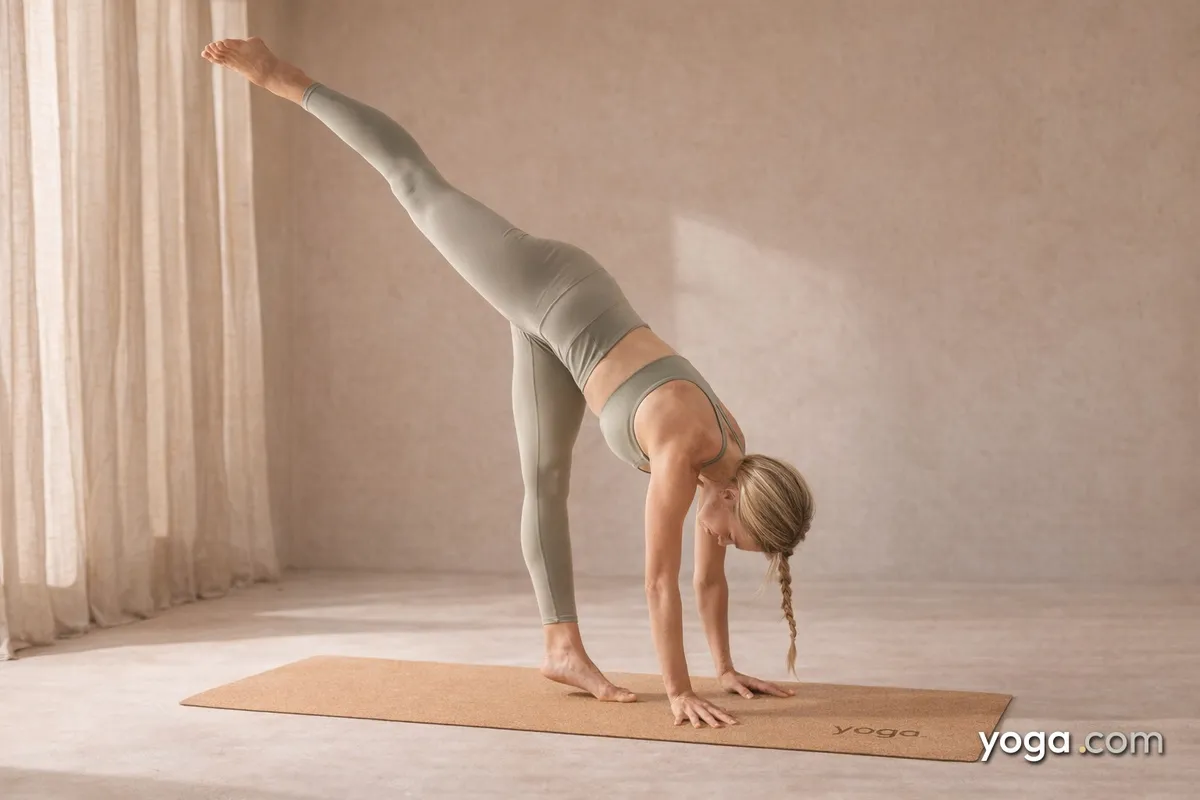
Forward Stretch Pose with Left Leg Up is a standing split-variant forward bend in which you hinge deeply at the hips, fold the torso toward one straight leg, and lift the opposite leg toward the ceiling. Its Sanskrit name is Ūrdhva Prasārita Eka Pādāsana - ūrdhva prasārita meaning "upward extended" and āsana meaning "seat" or "posture" - with the left leg raised as the defining variation. It appears naturally in standing sequences and transitions, and it asks for both hamstring length and single-leg stability before the lifted leg can rise freely.
At a Glance
- Level: Intermediate
- Type: Forward Bend
- Targets: Hamstrings, hip flexors, glutes, lower back extensors
- Good for: Building single-leg balance, lengthening the posterior chain, strengthening the standing-leg hip stabilizers
How to Do Forward Stretch Pose with Left Leg Up
- Begin in Mountain Pose, feet hip-width apart, arms at your sides. Root evenly through both feet and lengthen your spine before you move.
- On an exhale, hinge from your hips - not your waist - and fold forward into a standard Standing Forward Bend. Let the crown of your head drop toward the floor and rest your fingertips or palms on the mat beneath your shoulders.
- Shift your weight into your right foot. Press the four corners of that foot firmly into the mat to create a stable base.
- On your next inhale, reach your left leg straight back and up toward the ceiling. Keep the left hip squaring toward the floor - resist the urge to open it toward the left wall. Internally rotate the left thigh slightly so the left toes point down.
- Extend through the left heel as if you are pushing it away from you. Simultaneously lengthen through the crown of your head, creating a long line from head to raised heel.
- Keep your hands flat on the floor (or on blocks) and continue folding the torso toward the standing right leg. Draw your belly gently in and up to support the lumbar spine. Gaze is soft, directed at the floor a few inches in front of your right foot.
- Hold for 5-8 steady breaths, maintaining even pressure through the standing foot and keeping both hips level.
- To come out: On an exhale, lower the left foot to meet the right. Pause in Standing Forward Bend for one breath, then roll up slowly through the spine, rebuilding Mountain Pose from the feet upward. Shake out both legs gently before repeating on the second side.
Benefits
- Stretches the hamstrings and calf of the standing (right) leg through active load.
- Lengthens the hip flexors and quadriceps of the lifted (left) leg.
- Strengthens the glutes and posterior hip muscles of the raised leg isometrically.
- Builds stability in the standing-leg ankle, knee, and hip under asymmetrical load.
- Increases awareness of pelvic alignment - keeping both hips square develops proprioception in the hip rotators.
- Strengthens the erector spinae and lower back extensors as they work to maintain a long, neutral spine against gravity.
Common Mistakes and Alignment Cues
- Mistake: Opening the left hip toward the ceiling. Cue: Internally rotate the left thigh and draw the left hip down until both hip points face the floor.
- Mistake: Bending the standing knee to get the hands to the floor. Cue: Use blocks under your hands so you can keep the right leg straight without compromising the fold.
- Mistake: Rounding the lower back to compensate for tight hamstrings. Cue: Micro-bend the standing knee if needed, hinge at the hip crease, and prioritize a long spine over depth.
- Mistake: Lifting the leg so high that the lower back compresses. Cue: Raise the left leg only as high as your pelvis stays level - hip height is enough.
- Mistake: Collapsing weight into the standing-leg inner arch. Cue: Press actively through the big-toe mound and the outer heel equally; engage the right inner thigh.
Modifications and Props
- Blocks under hands: Place two blocks at their highest height under your palms. This reduces the distance to the floor and allows you to keep the standing leg straight and the spine long.
- Wall for the lifted leg: Stand about a leg's length from a wall, fold forward, and press the left heel into the wall rather than lifting freely. The wall gives proprioceptive feedback about hip height and makes balance far more accessible.
- Bent lifted knee: If your left hip flexors are tight, allow a soft bend in the left knee as the leg rises. Focus on hip leveling before chasing a straight leg.
- Fingertips on the floor: If full palms feel too compressed in the forward fold, work on fingertips with a longer spine rather than flattening the hands at the cost of lumbar rounding.
Cautions
- Hamstring or hip flexor strain: Avoid pulling aggressively into the fold or forcing the lifted leg higher. Work within a pain-free range and use props generously.
- Low back pain or disc issues: Keep a micro-bend in the standing knee and prioritize spine length over depth. Avoid this variation entirely if a full forward fold is already contraindicated for you.
- High blood pressure or head/eye conditions: Prolonged inversion (head below heart) may be unsuitable; keep the hold brief or substitute a supported table-top variation.
- Knee hyperextension: Maintain a soft, micro-bend in the standing knee rather than locking it out, to protect the joint under single-leg load.
If you're working with an injury or a medical condition, check with a qualified professional before practicing.
Related Poses
- Standing Forward Bend - the direct foundation for this pose; build hamstring length and hip-hinge mechanics here first.
- Bend to Left Leg - isolates the left-side hamstring stretch and prepares the hip for the asymmetrical demand of the lifted-leg variation.
- Intense Left Stretch with Hands Behind Back in Namaste - a natural progression that deepens the forward fold over the left leg with added shoulder opening.
- Downward-Facing Dog Pose - an excellent counter-pose and transitional shape that decompresses the spine and restores symmetry in the hips after this asymmetrical work.
For gentler sequences that include standing forward bends, see A Gentle Yoga Routine for Tired, Low-Energy Days and A 10-Move Chair Yoga Sequence for a Midday Reset.