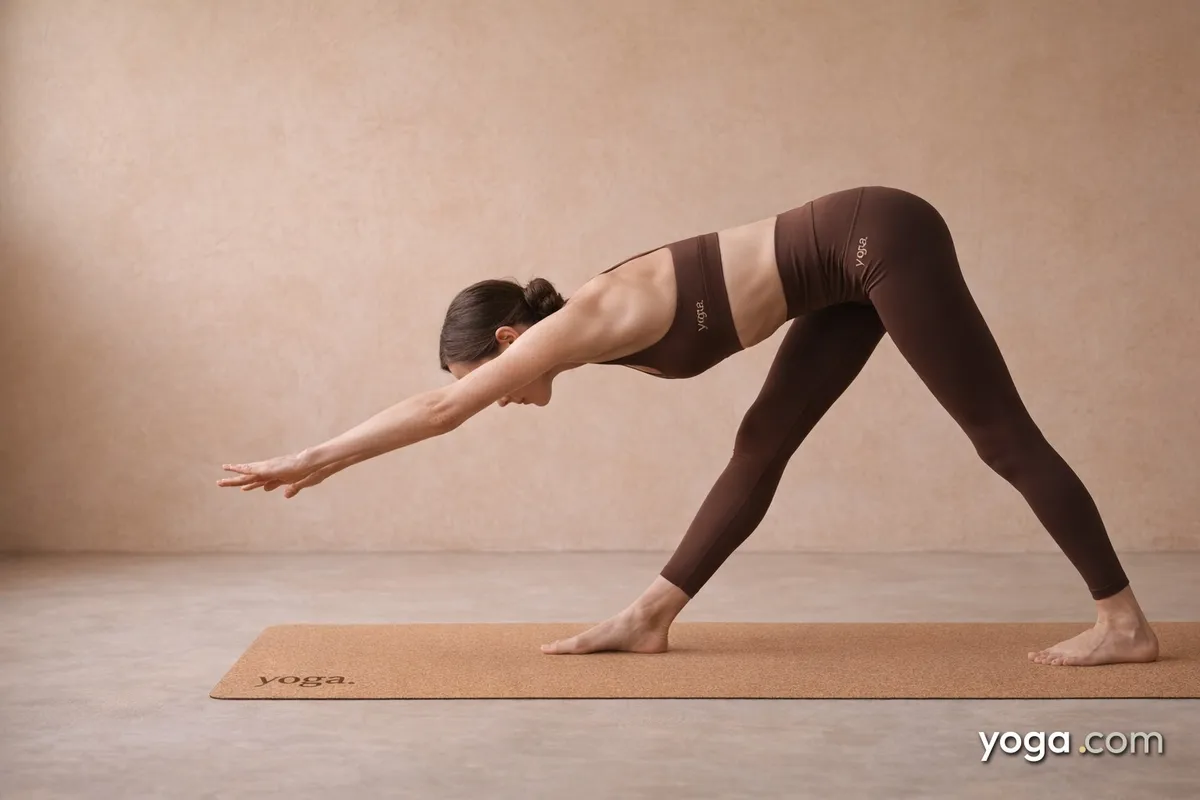
Intense Side Stretch Pose, Left Leg Forward is a standing forward bend performed over the left leg, with both arms extended forward along the floor or alongside the ears. Its Sanskrit name is Pārśvottānāsana (left, arms extended) - pārśva meaning side or flank, ut meaning intense, tān meaning stretch, and āsana meaning seat or posture. This asymmetrical fold appears naturally in sequences that build toward deeper single-leg forward bends and hip-opening work.
At a Glance
- Level: Intermediate
- Type: Forward bend
- Targets: Left hamstrings, left hip flexors, thoracic spine, shoulder girdle
- Good for: Lengthening the posterior chain, building standing balance, improving hip alignment in asymmetrical stances
How to Do Intense Side Stretch Pose, Left Leg Forward
- Stand in Mountain Pose. Step your right foot back approximately three to three-and-a-half feet, turning it out to about 45-60 degrees. Your left foot stays pointing straight forward. Square your hips as evenly as possible toward the front of your mat.
- Press all four corners of both feet firmly into the mat. Engage your quadriceps to draw the kneecaps up, and internally rotate the right thigh slightly to help level the pelvis.
- On an inhale, reach both arms overhead alongside your ears, palms facing each other, shoulder blades drawing down the back. Lengthen the entire spine.
- On an exhale, hinge forward from the hips - not the waist - leading with your sternum over the left leg. Keep the spine long as you begin the descent; resist the urge to round early.
- Continue folding until your torso is parallel to the floor or lower, bringing both arms forward and down to frame the left foot on the mat. Fingertips or palms rest on the floor on either side of the left foot, arms fully extended. If the floor is not accessible, allow the hands to rest on the shin or a block.
- Draw the crown of your head toward the left foot, keeping the neck in line with the spine. Gaze down and slightly forward. Both legs remain straight; microbend the left knee if there is any sharp sensation behind the knee.
- Hold for 5-8 breaths, rooting through both feet and lengthening the front body on each inhale while releasing deeper on each exhale.
- To come out, re-extend the arms alongside the ears and use an inhale to lift the torso back to upright with a long spine. Step the right foot forward to meet the left and return to Mountain Pose before switching sides.
Benefits
- Stretches the left hamstrings and calf muscles through a sustained, load-bearing lengthening
- Lengthens the left hip flexors and iliopsoas as the pelvis tilts anteriorly over the front leg
- Strengthens the stabilizing muscles of both ankles and the standing leg
- Increases range of motion in the thoracic spine with the arms-extended variation
- Builds shoulder and scapular stability as the arms reach long alongside the head
- Trains the pelvis to move symmetrically in an asymmetrical stance, reinforcing hip alignment habits useful in many standing poses
Common Mistakes and Alignment Cues
- Hiking the right hip: When the right hip rides up, the stretch is lost and the spine torques. Draw the right hip forward and down to level the pelvis before folding.
- Rounding through the lumbar early: Folding from the waist compresses the low back. Lead with the sternum and maintain the length of the front body all the way into the deepest position.
- Bending the left knee to reach the floor: A bent front knee offloads the hamstrings and can strain the joint. Use blocks under the hands instead, and keep the left leg straight with a soft, not locked, knee.
- Letting the arms go passive during the descent: As you hinge forward and reach the arms toward the floor, keep them active - engage the triceps and spread the fingers wide throughout the mid-fold descent. Once the hands land on the floor framing the left foot, they can settle and bear weight naturally in the finishing position.
- Shifting weight into the front foot: Distribute weight evenly across both feet. Press actively through the outer edge of the back foot to maintain stability and even hip loading.
Modifications and Props
- Blocks under the hands: Place one or two blocks on either side of the left foot at whatever height lets you keep a long spine. Lower the blocks as your hamstring length increases over time.
- Hands to shin: If blocks aren't available, rest both hands on the left shin. Focus on the pelvic hinge rather than how far you fold.
- Shorter stance: A narrower step between feet reduces the demand on hamstring flexibility and makes it easier to keep the hips squared. Widen gradually as you build range of motion.
- Wall support: Stand facing a wall and place fingertips on it at hip height. Walk the feet into the stance and hinge forward with the wall guiding the arms-extended position - useful for learning the spinal line of the pose.
Cautions
- Hamstring injury: Avoid a deep fold if you have an acute hamstring strain. Work with a shorter stance and hands on blocks, keeping the front knee microbent.
- Low back pain or lumbar disc issues: Be cautious about the degree of forward flexion. Prioritize spinal length over depth, and stop before any compression or discomfort arises in the low back.
- High blood pressure or head below heart concerns: Move slowly into and out of the inversion component; avoid holding the full fold for extended periods without guidance.
- Shoulder or neck injury: In the arms-extended variation, keep the arms lower (hands to the floor) rather than alongside the ears if there is any strain in the shoulders or cervical spine.
If you're working with an injury or a medical condition, check with a qualified professional before practicing.
Related Poses
- Standing Forward Bend - a symmetric preparatory fold that builds hamstring length before moving to the asymmetrical version
- Bend to Left Leg - a seated counterpart that targets the same posterior chain from a stable base
- Intense Left Stretch with Hands Behind Back in Namaste - the traditional arm variation of the same pose, offering a deeper chest and shoulder opening
- Downward-Facing Dog Pose - a counter-pose and transition that resets the spine and hamstrings symmetrically after asymmetrical bends
For sequences where this pose fits well, see A Gentle Yoga Routine for Tired, Low-Energy Days and A 10-Move Chair Yoga Sequence for a Midday Reset.