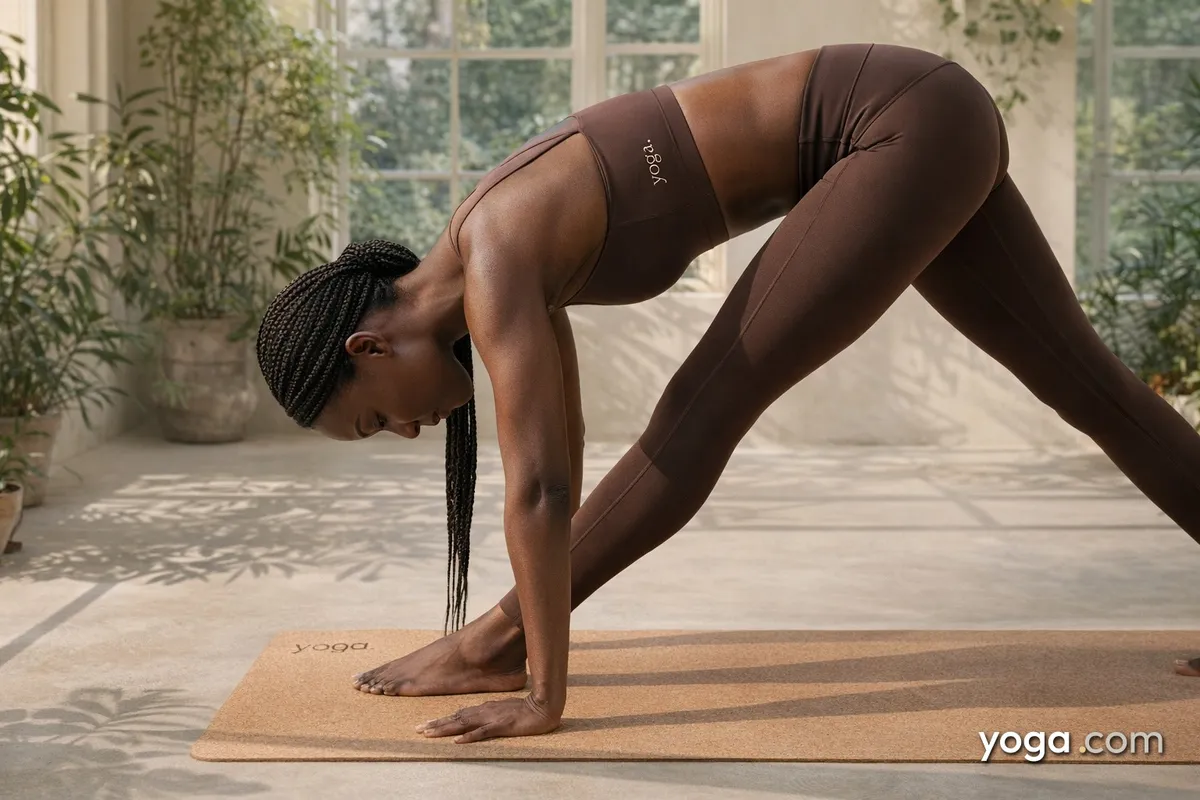
Intense Side Stretch to Right Leg is a standing forward bend that folds the torso deeply over the front leg while the back foot is planted at a 45-degree angle, creating a strong, asymmetrical stretch through the entire posterior chain. Its Sanskrit name, Pārśvottānāsana (right side), translates roughly as "intense side stretch pose" - pārśva meaning side, ut meaning intense, and tān meaning to stretch. Typically placed in the standing sequence of a practice, it bridges dynamic hip-opening work and the deeper single-leg forward folds to come.
At a Glance
- Level: Intermediate
- Type: Forward Bend
- Targets: Hamstrings, hip flexors, thoracic spine, shoulders
- Good for: Lengthening the posterior chain of the right leg, improving hip alignment, building single-leg balance and stability
How to Do Intense Side Stretch to Right Leg
- Set your stance. From Mountain Pose, step your left foot back approximately 3-3.5 feet. Turn the left foot out to about 45 degrees and press the entire sole firmly into the mat. Keep the right foot pointing straight forward.
- Square your hips. Draw the left hip forward and the right hip back so both hip points face the front of the mat. You may need to widen your stance slightly - think of standing on two parallel tracks, not a tightrope.
- Position your arms. Bring your hands to your hips or take them behind your back in reverse prayer (palms together, fingertips pointing up) or hold opposite elbows. Choose the arm variation that keeps your chest open rather than collapsed.
- Inhale and lengthen. On an inhalation, lift through the crown of your head, draw the lower belly in lightly, and extend the spine long. Let this lift initiate the fold - don't lead with the chin.
- Exhale and hinge forward. On an exhalation, hinge at the right hip and bring the torso over the right leg. Keep the right leg straight (micro-bend in the knee if the hamstrings are very tight) and the back heel rooted.
- Deepen the fold. Continue to lengthen the spine as you draw the chest toward the right shin. Rest fingertips or palms on the floor beside the right foot, or on a block. Gaze toward your right big toe or the floor - wherever the neck is comfortable.
- Hold and breathe. Stay 5-8 breaths. Each inhalation, find a little more length in the spine; each exhalation, allow the chest to soften closer to the leg without rounding the lower back.
- Come out with care. On an inhalation, press the back heel down, engage the legs, and lift the torso upright - lead with the chest, not the head. Step the left foot forward to Mountain Pose before switching sides.
Benefits
- Stretches the hamstrings and calf muscles of the front (right) leg through their full range
- Lengthens the hip flexors of the back (left) leg, particularly the psoas
- Mobilises the thoracic spine into extension when the arms are in reverse prayer
- Strengthens the quadriceps of both legs as they work to stabilise the pose
- Improves pelvic alignment and awareness of hip squaring in asymmetrical standing positions
- Builds proprioceptive awareness and single-leg balance through the standing right leg
Common Mistakes and Alignment Cues
- Back heel lifting: If the left heel peels off the mat, shorten your stance. A grounded back heel is non-negotiable for stable hip alignment.
- Hips rotating open: The left hip tends to drift back and out. Actively draw it forward toward the right foot throughout the pose. Place a hand on the left hip as a reminder.
- Rounding the lower back to reach the floor: Prioritise a long spine over depth. Place blocks under your hands so you can fold with integrity rather than collapse through the lumbar spine.
- Leading the fold with the chin: Let the crown of the head extend forward, keeping the back of the neck long. The gaze follows the movement - it doesn't pull the head down first.
- Locking the front knee: A rigid, hyperextended knee puts undue pressure on the joint. Engage the quadriceps actively and maintain a neutral knee rather than forcing it into hyperextension.
Modifications and Props
- Blocks under the hands: Place one or two blocks at their highest height beside the right foot. This shortens the distance to the floor, allowing you to keep the spine long and the back heel down simultaneously.
- Hands on a chair seat: Rest your hands on the seat of a chair placed in front of you for a supported, longer-spine variation - useful if hamstring flexibility is still developing.
- Hands on hips: Skip the arm variation entirely and keep both hands on your hips. This simplifies balance demands and lets you focus fully on hip alignment and spinal length.
- Wall support for the back heel: Press the back heel against a baseboard or wall to anchor it firmly, which makes it easier to feel and maintain the grounding action without conscious effort.
Cautions
- Tight hamstrings: Avoid pulling aggressively into the fold. Use blocks and work with the breath to progress gradually - forcing depth here strains the muscle attachments at the sitting bone.
- Lower back sensitivity: Keep a micro-bend in the right knee and prioritise spinal length over depth. If the lower back rounds significantly, raise the hands higher (blocks or chair) rather than folding further.
- Wrist or shoulder discomfort: Avoid reverse prayer and keep hands on the hips or use the opposite-elbow hold instead.
- Balance challenges or inner-ear conditions: Practice near a wall with one hand available for support, and widen the stance to create a more stable base.
If you're working with an injury or a medical condition, check with a qualified professional before practicing.
Related Poses
- Mountain Pose - the neutral starting point from which you set your stance
- Standing Forward Bend - a preparatory bilateral fold that warms the hamstrings for the asymmetrical demand here
- Downward-Facing Dog Pose - builds hamstring and calf length and prepares the shoulders for reverse prayer variations
- Intense Left Stretch with Hands Behind Back in Namaste - the natural counterpart on the opposite side, completing the symmetrical practice
Looking for a practice context? Try weaving standing forward folds into A Gentle Yoga Routine for Tired, Low-Energy Days, or explore accessible standing work in A 10-Move Chair Yoga Sequence for a Midday Reset.