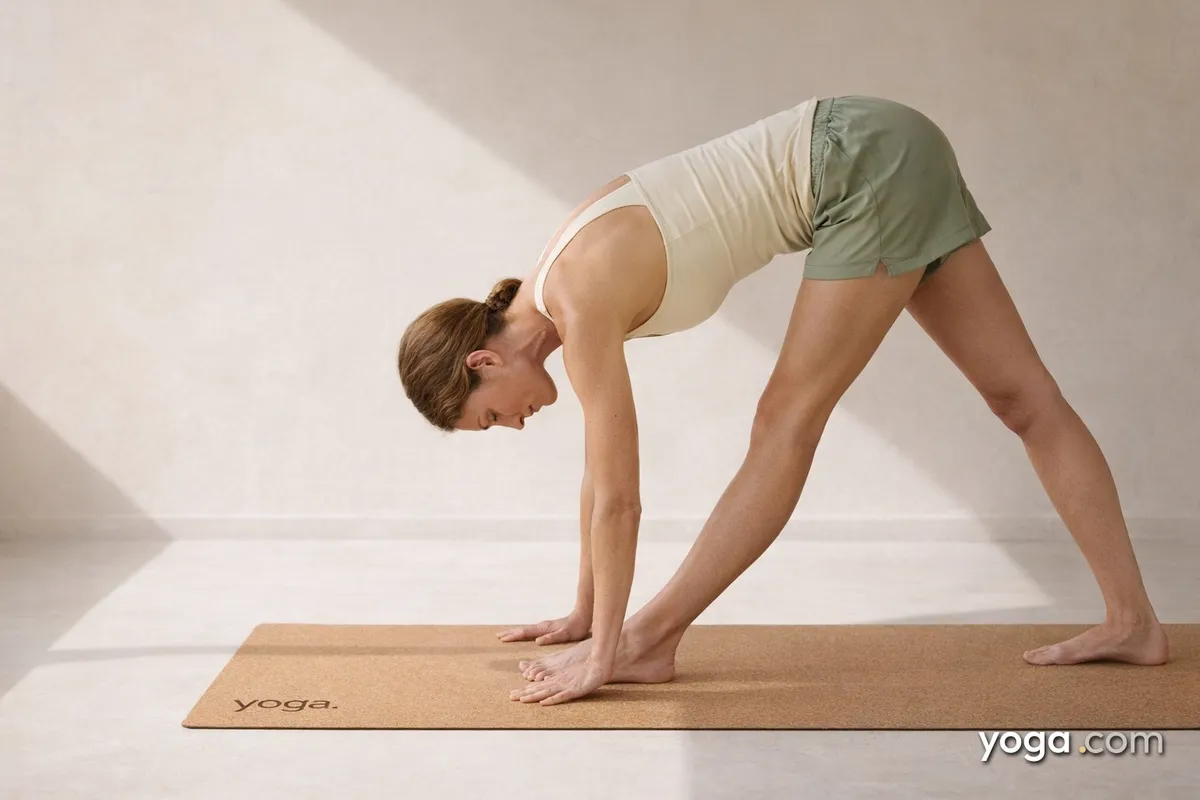
Intense Right Stretch Pose - Pārśvottānāsana (right side), from the Sanskrit pārśva (side), ut (intense), tān (stretch), and āsana (pose) - is a standing forward fold over the right leg that demands both hip flexibility and active hamstring lengthening. It appears in the standing sequence of the Ashtanga Primary Series and serves equally well as a focused preparatory pose in any Hatha or Vinyasa practice. The asymmetrical stance makes hip-square alignment a constant, productive challenge.
At a Glance
- Level: Intermediate
- Type: Forward Bend
- Targets: Right hamstrings, hip flexors, spine, shoulders
- Good for: Lengthening the posterior chain, improving hip alignment, building single-leg balance
How to Do Intense Right Stretch Pose
- Begin in Mountain Pose at the top of your mat. Bring your hands to your hips and step your left foot back approximately 3-3.5 feet, turning it out to roughly 45-60 degrees. Both feet press firmly into the floor.
- Square your hips toward the front of the mat: draw the left hip forward and the right hip back until both hip points face forward as evenly as possible.
- On an inhale, lengthen your spine - lift the crown of the head, broaden the collarbones, and feel the torso extend away from the pelvis.
- Bring your hands into reverse prayer (paścima namaskārāsana) behind your back - palms together, fingertips pointing up - or, if that is not available, cross your forearms and hold opposite elbows.
- On an exhale, hinge from the hips (not the waist) and fold forward over the right leg, keeping the spine long rather than rounding the back. Lead with the chest toward the right shin.
- Allow the crown of the head to release toward or past the right shin. Keep the right leg straight and the right foot grounded through the heel. Hold 5-10 breaths, maintaining steady hip alignment with each exhalation.
- To come out: On an inhale, engage the core, press into both feet, and rise back to upright with a long spine. Release the arms, step the left foot forward to Mountain Pose, and pause for two breaths before switching sides.
Benefits
- Stretches the right hamstrings and calf muscles through a deep, sustained lengthening.
- Opens and mobilises the hip flexors of the back (left) leg.
- Strengthens the quadriceps and engages the muscles that stabilise the front knee.
- Builds shoulder mobility and opens the chest when the hands are in reverse prayer.
- Trains a neutral-spine hip hinge - the action of folding forward from the hip joint with the back neither rounded nor arched - rather than passive spinal flexion.
- Develops proprioceptive awareness of hip-square alignment in a standing asymmetrical stance.
Common Mistakes and Alignment Cues
- Hips rotating open: If the right hip swings out and the left hip drops back, the stretch moves away from the hamstrings into the inner thigh. Draw the left hip actively forward and the right hip back before folding.
- Rounding the spine to reach deeper: A collapsed back compresses the lumbar spine and reduces hamstring recruitment. Keep the chest broad and the sternum reaching toward the shin; depth comes from the hip hinge, not spinal flexion.
- Front knee hyperextending: A locked-out knee can stress the joint. Micro-bend the right knee just enough to release the lock, then engage the quadriceps to straighten without forcing.
- Back foot collapsing inward: If the left arch rolls in, stability through the whole stance is compromised. Press the outer edge of the left foot down and lift the inner arch.
- Shoulders cramping in reverse prayer: If the wrists strain or the chest closes, release the hands and hold opposite elbows instead; the priority is an open, lifted chest.
Modifications and Props
- Blocks under the hands: Place two blocks on either side of the right foot at whatever height keeps the spine long. This gives you something to reach for if the floor is far away, without sacrificing back length.
- Hands on the shin or ankle: Instead of reverse prayer, rest your fingertips or palms on the right shin or ankle. This is especially useful while you build hamstring length.
- Wall support for balance: Face a wall and place your fingertips on it at hip height as you fold. The wall helps you feel the hip-square alignment and prevents pitching forward.
- Shorter stance: A narrower step back reduces the intensity of the hamstring stretch and makes squaring the hips easier. Gradually widen the stance as flexibility and stability develop.
Cautions
- Tight hamstrings: Move slowly into the fold and use blocks or hands on the shin to avoid overstretching the back of the right leg.
- Low-back sensitivity: Prioritise a neutral lumbar curve throughout. If the lower back rounds or aches, shorten the stance and reduce the depth of the fold.
- Wrist or shoulder discomfort: Skip reverse prayer entirely and use the elbow-hold or hands-on-shin variation.
- Balance concerns: Keep the gaze slightly forward rather than straight down, and use a wall or chair for support until single-leg balance feels secure.
- If you're working with an injury or a medical condition, check with a qualified professional before practicing.
Related Poses
- Mountain Pose - the starting point and a grounding reset between sides.
- Standing Forward Bend - a symmetrical forward fold that prepares the hamstrings before moving into the asymmetrical stance.
- Intense Left Stretch with Hands Behind Back in Namaste - the left-side counterpart to this pose, completing the bilateral practice.
- Seated Forward Bend - a complementary seated hamstring stretch to practice when standing balance is a limiting factor.
Looking for a sequence context? See A Gentle Yoga Routine for Tired, Low-Energy Days and A 10-Move Chair Yoga Sequence for a Midday Reset.