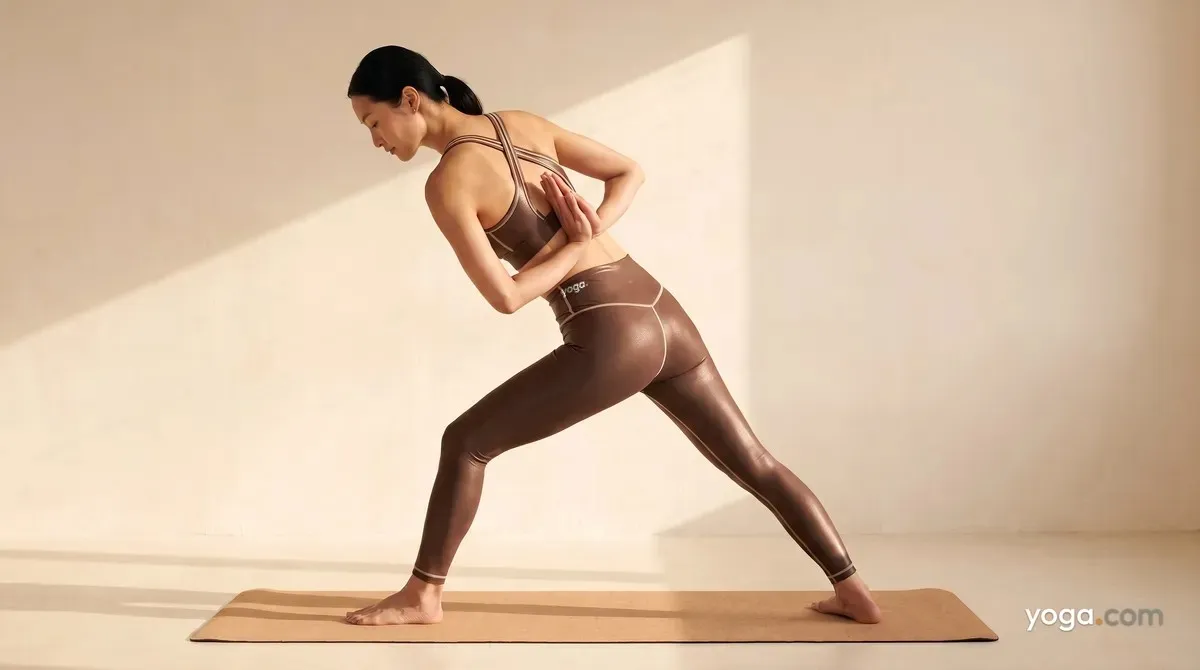
Pārśvottānāsana - from the Sanskrit pārśva (side), ut (intense), tāna (stretch), and āsana (pose) - is a deep single-leg forward bend that combines a powerful hamstring and hip lengthening with the shoulder-opening challenge of reverse prayer hands. This page covers the right-side variation with hands in namaste behind the back, folding over the right leg.
At a Glance
- Level: Intermediate
- Type: Forward Bend
- Targets: Right hamstrings, right hip flexors, left hip flexors (rear-leg stretch), thoracic spine, shoulders, wrists
- Good for: Hip mobility, shoulder flexibility, balance, spinal lengthening
How to Do Intense Right Stretch Pose with Hands Behind Back in Namaste
Getting in
- Begin in Mountain Pose (Tāḍāsana) at the top of your mat. Stand tall, feet together, weight even across both feet, arms at your sides.
- Set your hands first. Bring the backs of your hands to your lower back, then work the palms together into reverse namaste - fingertips pointing up between the shoulder blades. If the palms won't meet, hold opposite elbows or forearms behind you instead.
- Step your left foot back about 3-3.5 feet and turn it out 45-60 degrees. Square your hips to face forward over your right foot. Press the outer edge of your left foot firmly into the mat.
- Square your pelvis. Draw your left hip forward and your right hip back until both hip points face the front of the mat evenly. This is the core alignment action of the pose - do not rush past it.
- Inhale and lift your chest. Lengthen through the crown of your head and create a slight, deliberate extension in the upper back. Think of this as a mini-backbend before you fold.
- Exhale and hinge forward from the hips over your right leg, leading with the chest rather than the forehead. Keep both legs active without locking the knees - a micro-bend in each knee protects the joint and prevents hyperextension. Lower your torso toward your right thigh, bringing your face eventually toward your right shin.
- Press through both feet equally. Root the right heel down, engage the right quadriceps to gently lift the kneecap, and keep the left leg strong and straight with a soft knee. Your body weight should not dump into the front hip.
- Hold 5-10 breaths. With each inhale, create a little more length in the spine; with each exhale, soften deeper into the fold without rounding the lower back.
Coming out
- Inhale and press firmly through both feet as you lead with the chest to rise back to upright. Step your left foot forward to meet the right, release the hands, and return to Mountain Pose before switching sides or resting.
Benefits
- Lengthens the right hamstrings and calf muscles through a sustained, load-bearing forward fold.
- Stretches the left hip flexors (particularly the iliopsoas) as the rear leg holds a long, squared position.
- Mobilizes the thoracic spine and shoulders - the reverse namaste draws the scapulae together and opens the chest, counteracting forward-rounding habits.
- Challenges single-leg balance and proprioception, strengthening the stabilizing muscles around the right ankle and knee.
- Improves hip-crease awareness by training the hinge pattern - pelvis tips over the femur rather than the lumbar spine rounding.
Common Mistakes and Alignment Cues
Hips rotating open to the left Draw the left hip actively forward to keep both hip points squared over the right foot. Place your hands on your hips briefly to feel whether they are even. Locking the front knee into hyperextension Maintain a micro-bend in the right knee, especially as you deepen the fold. Engage the quadriceps to stabilize rather than relying on the joint to hold you. Rounding the lower back to get the head closer to the shin Prioritize a long spine over depth. If the hamstrings pull the pelvis into a posterior tilt, work higher with a flat back - depth will come over time. Rear heel lifting off the mat Ground the outer edge of the left foot. If the heel persistently rises, shorten your stance or place a folded blanket under the heel for support. Shoulders hunching to force the palms together Release the wrist pressure and let the shoulder blades draw toward each other naturally. Forcing the reverse namaste compresses the wrists and closes the chest - the opposite of the intended action.
Modifications and Props
- Wall for balance: Stand facing a wall and place your fingertips on it at hip height as you fold forward, or turn so the back heel braces lightly against the baseboard - both options steady the stance without limiting the fold.
- Block under the front hand: If you need a free hand for stability during setup, rest fingertips on a block beside the right foot while you establish hip alignment, then bring the hand behind your back.
- Strap or towel: Hold a looped strap between the hands behind the back if the palms cannot meet, keeping the elbows drawing toward each other.
- Blanket under the rear heel: Raising the left heel 1-2 inches reduces demand on the calf and Achilles, making it easier to keep the foot grounded and the stance squared.
- Hands on hips: Skip reverse namaste entirely and keep both hands on the hip bones to focus entirely on the hamstring stretch and pelvic alignment - a smart choice while learning the pose.
Cautions
- Avoid this pose or approach it carefully if you have a hamstring tear or recent strain on either leg.
- Those with wrist, elbow, or shoulder injuries should skip reverse namaste and hold opposite elbows instead.
- High blood pressure or a history of vertigo warrants a slower descent and coming up gradually to avoid dizziness.
- If you're working with an injury or a medical condition, check with a qualified professional before practicing.
Related Poses
- Standing Forward Bend - the bilateral version that builds hamstring length without the single-leg balance demand.
- Intense Left Stretch with Hands Behind Back in Namaste - the mirror-image companion; always practice both sides.
- Mountain Pose - the starting point and reset between sides, cultivating the upright alignment this pose depends on.
- Downward-Facing Dog Pose - a complementary hamstring and calf lengthener that also warms the shoulders for reverse namaste.