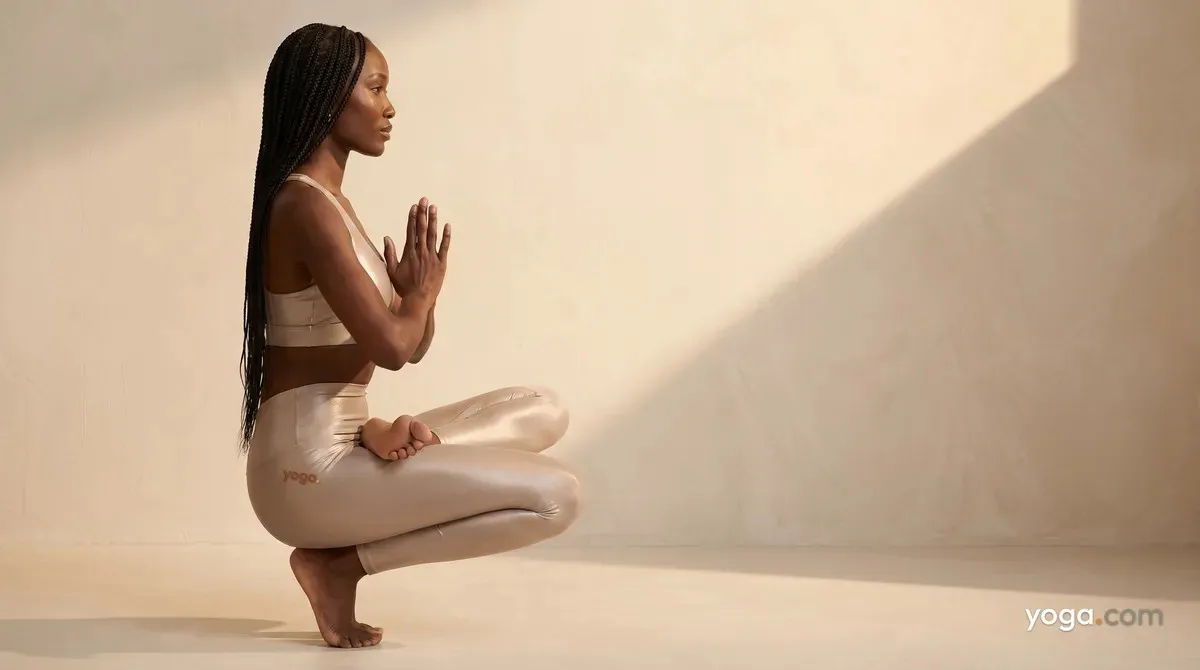
Left Toestand - Sanskrit Prapadāsana, from pāda (foot), aṅguṣṭha (big toe), and āsana (seat) - is a single-leg balancing pose in which you rise onto the toes of the left foot while holding the raised right leg in a specific position. The entire weight of the body concentrates through the left toes, demanding extraordinary proprioception, ankle stability, and focused attention.
At a Glance
- Level: Advanced
- Type: Balance
- Targets: Left foot intrinsic muscles, left calf and Achilles tendon (loaded in plantarflexion), left ankle stabilizers, hip flexors of the right leg, core
- Good for: Foot and ankle strength, single-leg stability, concentration
How to Do Left Toestand
Coming in:
- Begin in Mountain Pose. Shift your weight fully onto your left foot and find a steady focal point (drishti) at eye level roughly two to three feet in front of you.
- Spread all five toes of the left foot wide on the mat to create the broadest possible base. Press the ball of the foot and the base of each toe evenly into the floor.
- Lift your right knee toward your chest, then take hold of the right big toe with your right index and middle fingers, or clasp the right ankle with both hands - whichever variation you are working toward.
- Slowly begin to bend the left knee, lowering your hips as if sitting back onto a low stool. Keep the left shin as vertical as possible and the left knee tracking directly over the second toe of the left foot.
- As you descend, begin to rise onto the toes of the left foot - lifting the left heel and loading the calf and Achilles tendon fully in plantarflexion. Move these two actions (bending the knee and rising onto the toes) simultaneously so neither outpaces the other.
- Continue lowering until the back of the left thigh approaches the left calf, or as far as your ankle mobility and strength allow. The left heel is lifted completely off the floor and stays lifted throughout the pose.
- Extend the right leg forward or to the side if your variation calls for it, keeping the right hip level. Draw the lower belly gently in and up to stabilize the pelvis. Let your gaze remain soft and fixed.
- Hold for 3-8 breaths, maintaining an even, full breath cycle. Feel the left foot working actively - toes spread, metatarsals pressing down, ankle steady.
Coming out:
- Release the right leg and lower the right foot toward the floor as you simultaneously press through the left toes to begin straightening the left knee, lowering the left heel in a controlled manner.
- Return to Mountain Pose and pause for several breaths before switching sides or moving on.
Benefits
- Foot intrinsic strength: Rising onto the toes recruits the small muscles of the foot that support the arch and stabilize each toe joint.
- Calf and Achilles loading: Sustaining plantarflexion under the full weight of the body builds strength and resilience along the posterior lower leg.
- Ankle stability: Balancing on a narrow, raised base trains the peroneals and tibialis muscles to make constant micro-corrections.
- Hip flexor engagement: Holding the right leg lifted with control strengthens the right hip flexors and challenges the left hip stabilizers isometrically.
- Concentration and proprioception: The precision required sharpens body awareness and the capacity to sustain focused attention under physical demand.
Common Mistakes and Alignment Cues
- Mistake: Left knee collapses inward. Cue: Keep the left knee stacked over the second toe throughout the descent; if it drifts in, back off the depth until you can maintain alignment.
- Mistake: Toes curl or grip rather than spread. Cue: Actively spread all five toes of the left foot before and during the rise; gripping closes off the base and reduces stability.
- Mistake: Breath held or shallow. Cue: Let the exhale be slightly longer than the inhale; a released jaw and soft eyes help the breath stay full.
- Mistake: Rising onto toes before the knee is ready. Cue: Synchronize the heel lift with the knee bend - move both together so the Achilles loads gradually rather than abruptly.
- Mistake: Torso pitching forward. Cue: Lengthen through the crown of the head and keep the chest open; imagine a vertical line running from the top of the skull through the left toes.
Modifications and Props
- Fingertips to a wall: Place one or both fingertips lightly on a wall to your side while you build the balance. Use only as much contact as you need - the goal is gradually reducing it.
- Block under the left heel: Place a yoga block (or a firmly rolled blanket) under the left heel so it rests on the prop rather than fully lifting into the air. This reduces the range of plantarflexion required and allows you to work on the squat and balance before the full heel lift is available.
- Right foot lowered: Instead of extending the right leg, keep the right foot lightly touching the left shin or the floor beside it to simplify the balance demand.
- Partial depth: Stop the descent when the left thigh is parallel to the floor rather than going all the way down; this reduces load on the Achilles while you develop strength.
Cautions
- Avoid or approach carefully with recent left ankle sprains, Achilles tendon issues, or left knee injuries - the plantarflexion load and single-leg squat depth are significant.
- People with balance conditions or inner-ear disturbances should practice near a wall.
- Do not force depth in the squat; discomfort at the front of the left ankle or sharp sensation anywhere is a signal to reduce range of motion.
If you're working with an injury or a medical condition, check with a qualified professional before practicing.
Related Poses
- Tree Pose on Right Foot - a foundational single-leg balance on the same standing foot side that builds the stability Left Toestand demands.
- Warrior Pose on Left Foot - develops left-leg strength and hip control as a direct precursor to advanced left-foot balances.
- Advanced Extended Left Hand to Big Toe Pose - shares the standing-on-left-foot architecture with an added extension challenge for the lifted right leg.
- Lord of the Dance Pose (Left) - another demanding left-foot balance that trains the plantarflexion strength and focused drishti central to Toestand.