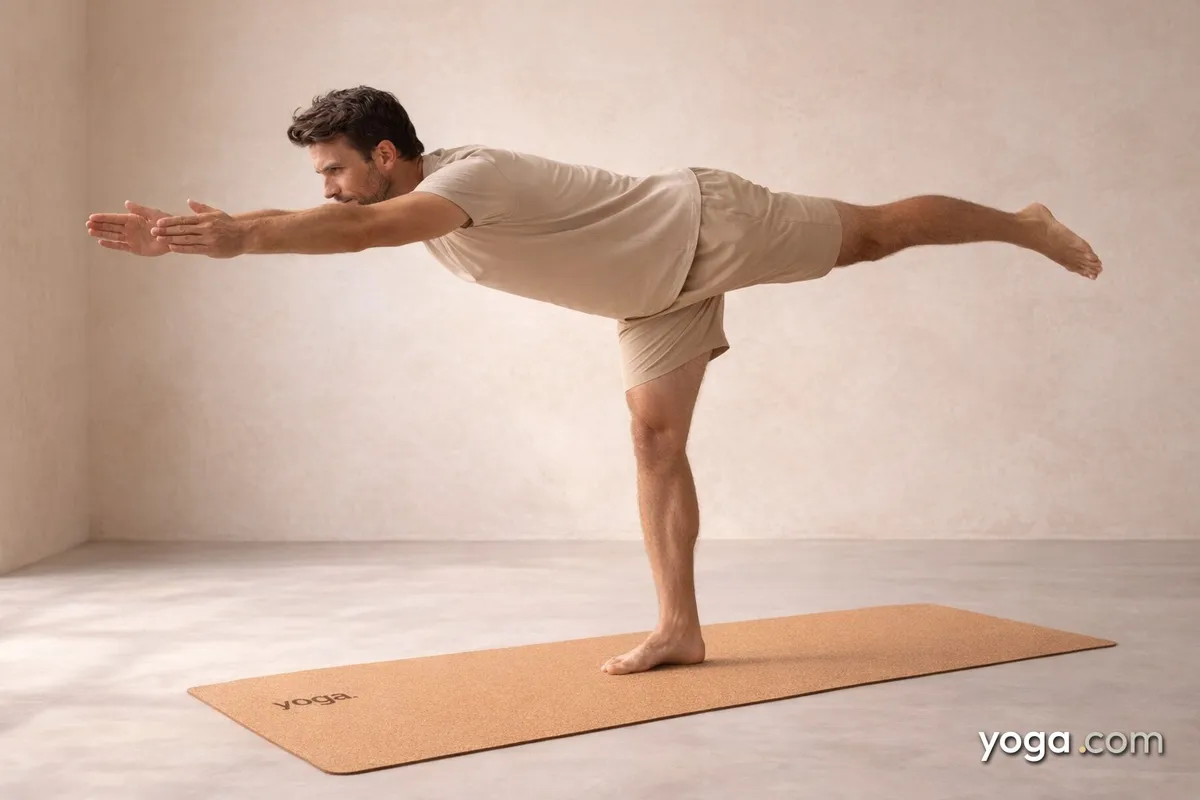
Warrior III on the left foot is a standing one-legged balance that challenges the whole body to work as a single, integrated unit. Its Sanskrit name, Vīrabhadrāsana III (left support), translates roughly as "the pose of the fierce warrior Vīrabhadra, standing on the left leg" - the left foot is your sole point of contact with the earth while the right leg and both arms extend horizontally. It appears naturally in standing sequences, often following Warrior I or Warrior II on the same side, and serves as a gateway to more demanding one-legged postures.
At a Glance
- Level: Intermediate
- Type: Balance
- Targets: Left leg and hip stabilizers, posterior chain (hamstrings and glutes), core, shoulders
- Good for: Building single-leg stability, strengthening the posterior chain, improving proprioception
How to Do Warrior Pose on Left Foot
- Start in Mountain Pose. Stand at the top of your mat with feet hip-width apart. Take a few breaths to ground through both feet and lengthen your spine.
- Shift your weight onto your left foot. Press all four corners of the left foot evenly into the mat. Engage your left quadriceps and draw the left hip slightly back to centre it over the ankle.
- Hinge at the hips. On an exhale, begin to tip your torso forward from the hip crease - not the waist - keeping your spine long. As your torso descends, let your right leg rise behind you at the same rate, so the body forms one straight line from the right heel to the crown of the head.
- Extend your arms. Reach both arms forward alongside your ears, palms facing each other, to create a continuous line from fingertips to right heel. Keep your shoulders drawing away from your ears.
- Level your hips. The right hip naturally wants to open toward the ceiling. Internally rotate the right leg slightly - right toes point straight down - and draw the right hip toward the floor until both hip points face the mat.
- Find your gaze. Look at a fixed point on the floor about a metre in front of your standing foot. A steady drishti (gaze point) directly supports your balance.
- Breathe and hold. Stay for five to eight slow breaths. Keep the left knee tracking over the second toe - avoid locking or hyper-extending it. Your standing foot is your anchor; press down to lift up.
- Come out with control. On an inhale, slowly lower the right foot back to the mat beside the left, returning to Mountain Pose. Pause for two breaths before switching sides.
Benefits
- Strengthens the left gluteus medius and minimus, improving lateral hip stability
- Builds isometric strength in the hamstrings and glutes of both legs
- Engages the deep core (transversus abdominis and erector spinae) to maintain a neutral spine under load
- Develops proprioception and neuromuscular coordination in the left ankle and foot
- Stretches the right hip flexors as the right leg extends fully behind you
- Builds scapular stability and shoulder endurance through sustained arm extension
Common Mistakes and Alignment Cues
- Mistake: The right hip hikes up. Cue: Rotate the right inner thigh toward the ceiling and actively draw the right hip toward the floor; imagine both hip bones shining straight down at the mat.
- Mistake: The standing knee locks or collapses inward. Cue: Maintain a micro-bend in the left knee and press the knee gently outward, tracking it over the second toe.
- Mistake: The torso drops below the lifted leg. Cue: Keep your body in one long, level plank-like line - use a mirror or a teacher's eye to check that heel, hips, and crown are at the same height.
- Mistake: Arms sag or shrug toward the ears. Cue: Firm the shoulder blades onto the back ribs, reach through the fingertips, and create length rather than tension in the neck.
- Mistake: Breath becomes shallow or stops. Cue: A held breath signals gripping; soften your jaw, relax the face, and let the exhale be as full as the inhale.
Modifications and Props
- Hands to a wall: Face a wall at arm's length. Press fingertips lightly against it as you hinge and lift the right leg. The wall provides just enough feedback to let you focus on hip and leg alignment without fighting for balance.
- Blocks under the hands: Place two blocks at their tallest height beneath your hands on the floor. This shortens the range of the forward fold and gives you a stable base, making it easier to keep the spine long.
- Arms alongside the body: Instead of reaching arms forward, bring hands to the hips or extend arms back alongside the torso ("airplane arms"). This lowers the center of gravity and reduces the balance demand.
- Chair support: Rest both hands on the back of a sturdy chair in front of you. Hinge forward, lift the right leg, and use the chair to practise the hip-squaring action before working toward freestanding balance.
Cautions
- Ankle instability or recent ankle sprain: Work with wall support or a chair until the ankle is strong enough to manage the single-leg load.
- Knee pain or ligament issues in the standing leg: Keep a soft bend in the left knee and avoid any posture that creates sharp or twisting sensations in the joint.
- Hip labral concerns: Be conservative with the range of hip flexion and avoid forcing the torso below parallel.
- Pregnancy (second and third trimester): A widened stance, wall support, and reduced hold time are advisable as balance and centre of gravity shift.
If you're working with an injury or a medical condition, check with a qualified professional before practicing.
Related Poses
- Mountain Pose - the grounding starting point and reset between balance postures
- Downward-Facing Dog Pose - a preparation that lengthens the hamstrings and warms up the posterior chain
- Tree Pose on Right Foot - a complementary single-leg balance on the opposite foot, good for building the same stability skills
- Lord of the Dance Pose (Left) - the natural next progression, deepening the single-leg balance with a backbend component
If you're looking to weave balance work into a broader practice, see A Gentle Yoga Routine for Tired, Low-Energy Days or try A 10-Move Chair Yoga Sequence for a Midday Reset for an accessible standing practice you can do anywhere.