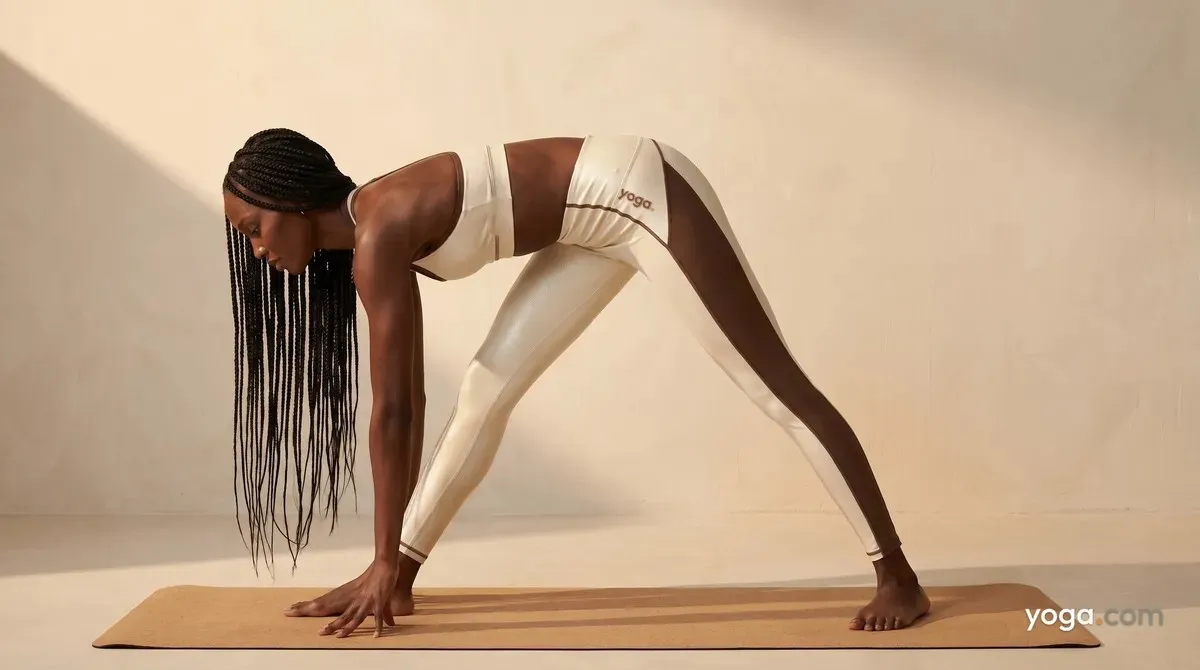
Standing Bend to Left Leg - Pārśvottānāsana ("intense side stretch pose"), directed toward the left leg - brings the torso into a deep sagittal forward fold over a single leg while you remain upright on both feet. The asymmetry trains each side of the posterior chain independently, making it a precise tool for improving forward-fold depth and hamstring flexibility.
At a Glance
- Level: Beginner
- Type: Forward Bend
- Targets: Left hamstrings, left calf, lumbar erectors, thoracic spine
- Good for: Improving forward-fold depth and hamstring flexibility, building body-side awareness, preparing for deeper single-leg forward folds
How to Do Standing Bend to Left Leg
- Begin in Mountain Pose, feet hip-width apart, spine long, weight even across both feet.
- Step your left foot forward roughly 12-18 inches so it sits clearly in front of your right foot. Your left toes point straight ahead; your right foot stays grounded and can angle out slightly for stability.
- Square your hips to face directly over the left leg. Draw your right hip gently forward and your left hip slightly back until both hip points face the same direction as your left toes.
- On an inhale, lengthen your spine - crown of the head reaching up, tailbone reaching back.
- On an exhale, hinge at the hips (not the waist) and begin to fold your torso forward and down over the left leg. Keep the spine as long as possible rather than rounding immediately.
- Let your hands travel down - to your shin, ankle, or the floor on either side of your left foot - stopping wherever you can maintain a neutral lower back. If the floor is out of reach, rest both palms on your left shin.
- With each inhale, create a little more length from tailbone to crown; with each exhale, soften deeper into the fold. Keep your left knee tracking over the second toe - avoid locking or hyperextending it. Your right leg remains active, micro-bent if needed, pressing firmly into the floor.
- Hold 5-8 breaths, allowing the left hamstring and calf to release gradually.
- To come out: On an inhale, engage your core, place your hands on your hips, and slowly rise back to upright by leading with the chest. Step your left foot back alongside the right and return to Mountain Pose. Pause for two breaths before practicing the right-side equivalent.
Benefits
- Lengthens the left hamstring group - sustained passive tension in the fold increases functional range of motion in knee flexion and hip extension.
- Decompresses the lumbar spine - gravity-assisted traction in the fold creates space between lumbar vertebrae when the pelvis tilts freely.
- Strengthens the right leg and ankle - the standing right leg works isometrically to stabilize the asymmetrical load throughout the hold.
- Trains hip-hinge mechanics - folding over a single leg with squared hips reinforces the posterior pelvic tilt pattern essential for safe forward bending in many poses.
- Builds body-side proprioception - working one leg at a time highlights flexibility and strength differences between sides, supporting more balanced practice overall.
Common Mistakes and Alignment Cues
- Mistake: Rotating the hips so they open away from the left leg. Cue: Before you fold, draw the right hip actively forward until both hip points face the same direction as your left toes. Re-check this square position halfway through the hold.
- Mistake: Rounding the lower back immediately instead of hinging at the hip. Cue: Think "chest toward the left shin" rather than "head toward the knee." Prioritize a long spine over reaching your hands lower.
- Mistake: Locking or hyperextending the left knee. Cue: Maintain a micro-bend in the left knee, engage the left quadriceps gently, and keep the kneecap lifting without snapping the joint back.
- Mistake: Letting the right foot lift or roll to the outer edge. Cue: Press all four corners of the right foot evenly into the mat throughout the pose. If balance is difficult, widen the stance slightly side to side.
- Mistake: Holding the breath and gripping the neck. Cue: Keep the jaw soft, let the crown of the head hang heavy, and use each exhale as the signal to release deeper rather than forcing with muscle.
Modifications and Props
- Tight hamstrings: Place a yoga block on its highest setting just inside your left foot and rest both hands on the block. This raises the floor to meet you so you can maintain a neutral spine.
- Balance challenge: Perform the pose with your back heel against a wall, or stand beside a chair and rest one hand on the seat back for support.
- Deeper fold: Once the spine is long and the hips are square, slide your hands beneath the left foot - fingers under the sole, toes resting on the wrist creases - for the classical Pārśvottānāsana hand position.
- Pregnancy or sensitive lower back: Keep a generous bend in both knees and use blocks at the highest height; fold only until you feel the first sensation of stretch, not beyond.
Cautions
- Avoid forcing the fold if you feel sharp pulling behind the left knee - back off until the sensation becomes a mild, even stretch.
- Take care if you have a recent hamstring strain, sciatic nerve irritation, or disc injury in the lumbar spine; keep the fold shallow and the knee generously bent.
- Dizziness can occur when rising from a deep fold - come up slowly and pause in a neutral standing position before moving on.
- If you're working with an injury or a medical condition, check with a qualified professional before practicing.
Related Poses
- Standing Forward Bend - the bilateral foundation this pose builds from
- Bend to Left Leg - the seated counterpart targeting the same left-side posterior chain
- Intense Left Stretch with Hands Behind Back in Namaste - deepens the left-leg forward fold with a shoulder-opening arm variation
- Seated Forward Bend - reinforces the same hip-hinge mechanics in a supported, gravity-reduced position