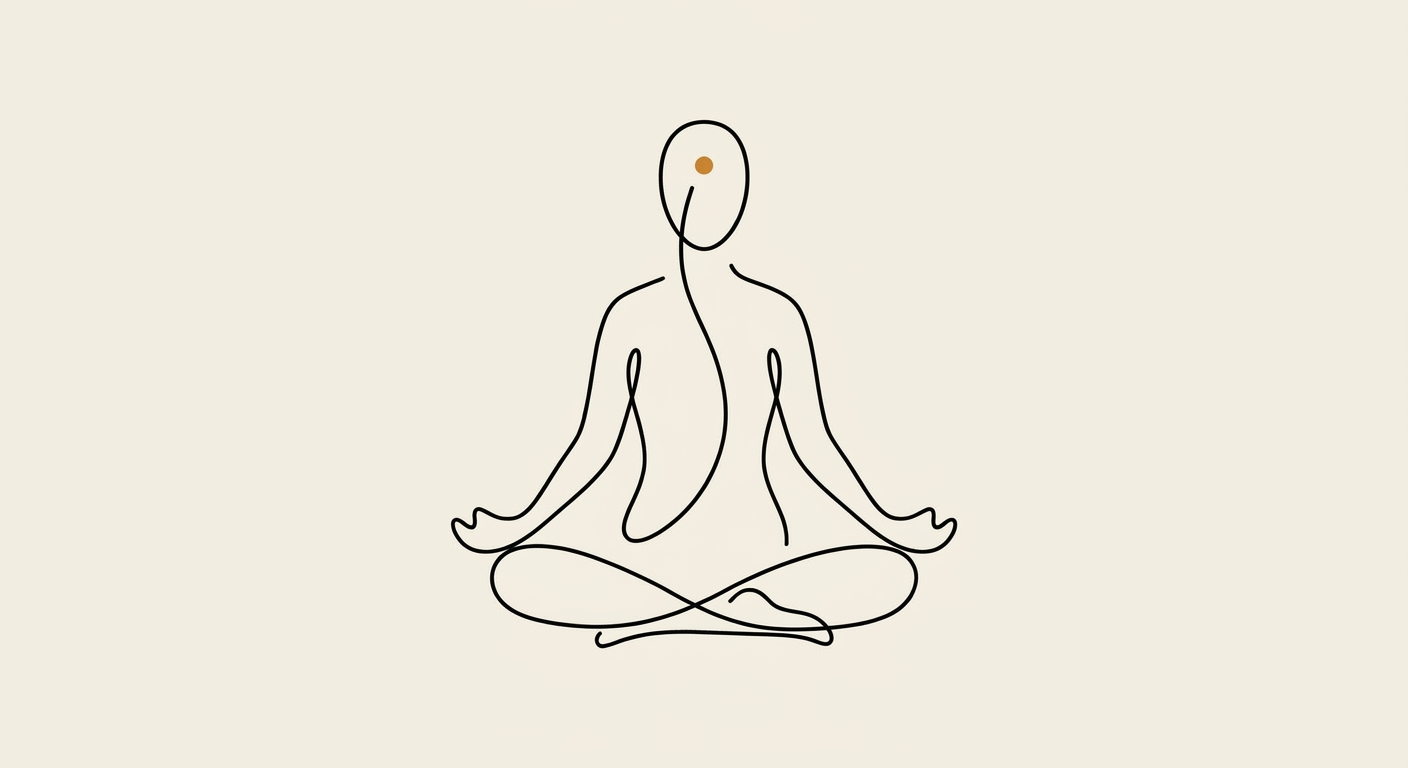
Half Lotus Pose with Right Leg Up, Ardha Padmāsana (right leg up) - from Sanskrit ardha (half), padma (lotus), and āsana (seat) - places the right foot high onto the left thigh while the left leg rests in a simple cross-legged position. This is the right-leg-up variant, which rotates the right hip externally and asks specific demands of the right knee and ankle distinct from its mirror image. It belongs naturally in seated pranayama or meditation sequences and serves as an accessible bridge between Easy Pose and full Lotus.
At a Glance
- Level: Intermediate
- Type: Seated
- Targets: Right hip external rotators, inner groins (both sides), right ankle, lumbar spine
- Good for: Building external hip rotation, developing upright seated posture, preparing the hips for full Lotus
How to Do Half Lotus Pose with Right Leg Up
- Sit on your mat in a simple cross-legged position. Place a folded blanket under your sitting bones if your pelvis tips backward and your lower back rounds.
- Root both sitting bones evenly into the support beneath you and lengthen up through the crown of your head to establish a neutral lumbar curve.
- Bring your left shin parallel to the front edge of your mat, foot beneath the right knee - this is the base leg; let it settle without forcing.
- Hold your right foot with both hands: cradle the heel in your left palm and support the top of the foot with your right hand. Move slowly - the rotation happens at the hip, not the knee.
- Externally rotate the right thigh so the right knee draws outward and downward, then lay the outer edge of the right foot as high as comfortable on the left thigh, sole facing upward. The right heel should rest near the left hip crease.
- Allow the right knee to release toward the floor gradually; never press the knee down with your hand. If it hovers well above the left thigh, that is fine - stay there.
- Rest your hands on your knees, palms down for a grounding quality or palms up for an open quality. Soften the face, draw the shoulder blades gently back, and gaze softly forward or close the eyes.
- To come out, release the right foot with both hands, return the right leg to a simple cross-legged seat, and take several breaths before switching sides or moving on.
Benefits
- Stretches the right hip external rotators, including piriformis and the deep six rotators.
- Lengthens the inner groin and adductors of both legs.
- Increases dorsiflexion and plantar-flexion range in the right ankle over time.
- Strengthens the muscles supporting an upright spine when held in a sustained seated position.
- Conditions the hip joints for the fuller external rotation required in Lotus Pose.
- Encourages diaphragmatic breathing by allowing the lower abdomen to remain soft and uncompressed.
Common Mistakes and Alignment Cues
- Forcing the right knee down: Pressing the knee toward the floor strains the medial structures of the knee. Let gravity do the work; your knee will descend over weeks of consistent practice.
- Foot placed too low on the thigh: If the foot rests near the inner knee rather than the hip crease, it creates a torque angle at the knee. Aim to position the right heel as close to the left hip crease as your range allows.
- Posterior pelvic tilt and rounding lower back: If you feel your pelvis tucking under, sit higher on a folded blanket so the hips are level with or above the knees, allowing the lumbar spine to find its natural curve.
- Collapsing through the chest: Watch for the ribcage sinking and the chin jutting forward. Stack the ribcage over the pelvis and draw the lower front ribs gently in.
- Holding the breath: Gripping in the hips often triggers breath-holding. Consciously soften the jaw and exhale fully to encourage the hip rotators to release.
Modifications and Props
- Blanket under sitting bones: Folding one or two firm blankets under the pelvis tilts it slightly forward, reducing strain on the lower back and making it easier to keep the spine upright.
- Block under the right knee: If the right knee sits high off the floor, slide a yoga block or folded blanket beneath it. This reduces the lever arm on the knee and lets you hold the pose longer without discomfort.
- Foot lower on the thigh: Place the right foot on the left calf or inner thigh rather than the upper thigh if the hip is not yet open enough to bring the foot higher without stressing the knee - think of it as a quarter-lotus position.
- Seated on a chair: Sit toward the front edge of a firm chair. Cross the right ankle over the left knee (figure-four position) to work the same external rotation without any load on the knees from the floor-based version.
Cautions
- Knee discomfort or injury: Any sharp or acute pain in the right knee is a signal to come out. The rotation for this pose originates at the hip; if the hip lacks the range, the stress transfers to the knee.
- Hip injury or recent hip surgery: Deep external rotation may be contraindicated. Work with a modification or avoid the pose until cleared.
- Ankle sprains or ligament laxity: The weight of the thigh rests across the ankle and foot. If you have an unstable or recently sprained ankle, use the chair modification or skip the pose.
- Sacroiliac joint sensitivity: Asymmetrical hip-opening poses can aggravate the SI joint if the pelvis is not supported and level. Use a blanket and take the pose slowly.
If you're working with an injury or a medical condition, check with a qualified professional before practicing.
Related Poses
- Bound Angle Pose - a foundational hip opener that prepares the inner groins and external rotators for Half Lotus.
- Cow Face Pose (Left Leg and Right Arm Up) - a deeper hip-stacking pose in the same family, offering a natural progression.
- Lotus Pose - the full expression this pose builds toward; practice Half Lotus symmetrically on both sides first.
- Corpse Pose - an ideal counter-pose after sustained seated work, allowing the hips and lower back to fully release.
For practice context, see A Gentle Yoga Routine for Tired, Low-Energy Days and A 10-Move Chair Yoga Sequence for a Midday Reset.