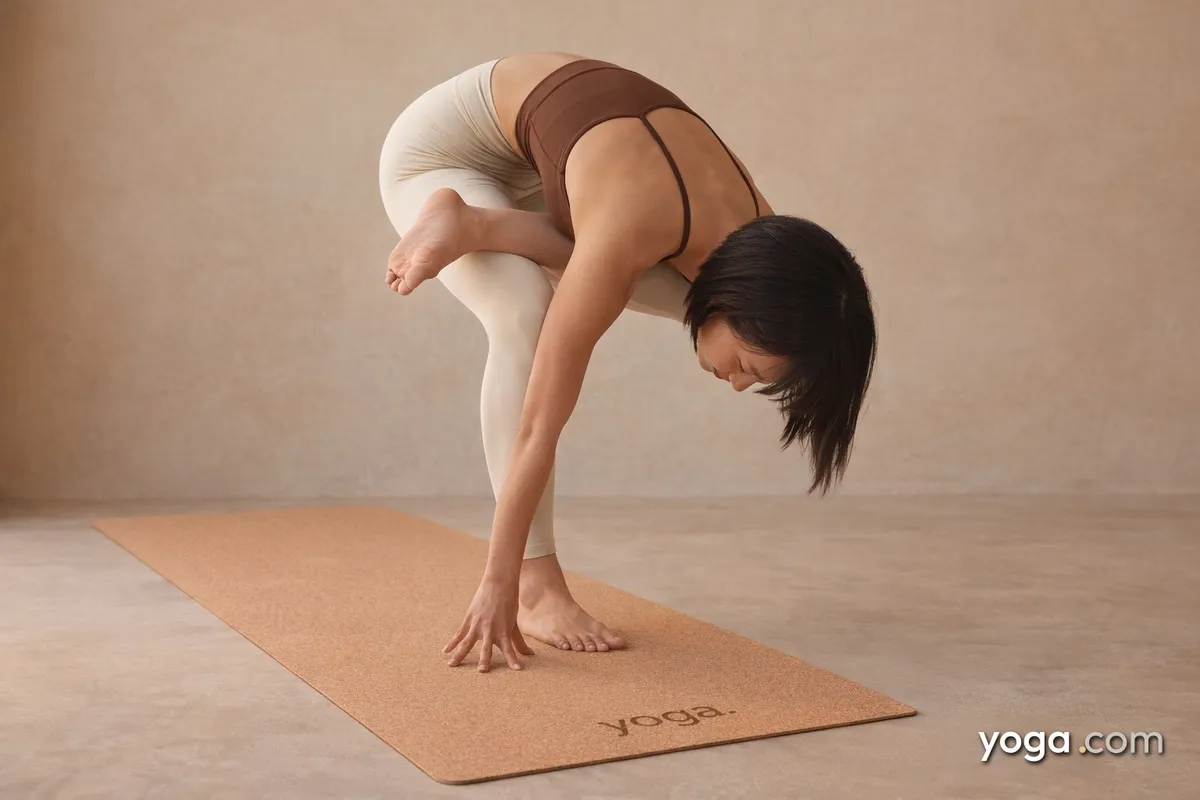
Right Half Bound Lotus Intense Stretch Pose is a standing forward fold that combines a half-lotus hip opener with a bound arm position, creating simultaneous demands on balance, hip mobility, and spinal length. Its Sanskrit name is Ardha Baddha Padmottānāsana (right side) - ardha meaning half, baddha bound, padma lotus, and uttānāsana intense stretch pose. It typically appears in the standing sequence of an Ashtanga Primary Series practice or as a peak pose in mixed-level Vinyasa classes.
At a Glance
- Level: Advanced
- Type: Forward Bend
- Targets: Right hip external rotators, left hamstrings and calf, thoracic spine, shoulder girdle
- Good for: Building single-leg balance, lengthening the standing-leg posterior chain, developing shoulder and hip mobility simultaneously
How to Do Right Half Bound Lotus Intense Stretch Pose
- Begin in Mountain Pose. Ground through all four corners of your left foot and draw the lower belly lightly inward to stabilize your pelvis.
- Bend your right knee and lift the right foot, cradling it with both hands. Draw the right heel toward the left hip crease, externally rotating the hip until the right foot rests high on the left thigh in half-lotus position. Keep the right foot actively flexed to protect the knee.
- Once the lotus foot is settled, inhale and reach your right arm behind your back. Wrap the right hand to catch the right big toe (or the outer edge of the right foot). If the bind is not accessible, keep the right hand on your lower back for now.
- Extend your left arm forward and up to lengthen the spine. On an exhale, hinge from the left hip - not the waist - folding the torso toward the left thigh. Keep both hip points squared forward throughout the descent.
- If you can fold fully, place the left fingertips or palm flat on the floor beside the left foot. Gaze is directed downward toward the toes - drishti at the toes.
- Hold for five to eight slow breaths. Press the left foot evenly into the floor, micro-bend the standing knee to avoid locking, and continue lengthening the crown of the head toward the floor on each exhale.
- To come out: inhale, press the left foot down, and slowly rise back to standing with a long spine before releasing the bind.
- Release the right foot carefully, shake out both legs, and repeat on the left side when ready.
Benefits
- Stretches the hamstrings and calf of the standing (left) leg through a deep forward fold.
- Opens the external rotators and hip flexors of the right hip via the half-lotus position.
- Strengthens the intrinsic muscles of the standing foot, ankle, and lower leg to maintain single-leg balance.
- Mobilizes the shoulder joint and stretches the anterior shoulder of the bound arm.
- Lengthens the thoracic and lumbar spine under axial traction created by folding with one arm bound.
- Builds proprioceptive awareness and concentration required for complex asymmetrical balance.
Common Mistakes and Alignment Cues
- Forcing the lotus before the hip is ready: If you feel pressure in the right knee rather than a sensation in the outer hip, back off - place the right foot lower on the thigh or work a modified version until external rotation improves.
- Collapsing the standing-leg knee inward: Press the left big toe mound firmly into the mat and lightly engage the left quadriceps to keep the kneecap tracking over the second toe.
- Rounding the lower back to reach the floor: Prioritize a long, neutral spine over depth; use a block under the left hand so the pelvis can tip forward rather than the lumbar spine rounding.
- Twisting the torso toward the bound side: Draw both shoulders level and keep the left shoulder stacked over the left hip throughout the fold.
- Holding the breath during the bind: Slow, even breathing keeps the nervous system settled; if you are gripping or straining to hold the bind, use a strap looped around the right foot instead.
Modifications and Props
- Block under the standing hand: Place a block at its highest height beside the left foot so the left hand has support, allowing the spine to lengthen rather than collapse.
- Strap for the bind: Loop a strap around the right foot before you fold. Hold the free end of the strap behind your back with the right hand - this maintains the shoulder opening without straining the rotator cuff.
- Wall for balance: Stand facing a wall and rest the left fingertips lightly on it. This lets you focus on building the lotus and bind without fighting for balance.
- Tree Pose variation: If the full lotus is not yet accessible, rest the right foot against the inner left calf (above the ankle, below the knee) and practice the forward fold from there to build the hip and hamstring work independently.
Cautions
- Knee discomfort in the lotus leg: Any sharp or pinching sensation in the right knee means the hip does not yet have enough external rotation for this position - do not push through it.
- Standing knee hyperextension: Keep a subtle micro-bend in the left knee throughout; locking the joint shifts load onto ligaments rather than muscle.
- Recent or chronic hamstring strain: Approach the forward fold cautiously, keeping the standing knee bent and limiting range of motion until the tissue is fully recovered.
- Shoulder or rotator cuff issues: The behind-the-back bind can stress an unstable or injured shoulder; use a strap or skip the bind entirely and keep the hand on the lower back.
If you're working with an injury or a medical condition, check with a qualified professional before practicing.
Related Poses
- Standing Forward Bend - foundational preparation for the standing-leg fold
- Left Half Bound Lotus Intense Stretch Pose - the balancing opposite-side variation to practice in the same session
- Seated Forward Bend - a floor-based alternative that builds hamstring length without the balance demand
- Intense Left Stretch with Hands Behind Back in Namaste - shares the standing forward fold structure with a different arm position, useful as a shoulder-opening preparation
For gentler practice on lower-energy days, see A Gentle Yoga Routine for Tired, Low-Energy Days. If you work at a desk, A 10-Move Chair Yoga Sequence for a Midday Reset offers accessible hip and hamstring work you can do between meetings.