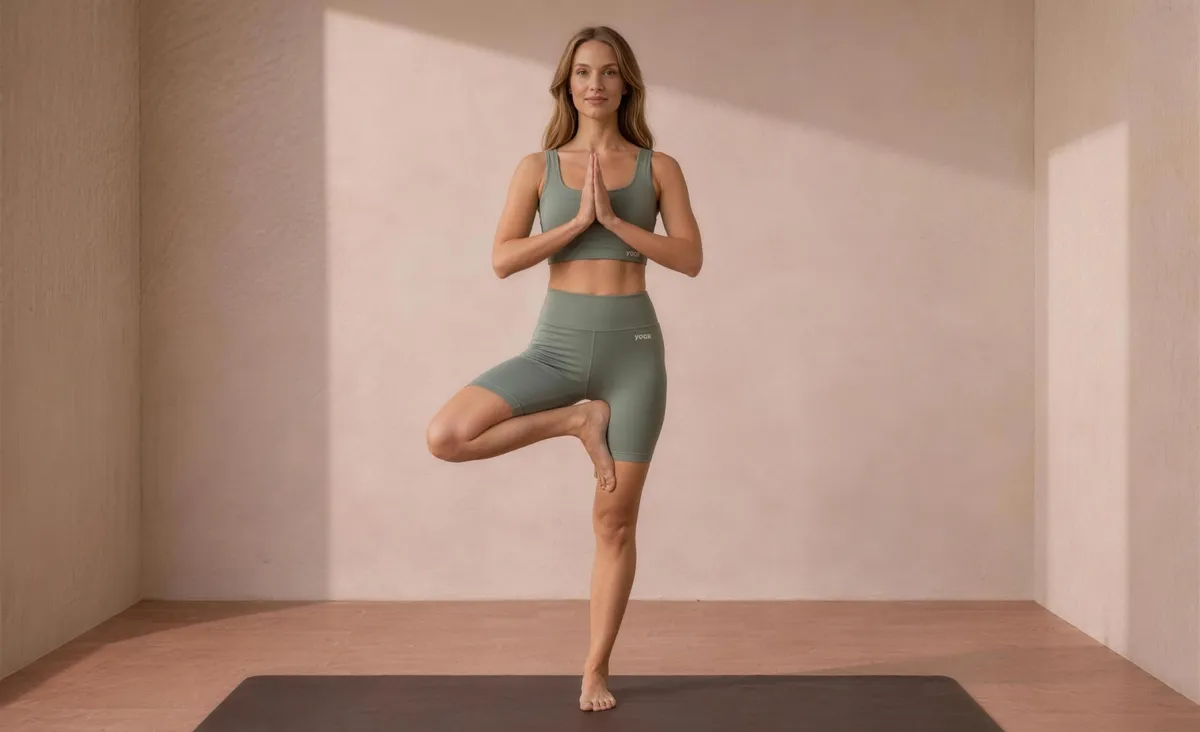
Dancing Shiva Balance, Right Leg Crossed is a standing balance that places the right foot on top of the left knee while the arms extend in one of several classical hand-gesture positions. Its Sanskrit name, Naṭarājāsana (right foot on left knee), translates literally as "pose of Naṭarāja" - the dancing form of the god Shiva - with this variation specifying the right leg as the lifted limb. It typically appears in the middle of a standing sequence, after the hips and ankles are warm, as a focused test of single-leg stability and hip mobility.
At a Glance
- Level: Intermediate
- Type: Balance
- Targets: Standing left leg (ankle, knee, and hip stabilizers), right hip external rotators, inner right thigh (adductors), core
- Good for: Building single-leg stability, improving hip external rotation on the right side, developing concentration and postural control
How to Do Dancing Shiva Balance, Right Leg Crossed
- Begin in Mountain Pose, feet hip-width apart, arms at your sides. Distribute your weight evenly across all four corners of both feet and draw the lower belly gently inward.
- Shift your weight onto your left foot. Press the left big-toe mound and outer heel firmly into the mat to stabilize the arch. Micro-bend the left knee so it tracks directly over the second toe.
- Lift your right knee toward your chest, then externally rotate the right hip so the right knee points out to the right side. Place the sole of the right foot - not the ankle - squarely on top of the left knee, toes pointing forward and slightly down.
- Press the right foot gently downward into the left knee and resist with the left quadriceps pressing upward; this mutual engagement steadies both the lifted leg and the standing leg. Avoid letting the left knee collapse inward.
- Bring your hands to a position of your choice: palms pressed at the heart in Añjali Mudrā, arms extended to the sides at shoulder height, or one arm raised and one arm lowered in a classical Naṭarāja hand gesture. Lengthen through the crown of the head.
- Fix your gaze (dṛṣṭi) on a single unmoving point at eye level to support balance. Breathe steadily for 5-8 full breaths, keeping the outer left hip firm and the right knee drawing back to deepen the external rotation.
- To come out, lower the right foot back to the floor with control, return briefly to Mountain Pose, and observe any difference between the two sides before practicing the left-foot variation.
Benefits
- Strengthens the ankle, knee, and hip stabilizers of the left (standing) leg.
- Stretches the right hip external rotators, including the piriformis and deep lateral rotator group.
- Lengthens the inner right thigh (adductors) as the right knee opens to the side.
- Activates the deep core muscles needed to maintain an upright pelvis on one leg.
- Trains proprioception and single-leg balance, which carry over to transitions throughout a standing practice.
Common Mistakes and Alignment Cues
- Left knee collapsing inward: Press the left big-toe mound down and engage the left outer hip to keep the knee tracking over the second toe.
- Right foot resting on the ankle joint instead of the knee: Slide the foot up until the sole rests on the meaty top of the left knee - placing weight directly on the ankle joint strains the ligaments.
- Hips tilting to the right: Draw the right hip actively down and level with the left; think of keeping both hip points at the same height.
- Gripping the toes of the standing foot: Soften the toes and spread them wide; gripping indicates the ankle stabilizers are not yet engaged.
- Gazing downward: Keep the gaze level at a fixed point - looking down shifts weight forward and destabilizes the standing leg.
Modifications and Props
- Wall support: Stand an arm's length from a wall and rest the fingertips of one hand lightly on it while you build confidence in the balance.
- Yoga block under the standing heel: If the left heel lifts, place a folded blanket or thin block under it to keep the foot fully grounded.
- Lower foot placement: If placing the right foot on the knee feels too intense for the right hip, rest the right foot on the lower left shin instead, keeping the foot off the ankle joint.
- Chair-assisted version: Sit on the front edge of a chair, plant the left foot firmly, and rest the right ankle just above the left knee for a seated variation that trains the same hip rotation without the balance demand.
Cautions
- Knee discomfort in the standing leg: If the left knee feels unstable or painful, come out of the pose; avoid locking or hyperextending the joint.
- Right knee or hip injury: Forcing the right knee outward with an unhappy hip or recovering knee can strain the joint capsule - work within a pain-free range only.
- Ankle instability: Those with recent ankle sprains on the standing side should use wall support or skip this pose until the ankle is fully rehabilitated.
- Pregnancy (second and third trimester): Single-leg balance poses require extra caution as the center of gravity shifts - use wall support and reduce hold time.
- If you're working with an injury or a medical condition, check with a qualified professional before practicing.
Related Poses
- Tree Pose on Right Foot - a foundational preparation that introduces the same right-foot placement and standing-left-leg stability.
- Eagle Pose (Right) - another intermediate standing balance that trains single-leg focus and hip-joint awareness.
- Lord of the Dance Pose (Left) - the complementary side and a natural next step for balancing the body after practicing the right-foot variation.
- Standing Lord of Dance Pose with Right Foot Near the Head - the advanced progression, requiring significantly greater hip flexibility and balance than this pose.
For accessible sequences that build the standing-leg strength this pose demands, see A Gentle Yoga Routine for Tired, Low-Energy Days and A 10-Move Chair Yoga Sequence for a Midday Reset.