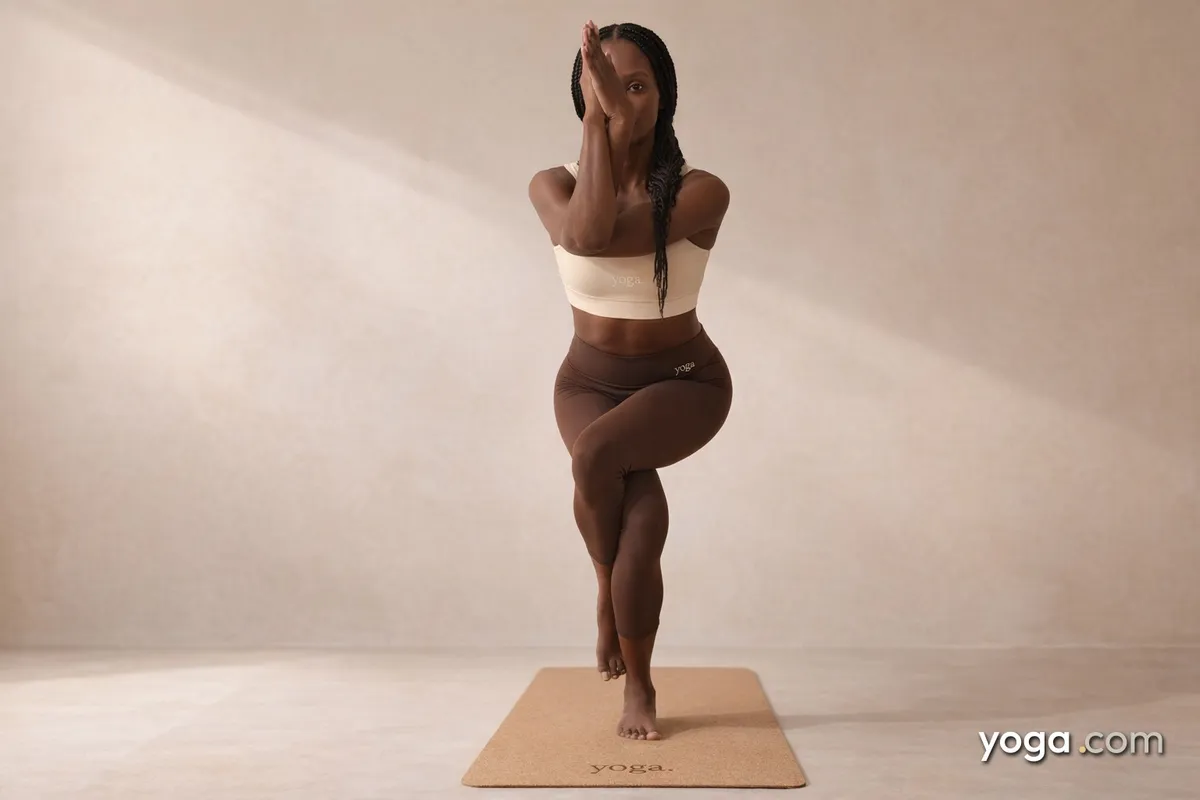
Eagle Pose (Garuḍāsana (right side) - named for Garuḍa, the mythic eagle and vehicle of Vishnu) is a standing balance that wraps both arms and legs into a single, spiraling shape. On this right-side variation, your right leg crosses over and hooks behind the left calf while your right arm threads under the left to bind at the hands. It works well in the middle of a standing sequence, after the hips and shoulders have had a chance to warm up.
At a Glance
- Level: Intermediate
- Type: Balance
- Targets: Hips (external and internal rotators), shoulders and upper back, ankles, quadriceps
- Good for: Single-leg balance and focus, hip-joint mobility, scapular stability
How to Do Eagle Pose (Right)
- Begin in Mountain Pose, feet hip-width apart, arms at your sides. Settle your weight evenly through both feet and lengthen the crown of your head toward the ceiling.
- Bend both knees slightly, as if sitting back into a low chair. Keep your spine long and your chest lifted - this squat is the foundation of the pose.
- Shift your weight into your left foot. Lift your right leg, cross your right thigh high over the left thigh, and point your right knee forward. If you can, hook the top of your right foot behind the left calf; if not, press the right toes against the left shin.
- Extend both arms forward at shoulder height, parallel to the floor. Swing the right arm under the left so that the right elbow rests in the crook of the left elbow.
- Bend both elbows and wrap the forearms around each other, bringing the palms to face each other. Press the palms together (or as close as they come) and lift the elbows to shoulder height. Draw the shoulders away from your ears.
- Fix your gaze on a still point at eye level. Breathe steadily, grounding down through the left foot and lifting through the wrapped arms. Hold for 5-10 breaths.
- To come out, inhale and unwind the arms, then step the right foot back to the floor. Straighten both legs and return to Mountain Pose. Pause for a breath before moving to the left-side version.
Benefits
- Strengthens the quadriceps, glutes, and ankle stabilizers of the standing (left) leg.
- Stretches the outer hip and gluteal muscles of the crossed (right) leg.
- Mobilizes the shoulder joints and stretches the muscles of the upper back and posterior deltoids.
- Trains single-leg balance and proprioception through the ankle and foot.
- Builds isometric strength in the core as it works to maintain an upright spine under the asymmetric load.
Common Mistakes and Alignment Cues
- Mistake: Letting the standing knee collapse inward. Cue: Press the standing (left) knee out over the second toe and keep a firm press through the outer edge of that foot.
- Mistake: Rounding the upper back as the arms wrap. Cue: After you bind the hands, actively lift the elbows and draw the shoulder blades apart - think of spreading the back ribs wide.
- Mistake: Tilting the torso forward to compensate for a shallow squat. Cue: Sit the hips back and down rather than tipping the chest down; keep the spine as vertical as you can.
- Mistake: Gripping the floor with the standing toes (a sign of balance panic). Cue: Spread all ten toes before you cross the legs and keep them relaxed; let the ankle do the stabilizing work.
- Mistake: Losing the wrap of the right foot behind the calf. Cue: Cross the right thigh as high over the left as possible first; the hook usually follows once the thighs are fully crossed.
Modifications and Props
- Foot to floor: Instead of hooking the right foot behind the calf, rest the right toes lightly on the floor beside the left foot for extra stability while you build balance.
- Wall support: Stand with your left shoulder a few inches from a wall. Touch the wall with your left shoulder if needed - this gives proprioceptive feedback without fully removing the balance challenge.
- Arms only: If the shoulder wrap is inaccessible, press the backs of the hands together instead of the palms, or simply cross the arms and hold opposite shoulders in a self-hug.
- Block under the standing foot: Placing the heel of the standing foot on a folded blanket or low block can make the squat more comfortable if the ankle is stiff.
Cautions
- Knee concerns: The deep bend and rotational forces on the standing knee can aggravate existing knee issues. Keep the standing knee tracking over the second toe and reduce the depth of the squat as needed.
- Ankle instability: Recent ankle sprains or chronic instability may make single-leg balance unsafe without support; use a wall or keep the toes of the raised foot on the floor.
- Shoulder or elbow pain: If the arm wrap creates sharp or pinching sensations in the shoulder joint, work with the self-hug modification instead of forcing the bind.
- Balance disorders or vertigo: Practice near a wall and keep your gaze particularly steady at a fixed point at eye level.
- If you're working with an injury or a medical condition, check with a qualified professional before practicing.
Related Poses
- Mountain Pose - the neutral starting and finishing point for all standing balance poses.
- Tree Pose with Right Foot in Front of Thigh - a gentler single-leg balance that prepares the standing ankle and hip for Eagle.
- Tree Pose on Right Foot - a direct preparation: same standing leg, simpler arm position.
- Lord of the Dance Pose (Left) - a logical next progression in balance intensity from the same standing-balance family.
Looking for a practice context? Eagle fits naturally into the sequences explored in A Gentle Yoga Routine for Tired, Low-Energy Days and A 10-Move Chair Yoga Sequence for a Midday Reset.