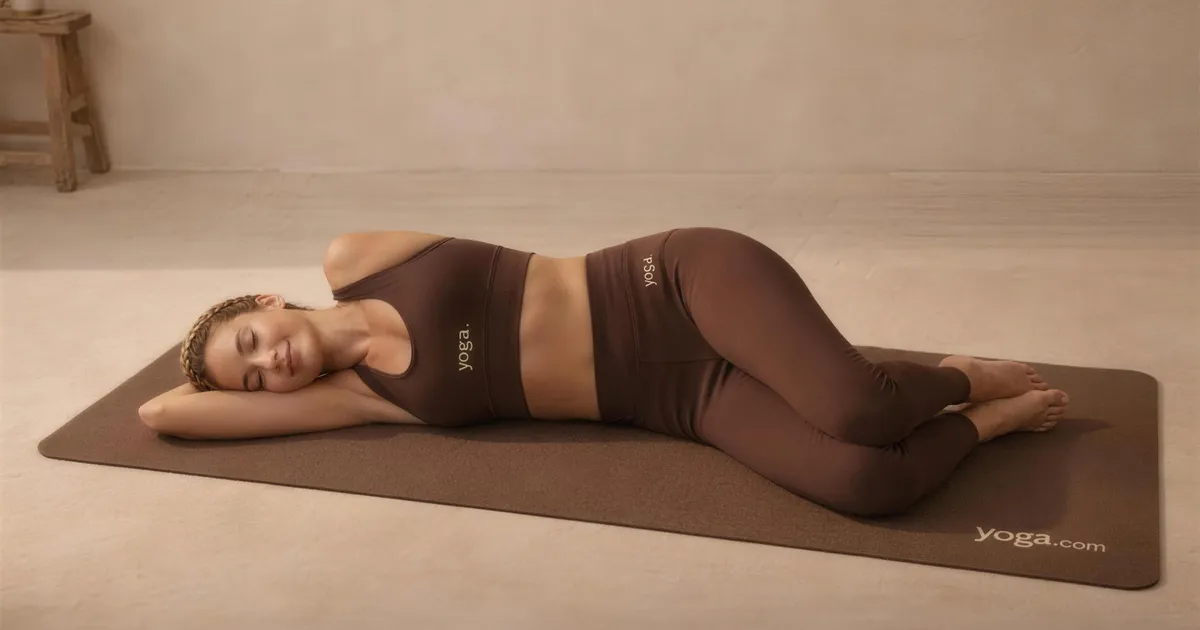
Reclining Crocodile Twist, Right Side - Jaṭhara Parivartanāsana variant - is the simplest introduction to prone spinal twisting. Starting face-down, you roll the entire body onto the right side, letting gravity decompress the lumbar vertebrae while the left ribs lift freely into the breath. The crocodile imagery comes from the Sanskrit nakra (crocodile) and describes the reptile's unhurried roll in shallow water: deliberate, grounded, and complete.
At a Glance
- Level: Beginner
- Type: Prone twist, passive
- Targets: Lumbar spine (right rotation), thoracic spine, left intercostals and left lateral ribcage, right hip flexors, abdominal obliques
- Good for: Spinal mobility warm-up or cool-down, breath awareness, releasing tension in the lower back after active prone backbends
How to Do Reclining Crocodile Twist, Right Side
Coming into the pose
- Start prone. Lie face-down with your legs extended, feet roughly hip-width apart, and the tops of your feet on the mat. Let your forehead rest on the mat or on stacked hands for a moment to settle.
- Clear the right arm. Before you roll, sweep your right arm forward overhead along the mat so it extends past the crown of your head - palm down, arm relaxed - or bend the right elbow and slide the right hand under your right cheek. Either choice gets the right arm out of the path of the roll. Do not leave your right arm out to the side in a T; it will be trapped beneath you and become unreachable once you rotate.
- Position the left arm. Rest your left arm alongside your left hip, palm facing up, or drape it loosely across your left ribcage. It will land naturally once the roll is complete.
- Initiate the roll. On an exhale, use a gentle push through the left hand (if it is on the mat) and the natural weight of your legs to roll the hips and lower body to the right, allowing the shoulders to follow a beat later so that a mild segmental twist develops through the lumbar and thoracic spine.
- Find the resting shape. Your right cheek or right temple rests on the mat or on the crook of the right arm. The left side of the body faces the ceiling. Stack your legs or allow the top left leg to drift slightly forward for balance. Feel the full right side of the body - from right shoulder to right hip - in contact with the floor.
- Breathe into the left ribs. Because the right lung is now compressed against the floor, the breath naturally migrates to the free left side. With each inhale, feel the left ribs expand laterally and upward, gently mobilizing the left intercostals and thoracic cage. With each exhale, let the body soften heavier into the floor.
- Hold for 5-10 breaths, remaining passive and allowing gravity to do the work rather than muscling deeper into the rotation.
Coming out
- Press the left palm into the mat in front of your chest and use a slow exhale to roll back to prone, keeping the head heavy until the body is fully face-down again.
- Rest in neutral prone for two or three breaths before transitioning to the left side or to another pose.
Benefits
- Lumbar mobility: Passive right rotation lengthens the left lumbar rotators and multifidi, creating space between the lower vertebral facets on the right side.
- Thoracic rotation: The segmental sequencing of the roll encourages mobility through the mid-back, a region that often becomes restricted with prolonged sitting.
- Left intercostal lengthening: As the left ribs lift away from the floor and expand with each inhale, the intercostal muscles and lateral fasciae on the left side receive a sustained, breath-driven stretch.
- Breath coordination: The asymmetry between the compressed right lung and the open left lung trains awareness of unilateral breathing and deepens diaphragmatic control.
- Nervous system downregulation: The prone, supported position with minimal muscular effort signals the nervous system to shift toward a parasympathetic state, making this pose effective at the end of a practice.
Common Mistakes and Alignment Cues
- Mistake: Leaving the right arm in a T before rolling. Cue: Always sweep the right arm forward overhead or bend it under the head first. A T-positioned arm becomes pinned under your torso the moment you rotate right.
- Mistake: Rolling hips and shoulders simultaneously so that no spinal twist develops. Cue: Let the hips lead and the shoulders follow a beat later, so the lumbar and thoracic spine rotate rather than tipping as one rigid unit.
- Mistake: Tensing the neck and lifting the head. Cue: Let the right cheek or the right arm fully support the head's weight. Soften the jaw and the back of the neck.
- Mistake: Forcing the left shoulder toward the ceiling for a deeper twist. Cue: This is a passive pose. Arrive at your natural endpoint and let gravity and breath do the work over several rounds.
- Mistake: Holding the breath. Cue: Notice the left ribs rising with the inhale and softening with the exhale. Continuous breathing is the mechanism of the pose.
Modifications and Props
- Head support: If the right arm under the head creates shoulder discomfort, fold a blanket and rest the right cheek on it so the arm can stay extended or relaxed.
- Hip and knee comfort: Place a folded blanket between the thighs or under the right hip if bony contact with the floor is uncomfortable.
- Less rotation: Stack a bolster lengthwise along the right side of the torso before rolling so the body rests at a 30-45 degree angle rather than fully on its side.
- Deeper breath work: Place the left hand on the left ribcage to give tactile feedback for lateral expansion on each inhale.
Cautions
- Avoid or modify if you have acute disc herniation, recent spinal fracture, or instability in the lumbar or thoracic spine.
- Pregnancy beyond the first trimester: prone positions are generally contraindicated; consult your care provider.
- If rolling onto the right side provokes sharp or radiating pain rather than a dull, pleasant stretch, back out of the rotation immediately.
- If you're working with an injury or a medical condition, check with a qualified professional before practicing.
Related Poses
- Left Turn Crocodile Pose - the mirror-image rotation; practice both sides for balanced spinal mobility.
- Crocodile Pose - the neutral prone starting position from which this twist originates.
- Corpse Pose - a supine counterpart for full-body release after prone work.
- Reverse Corpse Pose - the neutral face-down rest that bookends the crocodile family.