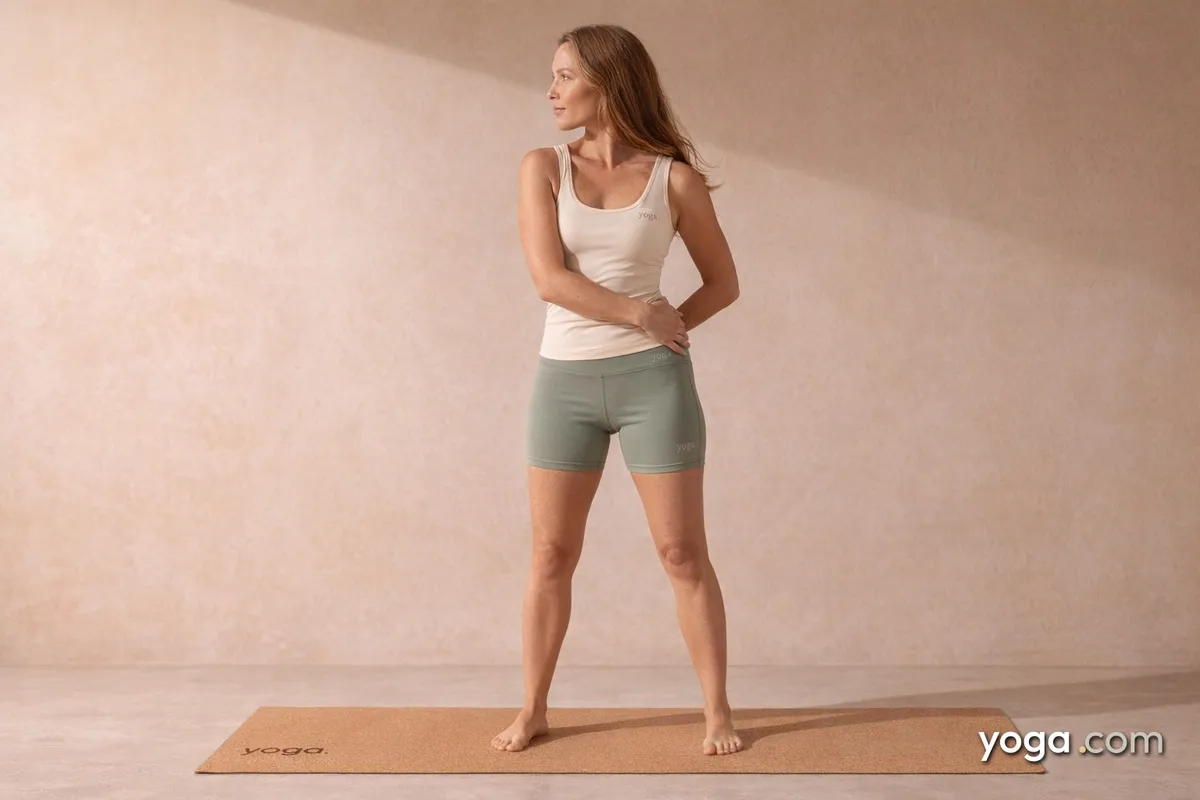
Right Waist Rotation Pose is a gentle standing twist that rotates the torso to the right while the feet stay grounded and the arms swing freely with the movement. Its Sanskrit name, Kaṭicakrāsana (right rotation), translates roughly as "waist wheel pose turning right" - kaṭi meaning waist or hip region, cakra meaning wheel or rotation. It appears frequently at the opening of a standing sequence or as a warm-up before deeper twists and lateral poses.
At a Glance
- Level: Beginner
- Type: Standing
- Targets: Thoracic spine, obliques, shoulders, hip rotators
- Good for: Mobilising the spinal column, building rotational awareness through the trunk, warming the shoulder girdle
How to Do Right Waist Rotation Pose
- Stand in Mountain Pose with your feet hip-distance apart, weight distributed evenly across both soles. Let your arms hang at your sides.
- Soften your knees slightly - enough to release any locking in the joints without bending deeply.
- On an inhale, lengthen through the crown of your head, drawing the spine tall and the lower belly gently in.
- On an exhale, initiate the twist from your waist: rotate your torso to the right, allowing both arms to swing passively with the momentum. Your left arm swings across the front of your body; your right arm swings behind you and may wrap loosely around the lower back.
- Let your head follow the rotation naturally so your gaze travels to the right. Keep both feet firmly planted and the hips facing forward as much as possible - the movement is in the waist, not the pelvis.
- Hold the rotated position for one full breath, feeling length through the left side of the waist and a gentle compression through the right.
- To come out, inhale and use the breath to unwind the torso back to centre, letting the arms float back to your sides. Return to Mountain Pose and pause for a breath before moving to the left-side variation or repeating.
Benefits
- Mobilises the thoracic and lumbar vertebrae through their rotational range of motion.
- Stretches the oblique muscles and the muscles along the left side of the trunk during the rightward rotation.
- Warms the shoulder joints and loosens the upper back musculature through the free swing of the arms.
- Activates the deep spinal stabilisers, including the multifidus, as they control the rotation.
- Encourages rhythmic coordination between breath and movement, establishing a steady internal tempo for practice.
Common Mistakes and Alignment Cues
- Rotating from the hips rather than the waist: Keep both hip points facing forward throughout. The twist originates above the pelvis - think of your hips as a stable base while the ribcage turns.
- Locking the knees: A softly bent knee allows the lower back to decompress. Check that you haven't straightened and braced the legs as you swing.
- Collapsing the chest or rounding the upper back: Maintain the lift through the sternum before and during the rotation. Imagine the crown of your head being drawn gently upward even as you twist.
- Forcing the arms or adding muscular tension: The arms should swing freely, moved by momentum rather than effort. If you find yourself gripping or hauling the arms around, ease the speed and let gravity do the work.
- Holding the breath: Pair the swing with the exhale and the return with the inhale - breath and movement should stay connected.
Modifications and Props
- Chair support: Sit upright on the front edge of a firm chair with feet flat on the floor. This removes balance demands and lets you focus entirely on the spinal rotation - useful when standing balance is a concern.
- Wall for feedback: Stand with your back 30-40 cm from a wall. As you rotate right, try to touch the wall with both palms. This gives clear tactile feedback about how far your rotation actually travels.
- Wider stance for stability: Step your feet wider than hip-distance if you feel unsteady. A broader base lowers your centre of gravity and steadies the pelvis.
- Slowed, held version: Instead of a swinging dynamic movement, rotate deliberately to the right, place your left hand on your right shoulder and your right hand on the back of the left hip, and hold for three to five breaths. This static version builds more sustained awareness of the rotational stretch.
Cautions
- Move slowly and avoid forceful swinging if you have a recent or acute back injury - the momentum of the arms adds rotational load to the spine.
- Take care with spinal disc conditions; keep the rotation mild and stay within a pain-free range.
- If you have vertigo or significant balance challenges, practice next to a wall or seated in a chair.
- Avoid deep or rapid rotation if you are in the later stages of pregnancy - use only a gentle, controlled range of movement and check with your care provider.
If you're working with an injury or a medical condition, check with a qualified professional before practicing.
Related Poses
- Mountain Pose - the natural starting and returning point for this pose; practise it first to establish grounded alignment.
- Mountain Pose with Upward Stretch - lengthens the spine and opens the side body before rotation, making it an effective preparation.
- Cat Pose - introduces spinal mobility in a supported position; useful for practitioners who need more spinal warm-up before standing twists.
- Child's Pose - a gentle counter-pose to release the lower back and quiet the nervous system after rotational work.
See also: A Gentle Yoga Routine for Tired, Low-Energy Days and A 10-Move Chair Yoga Sequence for a Midday Reset.