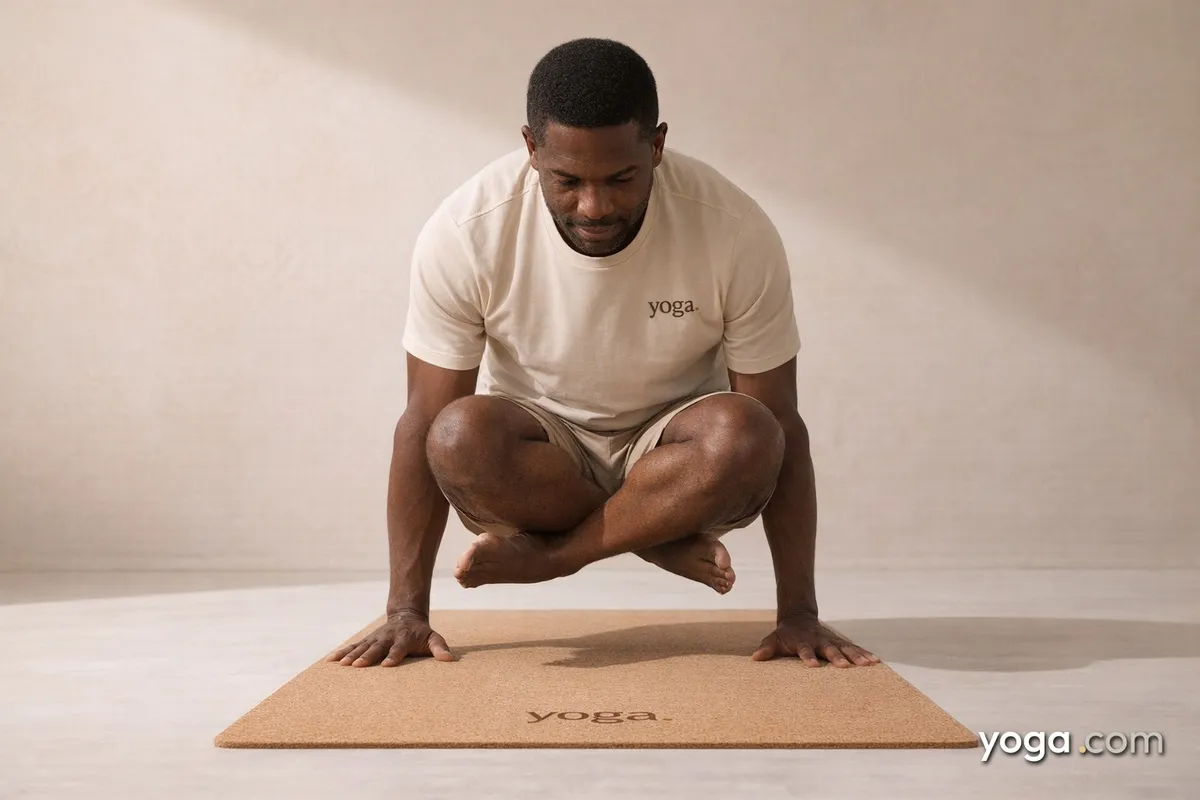
Roller Pose (Lolāsana, from the Sanskrit lola, meaning "dangling" or "swinging") is an advanced arm balance in which the entire body is lifted off the ground from a kneeling position, the legs tucked tightly and the torso suspended between the hands. It typically appears near the peak of a strong Ashtanga-influenced sequence or as a transitional vinyasa between seated and kneeling poses, demanding integrated wrist, core, and shoulder strength in equal measure.
At a Glance
- Level: Advanced
- Type: Arm Balance
- Targets: Wrists and forearms, core (transverse abdominis, hip flexors), shoulders, upper back
- Good for: Building full-body pressing strength, developing scapular control, training compact body awareness
How to Do Roller Pose
- Start in a high kneeling position with a folded blanket under your shins if the floor is hard. Place your palms flat on the mat, shoulder-width apart, fingers spread wide and pointing forward, just outside your hips.
- Cross your ankles - right ankle over left, or left over right - and draw your heels firmly toward your sitting bones. Keep the tuck compact; loose legs bleed strength.
- Press the floor away firmly through both palms. Round your thoracic spine upward, draw your low belly in and up, and bring your gaze to a soft point on the floor about a foot in front of your hands.
- Lean your torso slightly forward to shift your center of mass over your wrists. This forward tipping is what makes the lift possible; do not simply try to pull the legs up straight from a vertical torso.
- Exhale completely, inhale to prepare, then on the next exhale compress your inner thighs toward each other, engage the pelvic floor, and press down through the index-finger mounds to lift your knees and feet off the mat. Your body should hang suspended - dangling - between your arms.
- Hold for two to five breaths, keeping the shoulder blades wide and the elbows slightly soft (micro-bend), not locked. Maintain an active protraction - push the floor away the whole time.
- To come out, exhale and lower your knees back to the mat with control. Sit back into Child's Pose or swing directly into a forward vinyasa if you are working a flow sequence.
Benefits
- Strengthens the wrist flexors, extensors, and forearm muscles under load-bearing conditions.
- Builds pressing strength and serratus-anterior activation through active scapular protraction.
- Develops deep core engagement, particularly the transverse abdominis and hip flexors, which must work together to hold the tucked position.
- Trains proprioceptive awareness of the body's relationship to its own center of gravity.
- Improves shoulder girdle stability in a horizontal pressing plane.
- Conditions the upper-back muscles (rhomboids, lower trapezius) to support a rounded, active spine under compression.
Common Mistakes and Alignment Cues
- Mistake: Straight or loose spine. Cue: Round your thoracic spine toward the ceiling deliberately - think "angry cat" through the upper back - before you even attempt the lift.
- Mistake: Hands too far forward. Cue: Keep your palms beside your hips so that as you round and lean forward, your shoulders come directly over your hands; placing the hands too far forward at the outset shifts weight past the wrists and collapses the lift.
- Mistake: Elbows flaring wide. Cue: Draw the outer elbows toward each other slightly so the upper arms track parallel, protecting the wrists and creating a sturdier column of support.
- Mistake: Holding the breath. Cue: Initiate the lift on a full exhale and keep breathing in the hold; gripped breath tightens the very core muscles you need to recruit freely.
- Mistake: Feet dangling loosely. Cue: Actively press the crossed ankles together and dorsiflex the feet slightly; this small muscular engagement raises the legs a centimeter or two and lightens the load on your arms.
Modifications and Props
- Yoga blocks under the hands: Place two blocks on their highest setting directly under each palm. The added height creates more clearance for the hips and shins, making the tuck-and-lift far more accessible while you build strength.
- Blanket under the shins: Fold a blanket two layers thick under your knees and shins to protect the tibias from mat pressure during the setup and landing phases.
- Partial lift drill: Instead of full suspension, practice pressing down and simply lifting the knees a few centimeters, holding for one breath, and replacing them. Repeat five times to train the pressing pattern without demanding full clearance.
- Wall-supported lean: Practice the forward weight-shift with your fingertips lightly touching a wall in front of you. The wall gives tactile feedback for how far forward to tip before the lift becomes possible.
Cautions
- Wrist sensitivity or injury: Lolāsana places significant compressive and shear force on the wrist joint. Avoid if you have acute wrist pain or an unresolved sprain; build to the pose progressively with block support.
- Shoulder impingement or rotator-cuff issues: The horizontal pressing load can aggravate existing shoulder pathology. Approach with caution and reduce the range until strength and mobility are established.
- Recent abdominal surgery or hernia: The intense intra-abdominal engagement required here is not appropriate while healing.
- Pregnancy: Avoid deep core compression of this kind during pregnancy.
- If you're working with an injury or a medical condition, check with a qualified professional before practicing.
Related Poses
- Crane Pose - the closest arm-balance cousin; share the same wrist-loading and scapular-protraction demands.
- Four-Limbed Staff Pose - foundational for building the pressing strength and elbow alignment Lolāsana requires.
- Easy Crow Pose - an excellent stepping stone that trains the forward weight shift and tuck before full suspension.
- Plank Pose - builds the shoulder-girdle and core endurance that underpins all arm balances, including this one.
If arm balances are not yet in your practice, start gently: A Gentle Yoga Routine for Tired, Low-Energy Days or try A 10-Move Chair Yoga Sequence for a Midday Reset to build foundational body awareness first.