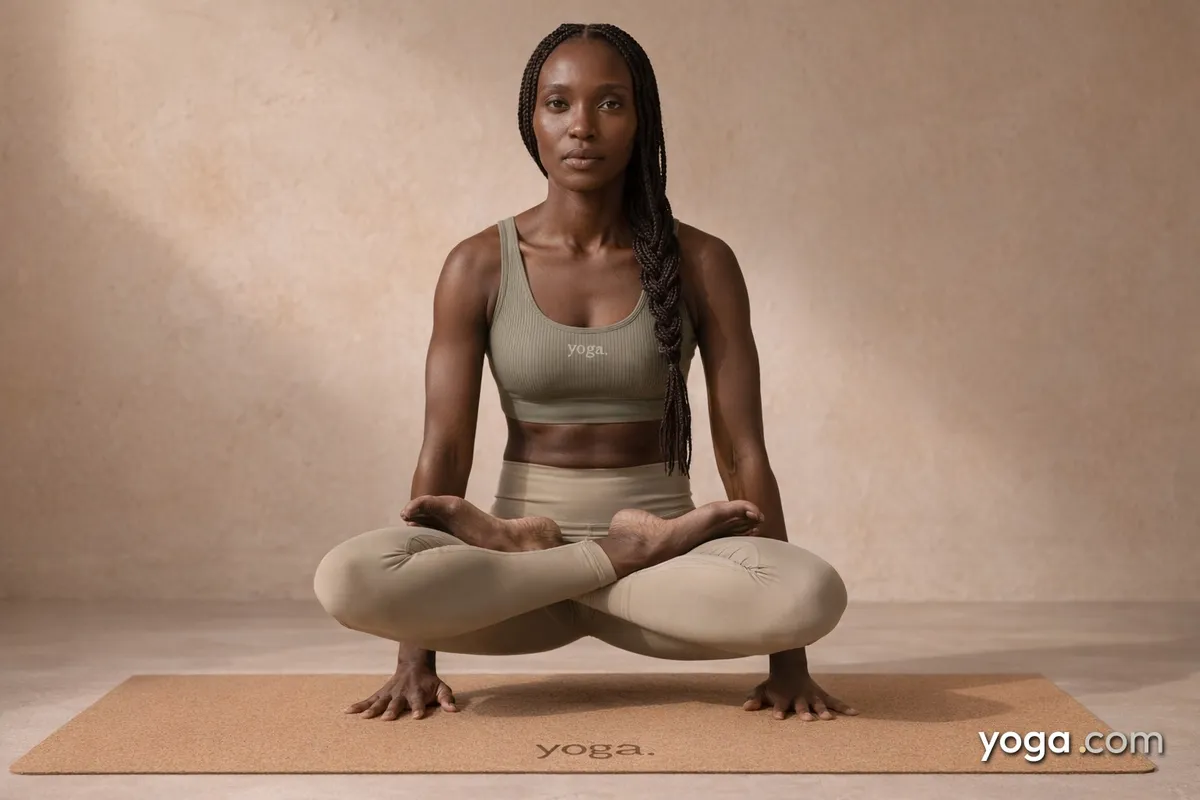
Scale Pose in Lotus Variation (Tolāsana (Lotus variation) - from tola, meaning "pair of scales" or "balance," and āsana, "seat") is an advanced arm-balance in which the entire lower body is held in full Lotus while you press the hands into the floor and suspend the body completely off the ground. You'll usually meet it near the peak of a seated or advanced sequence. It asks for two things at once - the deep hip openness of Lotus and honest pressing strength - and neither can be faked.
At a Glance
- Level: Advanced
- Type: Arm-balance
- Targets: Core (deep abdominals and hip flexors), shoulder girdle and triceps, wrists, hip external rotators
- Good for: Building full-body pressing strength, developing core compression and body-weight control, deepening awareness of scapular stabilization
How to Do Scale Pose in Lotus Variation
- Begin in Lotus (Padmasana). Sit upright on your mat with both legs in full Lotus - right foot on left thigh, left foot on right thigh (or your preferred order). If the ankles or the tops of the feet are already complaining, sort that out first - don't add load to a Lotus that hurts.
- Place the hands. Press your palms flat on the floor directly beside your hips, fingers spread wide and pointing forward. Stack the wrists directly under the shoulders.
- Engage the core and protract the shoulders. Draw the low belly firmly in and up. Round the upper back slightly by spreading the shoulder blades apart - that "doming" through the thoracic spine is where the lift actually comes from. Skip it and you just hang.
- Exhale and press down to lift. On a strong exhale, press evenly through all four corners of each hand, straighten the arms, and draw the knees and the entire Lotus up off the floor. Keep the Lotus compact and level. If one knee starts dipping, you'll feel the whole shape tilt with it.
- Hold and breathe. Gaze softly forward or slightly down. Keep the arms fully extended, shoulders away from the ears, and the Lotus drawn toward the lower belly for 3-5 steady breaths.
- Come out with control. On an exhale, lower the Lotus back to the mat slowly - the descent is its own strength work, so resist gravity instead of dropping.
- Release and counter. Carefully uncross the legs from Lotus, then take a gentle seated or supine counter-stretch (a simple seated forward fold or reclined leg extension) before switching the Lotus crossing and repeating on the second side.
Benefits
- Strengthens the triceps, anterior deltoids, and serratus anterior through sustained pressing
- Builds deep core compression - particularly the transverse abdominis and hip flexors - required to hold the Lotus aloft
- Develops scapular stability and protraction control essential to all arm-balances
- Stretches and mobilizes the wrist flexors under load, improving wrist resilience for advanced practice
- Teaches your hands to share the load evenly - a subtler skill than it sounds
- And it reinforces the hip external rotation and adductor length you already earned getting into Lotus
Common Mistakes and Alignment Cues
- Shrugging the shoulders toward the ears: Actively depress and spread the shoulder blades before you press up; think "shoulders away from the ears" throughout the hold.
- Bending the elbows: Lock the arms into full extension before lifting - bent elbows transfer load to the joints rather than the muscles.
- Collapsing the chest and hanging passively: The lift comes from active rounding of the spine - dome the upper back and draw the ribs in rather than letting the torso sag between the arms.
- Uneven Lotus dropping to one side: Before pressing, visualize the knees level; engage the inner thighs to keep the Lotus symmetrical as you rise.
- Holding the breath: Maintain a steady, audible exhale on the lift and normal breathing in the hold - a held breath feels stronger, but it gives you less control, not more.
Modifications and Props
- Yoga blocks under the hands: Place a block (medium height) under each palm to add clearance between the floor and your Lotus, which buys you extra clearance while the pressing strength catches up.
- Half Lotus or crossed-leg variation: If full Lotus is not accessible for your hips, practice Scale Pose with the legs in a comfortable crossed position (Sukhasana) first. That way you're building the press on its own, before Lotus enters the picture.
- Chair-assisted version: Sit on the front edge of a sturdy, non-rolling chair with hands on the seat beside the hips. Practice the pressing action and core lift without the full floor-clearance demand.
- Partner or wall spot: Have a partner lightly support the Lotus from below on your first attempts, or practice near a wall for confidence so you can brace the knees lightly against it for orientation.
Cautions
- Wrist pain or injury: This pose places significant compressive and shear force through the wrists. Avoid or substitute if you have carpal tunnel syndrome, wrist sprains, or chronic wrist discomfort.
- Knee or ankle issues: Lotus already stresses the knee and ankle joints; do not force full Lotus if you feel pinching or sharp pain in these areas.
- Shoulder impingement or rotator-cuff injury: All that sustained pressing and protraction can aggravate an existing shoulder problem. Go carefully, and don't trade alignment for the lift.
- Pregnancy: Avoid deep core compression and body-weight suspension poses during pregnancy.
If you're working with an injury or a medical condition, check with a qualified professional before practicing.
Related Poses
- Plank Pose - builds the foundational pressing strength and shoulder stability the lift requires
- Crane Pose - the closest arm-balance family member; develops identical pressing mechanics without the Lotus demand
- Four-Limbed Staff Pose - trains tricep and core control integral to lowering with precision
- Easy Crow Pose - an accessible arm-balance stepping stone for developing body-weight transfer confidence
Looking for sequences that build toward or down from peak poses? See A Gentle Yoga Routine for Tired, Low-Energy Days and A 10-Move Chair Yoga Sequence for a Midday Reset.