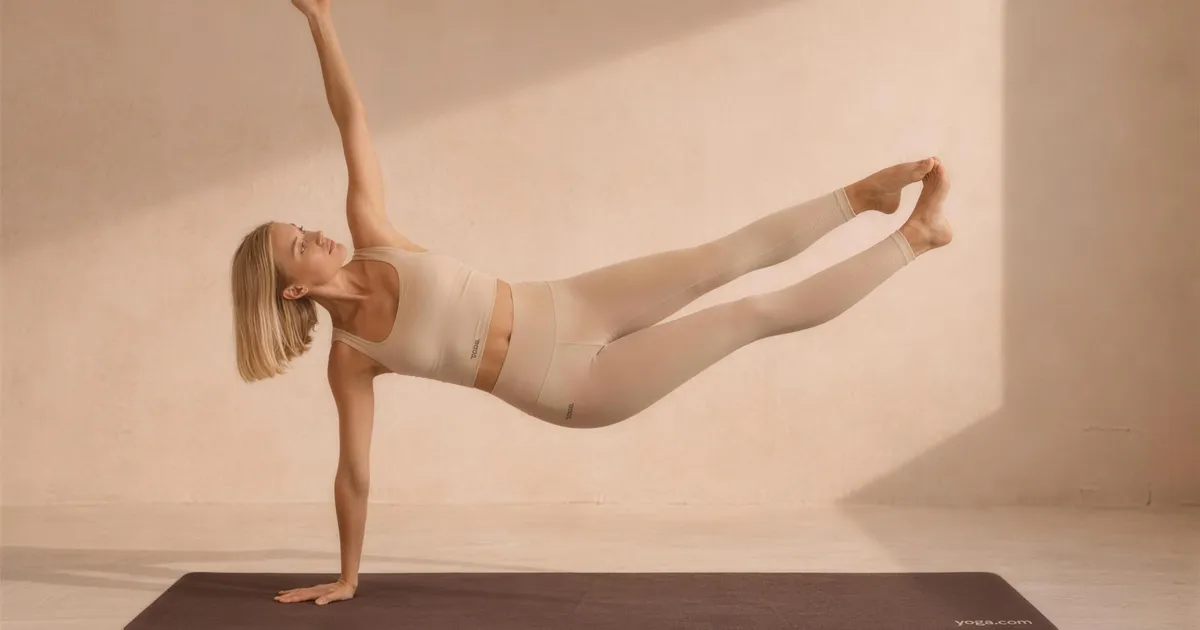
Side Plank Pose with Left Leg Up - Vasiṣṭhāsana, named for the revered Vedic sage Vasiṣṭha - takes the lateral stability challenge of classic Side Plank and layers on a single-leg lift that demands coordinated strength from fingertips to raised heel. Balancing on the right hand and outer right foot while the left leg floats skyward, you build the kind of full-body integration that underpins nearly every arm balance in the practice.
At a Glance
- Level: Intermediate
- Type: Arm Balance
- Targets: Right wrist and shoulder stabilizers, lateral right-side trunk (obliques, quadratus lumborum), left hip flexors and abductors, left inner thigh, glutes bilaterally
- Good for: Lateral core strength, shoulder girdle stability, hip abductor activation, body-line awareness
How to Do Side Plank Pose with Left Leg Up
- Begin in Plank Pose. Stack shoulders over wrists, press all ten fingers evenly into the mat, and draw the low belly in and up. Take one full breath to set your foundation.
- Pivot onto the outer edge of the right foot. Roll the whole body to the right, stacking the left foot on top of the right or placing it slightly behind for initial balance. The right hand remains directly under the right shoulder - not in front of or behind it.
- Press the right palm firmly and spread the fingers. Grip the mat through the index finger mound to protect the right wrist. Keep the right elbow straight but not hyper-extended.
- Lift the hips. Drive the right outer heel down and push the floor away with the right hand simultaneously. Raise the hips until your body forms one long diagonal line from the right heel through the crown. Avoid letting the right hip sag or pike upward.
- Extend the left arm toward the ceiling. Reach the left fingertips straight up, turning the chest open to the left. Gaze can travel up toward the left hand or forward if the neck prefers neutral.
- Lift the left leg. Flex the left foot, engage the left quad, and raise the left leg to hip height or higher - wherever you can maintain a level pelvis and a stable right shoulder. Keep the left leg neutral so the left inner thigh and toes face the wall in front of you, not the ceiling.
- Hold and breathe. Stay for 3-6 breaths. Keep the right shoulder blade drawing toward the spine - do not let it wing out. The left arm, left leg, and crown of the head all extend away from the midline in opposing directions.
- To exit: Lower the left leg back onto the right, return to full Plank Pose, and rest in Child's Pose or Downward-Facing Dog for a breath before repeating on the opposite side.
Benefits
- Lateral trunk strengthening: The right-side obliques and quadratus lumborum work continuously to keep the hips lifted against gravity.
- Shoulder girdle stability: The right rotator cuff and serratus anterior must co-contract to stabilize a single-arm load, reinforcing healthy scapular mechanics.
- Hip abductor activation: Lifting and holding the left leg recruits the left gluteus medius and minimus through their full range of motion.
- Wrist and forearm conditioning: Sustained single-hand weight-bearing progressively strengthens the right wrist extensors and intrinsic hand muscles.
- Full-body proprioception: Balancing on one hand and one foot with a limb in the air sharpens the nervous system's sense of where the body is in space.
- Contralateral coordination: Simultaneously extending the left arm up and left leg away trains the body to create length and stability through opposing diagonal lines.
Common Mistakes and Alignment Cues
- Mistake: Right hip sags toward the floor. Cue: Press the outer right heel actively downward and squeeze the right glute to drive the hips back to the diagonal line.
- Mistake: Right shoulder collapses inward and the elbow bends. Cue: Imagine pushing the floor away from you; straighten the right elbow and draw the right shoulder blade toward the center of the back.
- Mistake: Left hip rotates open so the left knee faces the ceiling. Cue: Internally rotate the left thigh slightly so the left inner thigh and left toes face the wall in front of you, not the sky.
- Mistake: Neck cranks upward to look at the left hand. Cue: Let the gaze go where it is comfortable - looking forward is completely valid; only look up if the right side of the neck stays long.
- Mistake: Left leg rises so high that the left hip hikes and the waist shortens on the right. Cue: Raise the left leg only as high as you can while keeping both sides of the waist equally long.
Modifications and Props
Lower the right knee: From Side Plank on the right hand, bend the right knee and place it on the mat at roughly a 45-degree angle from the hip. This reduces the load on the right shoulder and lets you focus on left-leg lifting with a stable base.
Use a block under the right hand: If the right wrist is uncomfortable, place a block at its lowest height under the right hand to reduce wrist extension.
Hold the left big toe: For a deeper stretch, loop the left index finger and thumb around the left big toe as the leg lifts, extending the leg forward or to the side in a standing-split variation of the arm balance.
Wall support: Practice near a wall with the outer right foot pressing into the baseboard for lateral grounding while you learn to lift the left leg independently.
Cautions
- Avoid full weight-bearing on the right wrist if you have an acute wrist sprain, carpal tunnel syndrome, or recent wrist fracture - use the forearm variation of Side Plank instead.
- Right shoulder impingement or rotator cuff irritation may be aggravated by single-arm loading; come down if you feel pinching at the front of the right shoulder joint.
- Left hip flexor or IT band tightness may limit how high the left leg rises - work within a pain-free range rather than forcing height.
If you're working with an injury or a medical condition, check with a qualified professional before practicing.
Related Poses
- Plank Pose - the foundation from which Side Plank is entered and exited.
- Side Plank Pose on Left Hand, Legs Together - the mirror-side version to balance your practice.
- Downward-Facing Dog Pose - a natural counter-stretch for the right shoulder and wrist after lateral loading.
- Upward-Facing Dog Pose - reinforces the shoulder-blade retraction and wrist stability that make Side Plank sustainable.