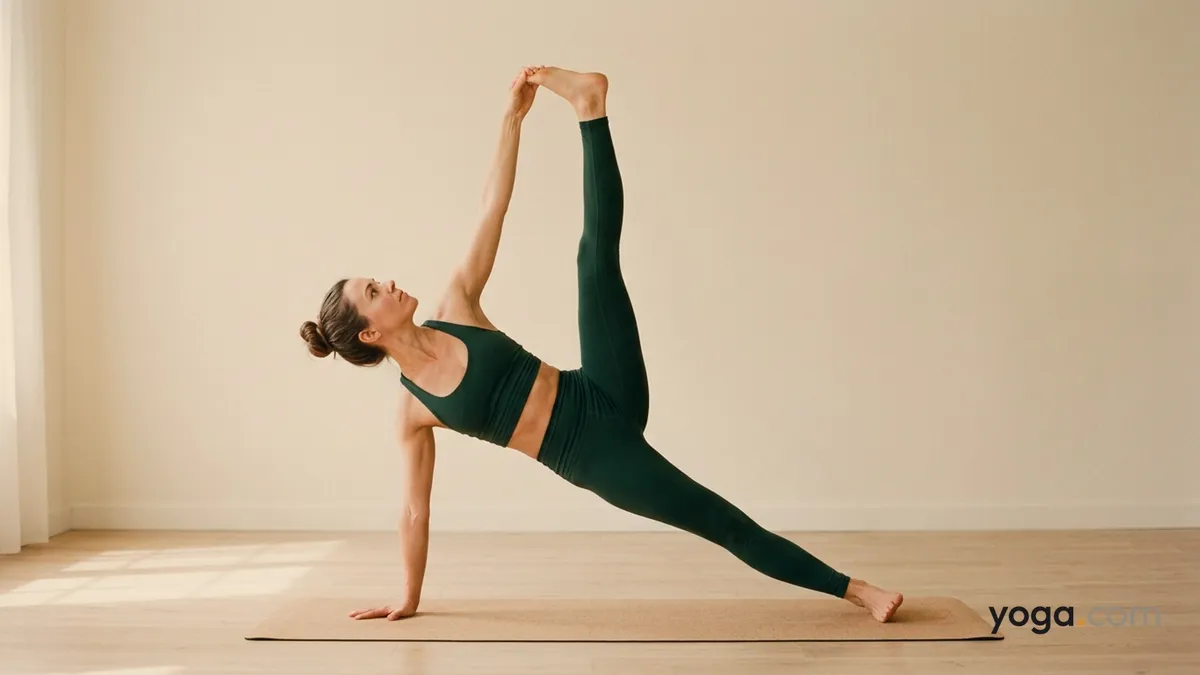
Vasiṣṭhāsana — named for the revered Vedic sage Vasiṣṭha — translates loosely as Pose of the Sage Vasiṣṭha. This variation adds a vertical leg lift to the classic side plank, demanding that the left arm, left hip, and stacked feet work as a single load-bearing column while the right leg rises freely toward the ceiling. The result is a full-body conversation between strength and balance that sharpens proprioception on both sides of the body.
At a Glance
Level: IntermediateType: Arm BalanceTargets: Left wrist and forearm extensors (base support), left shoulder stabilizers (serratus anterior, rotator cuff), lateral core (left obliques, left quadratus lumborum), right hip flexors and adductors (lifting leg), right hamstrings and inner thighGood for: Lateral core strength, shoulder stability, hip mobility, full-body coordinationHow to Do Side Plank Pose with Right Leg Up
Start in Plank Pose. Place your hands directly under your shoulders, arms straight, body in one long line from crown to heels. Spread your left fingers wide and press firmly through the left index finger and thumb — you will be pivoting onto this hand.Shift onto your left hand. Roll onto the outer edge of your left foot, turning your torso to the right. Stack your right foot on top of the left foot so both feet are parallel, soles facing right. Your left palm is flat on the mat, left arm fully extended.Align the column. Stack your right hip directly above your left hip. Press your left heel actively into the mat (or into the wall if you are using one for feedback). Engage your left obliques to lift the left hip — the pelvis should be level, not sagging.Extend the right arm. Reach your right arm straight up toward the ceiling, fingertips pointing skyward. This is the free hand that will later take the right big toe. Check that your right shoulder stacks above your left shoulder.Root through the left hand. Press evenly through the entire left palm. Protract your left scapula — push the mat away rather than letting the shoulder collapse. Keep your left elbow soft, not locked into hyperextension.Lift the right leg. Bend your right knee and loop your right index and middle fingers around your right big toe (yogi toe lock). Straighten the right leg as much as your hamstring length allows, extending the heel toward the ceiling. The left foot remains the single base of support on the floor.Hold and breathe. Gaze up at your right hand or forward if balance is challenging. Keep the left hip lifted, the left lateral line long, and the right inner thigh rotating slightly upward. Stay for 5–10 breaths.Come out by releasing the right big toe, lowering the right foot back to stack on the left, and returning through Plank Pose. Pause in Plank to reset before switching sides.Benefits
Lateral core strength. The left obliques, transverse abdominis, and quadratus lumborum work continuously to prevent the left hip from dropping, building endurance along the entire lateral chain.Shoulder girdle stability. Serratus anterior on the left side must protract and upwardly rotate the scapula to keep the shoulder from winging, reinforcing functional overhead and pushing strength.Hip flexor and hamstring lengthening. Straightening the lifted right leg against gravity provides an active stretch through the right posterior chain while the right hip flexors work concentrically to hold the position.Wrist and forearm conditioning. Bearing full bodyweight on a single palm strengthens the wrist extensors and builds the connective-tissue resilience needed for more advanced arm balances.Balance and proprioception. Balancing on one hand and one foot with a limb in motion trains the neuromuscular system to detect and correct small postural shifts in real time.Common Mistakes and Alignment Cues
Left hip sagging toward the floor Press your left heel down and drive the left hip up actively. Think of the left obliques shortening to close the gap between your left ribs and left hip. Left shoulder collapsing into the ear Push the mat away with your left palm. Protract the left scapula and keep the left arm fully extended to create space between your left ear and left shoulder. Right leg barely lifting off the stack Before gripping the toe, fire your right hip flexors to raise the right leg; then reach the right hand down to meet it rather than pulling the leg up with arm strength alone. Torso rotating forward (chest dropping toward the mat) Stack the right shoulder directly over the left and roll the right ribcage open toward the ceiling. Imagine the front of your body facing a wall to your right. Gripping the right toe with the wrong hand Your left hand is on the mat. Your right hand grips the right big toe. If you feel yourself tipping, release the toe and simply raise the right arm until stability improves.
Modifications and Props
Lower the left knee. If the full pose feels unstable, lower your left knee to the mat. The left knee becomes a secondary base of support while the right leg still lifts freely — the lateral core benefit is preserved with reduced demand on left-arm endurance.Use a wall. Place the outer edge of your left foot against a baseboard. Pressing the left heel into the wall gives proprioceptive feedback and prevents the foot from sliding, letting you focus on the hip lift and leg extension.Use a strap. Loop a yoga strap around your right foot before entering the pose. Hold the free end with your right hand so tight hamstrings do not prevent leg extension.Keep the right arm up. Skip the toe-lock entirely and simply extend both the right arm and right leg, holding the form without gripping. This builds the foundational strength before adding the bind.Elevate the left hand. Place your left hand on a block at its lowest height to reduce the range of motion at the left wrist and ease compression for those with wrist sensitivity.Cautions
Avoid or modify if you have acute pain in the left wrist, left elbow, or left shoulder — the entire structure relies on that joint chain.Proceed carefully with rotator cuff strains; the demand on left serratus anterior and rotator cuff is high and sustained.If you experience left hip or left IT-band pain during the hold, exit and assess your alignment before re-entering.Those with hamstring strains on the right side should use a strap rather than gripping the toe to avoid overpulling the injured tissue.If you’re working with an injury or a medical condition, check with a qualified professional before practicing.
Related Poses
Plank Pose — the standard entry and exit point for this variationSide Plank Pose on Left Hand, Legs Together — the direct prerequisite: same base hand and foot, no leg liftDownward-Facing Dog Pose — restores the wrists and resets the shoulders between attemptsUpward-Facing Dog Pose — shares the demand for active thoracic extension and shoulder protraction under load