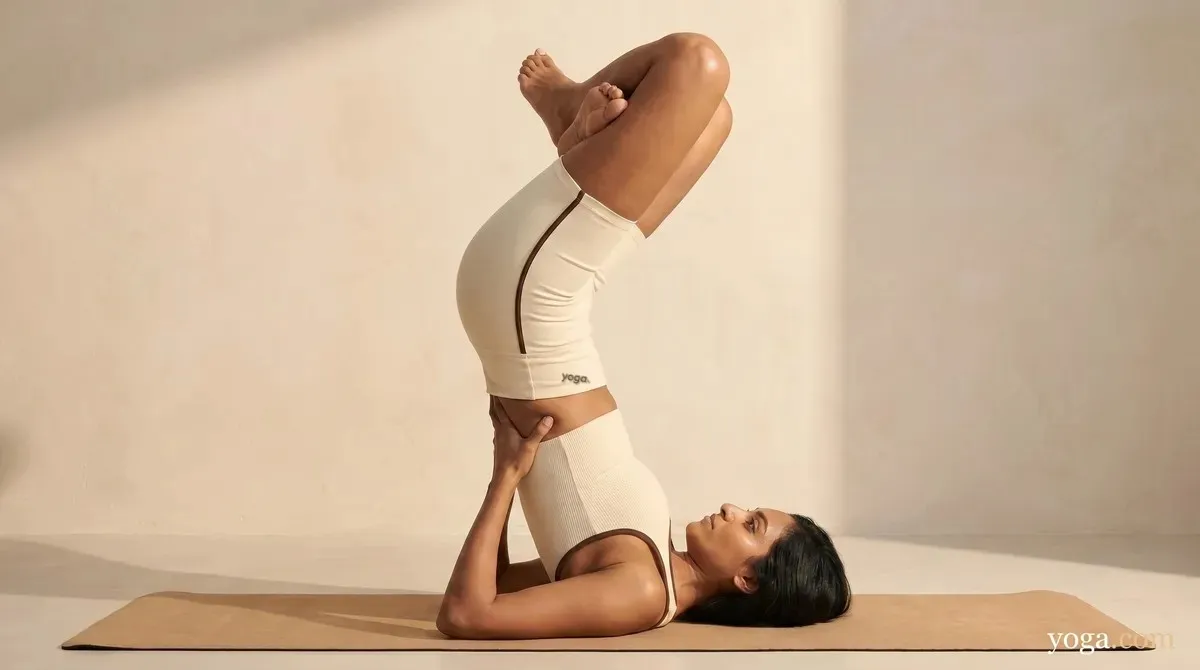
Upward Lotus Pose (Ūrdhva Padmāsana - literally "upward lotus posture") balances the full expression of Lotus Pose atop a Shoulderstand, inverting the pelvis while the legs remain locked in Padmāsana. It appears near the peak of traditional Sarvāngāsana sequences and demands mature hip flexibility, a stable inversion foundation, and steady concentration before it is attempted.
At a Glance
- Level: Advanced
- Type: Inversion
- Targets: Hip external rotators, core stabilizers, cervical and thoracic spine, shoulder girdle
- Good for: Building balance on an inverted base, deepening hip external rotation, developing postural control through the shoulder line
How to Do Upward Lotus Pose
- Establish Shoulderstand (Sarvāngāsana). Lie on your back, swing your legs overhead, and lift your hips directly above your shoulders. Press your palms firmly into your mid-back with fingers pointing upward, and stack ankles over knees over hips in one vertical line. Hold here until your breath is even.
- Steady your foundation. Draw your elbows toward each other and broaden across the collarbones. The back of your head stays on the mat; your chin angles slightly toward your sternum. Press down through the outer upper arms to create a shelf of support.
- Cross into Lotus - first leg. Keeping the hips lifted and square, bend your right knee and draw it toward your right shoulder. Externally rotate the hip so the right foot can cross onto the top of your left thigh, as close to the hip crease as possible. Work slowly; never force the knee.
- Add the second leg. Bend the left knee and guide the left foot onto the top of your right thigh in the same manner. Both feet should now rest in the full Lotus position above the pelvis, soles facing upward toward the ceiling. If the legs resist, pause here rather than pulling.
- Find the balance point. With both legs interlaced, shift your hand pressure to fine-tune your vertical alignment. The hips continue to reach skyward; the knees angle slightly toward the floor at each side. Breathe fully into the chest and hold for 5-10 slow breaths.
- To come out - release Lotus first. Carefully unfold one leg at a time back to a straight vertical position, pausing in Shoulderstand with both legs extended to reset.
- Lower from Shoulderstand with control. Lower your legs to a 45-degree angle, release your hands to the mat, and slowly roll your spine down vertebra by vertebra until you are lying flat. Rest in Corpse Pose for several breaths before sitting up.
Benefits
- Stretches the hip external rotators, adductors, and knee-surrounding musculature through a full Lotus range of motion while the pelvis is unloaded by gravity.
- Strengthens the shoulder external rotators, triceps, and serratus anterior, which must work continuously to support the inverted torso.
- Lengthens the cervical and thoracic paraspinal muscles as the upper spine flattens into the mat.
- Builds proprioceptive awareness of the pelvis in an overhead position, refining balance through the shoulder girdle.
- Engages the deep abdominal stabilizers to keep the hips stacked directly above the shoulders throughout.
Common Mistakes and Alignment Cues
- Mistake: Collapsing into one hip when crossing into Lotus. Cue: Before bending each knee, press both palms evenly into the back and check that both hip points remain at equal height.
- Mistake: Forcing the knee into Lotus from above. Cue: Lead with hip external rotation, not with foot pressure. If the outer knee protests, stay in Half Lotus or skip this pose for today.
- Mistake: Chin jutting up and compressing the neck. Cue: Allow a natural, soft chin-to-chest tuck; no hard pressing. The gaze rests on the chest or straight up toward the ceiling.
- Mistake: Elbows splaying wide and losing the back-support shelf. Cue: Draw the elbows toward each other so they are no wider than shoulder-width; this keeps the thoracic lift firm.
- Mistake: Rushing the descent from the inversion. Cue: Release Lotus first, then lower from Shoulderstand slowly, using the abdominals to control each segment of the spine to the floor.
Modifications and Props
- Folded blanket under the shoulders: Place one or two firm, folded blankets under your upper back and shoulders (neck and head on the mat). This reduces compression in the cervical spine and makes it easier to maintain the shoulder shelf - highly recommended for most practitioners.
- Half Lotus variation: Cross only one foot onto the opposite thigh and leave the other leg bent with the foot resting on the inner thigh. Practice on both sides over separate sessions to develop even hip flexibility.
- Wall for vertical reference: Set up Shoulderstand with your hips about six inches from a wall. The wall gives you a reference point for vertical alignment while you experiment with the leg crossing, without the risk of toppling forward.
- Practice Lotus on the floor first: If you cannot sit in a relaxed, full Lotus Pose on the ground for at least 30 seconds without forcing, this inversion form is not yet accessible. Invest time in hip-opening preparation before progressing.
Cautions
- Avoid this pose if you have a current or recent neck injury, cervical disc issue, or any condition for which your doctor or therapist has advised against bearing weight on the neck.
- Do not practice this pose if your knees are injured or inflamed, or if you cannot enter full Lotus without any sensation of strain in the outer knee.
- Menstruation is a traditional contraindication for sustained inversions; practice your own discernment or consult your teacher.
- Avoid practicing Upward Lotus Pose without a confident, stable Shoulderstand as a prerequisite - work with Headstand Preparation Pose I and sustained Sarvāngāsana before adding the Lotus element.
If you're working with an injury or a medical condition, check with a qualified professional before practicing.
Related Poses
- Headstand Preparation Pose I - builds the shoulder stability and inversion comfort this pose requires.
- Plow Pose - a natural predecessor in the Sarvāngāsana sequence that warms the spine and shoulders.
- Ear Pressure Pose - a complementary inverted shape practiced in the same sequence.
- Corpse Pose - the essential counter-pose; always rest here after coming down from any sustained inversion.
For contrast with your advanced practice, see A Gentle Yoga Routine for Tired, Low-Energy Days and A 10-Move Chair Yoga Sequence for a Midday Reset.