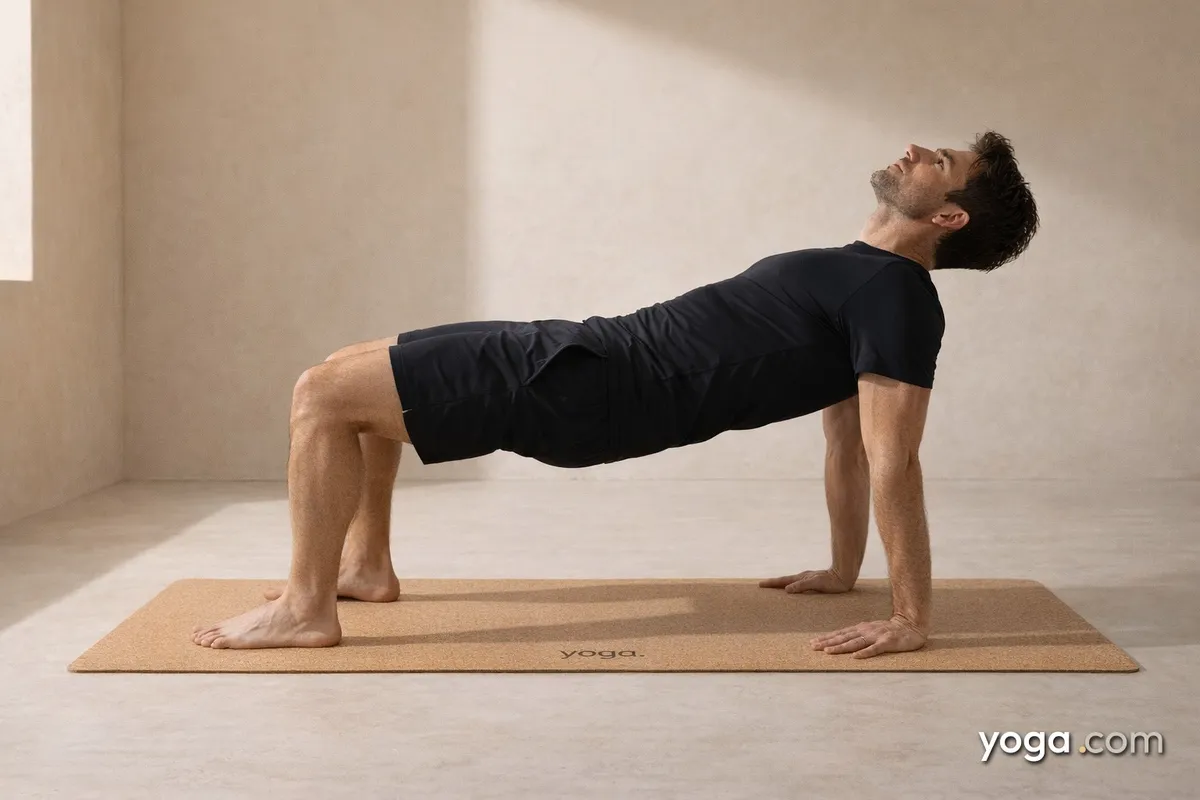
Upward Table Pose (Ardha Pūrvottānāsana) is a floor-based backbend that lifts the hips and chest into a tabletop position from a seated start. It belongs to the family of mild heart-openers and hip elevators, making it a natural bridge between seated warm-ups and deeper backbends later in a practice.
At a Glance
- Level: Beginner
- Type: Backbend
- Targets: Wrists and shoulders, hip flexors, chest and anterior shoulders, glutes and hamstrings
- Good for: Building shoulder stability, strengthening the posterior chain, improving spinal extension
How to Do Upward Table Pose
- Sit on the floor with your knees bent and feet flat, hip-width apart, about 12 inches in front of your sitting bones. Place your hands behind your hips, fingers pointing toward your feet (or slightly out to the sides if your wrists need room).
- Press your palms firmly into the floor and draw your shoulder blades together and down your back to create a stable base in the upper body.
- On an inhale, press through both feet and both hands simultaneously and lift your hips until your torso is roughly parallel to the floor. Your shins should be vertical and your arms straight.
- Squeeze your inner thighs gently toward each other to keep the knees tracking over the second toes - resist letting them splay wide.
- Broaden across the collarbones and lift the sternum. Either keep your chin slightly tucked with your gaze at the ceiling, or let the head drop back carefully if the neck is comfortable.
- Hold for 5-8 steady breaths, keeping the hips level and the core lightly engaged so the lower back does not compress.
- To come out, lower your hips smoothly to the floor on an exhale, then release your hands and shake out the wrists gently.
Benefits
- Stretches the hip flexors and anterior chest, counteracting the effects of prolonged sitting.
- Strengthens the glutes, hamstrings, and posterior shoulder muscles needed to hold the body level.
- Builds wrist and shoulder stability under a moderate load.
- Develops spinal extension through the thoracic and lumbar spine.
- Activates the core in an isometric hold, reinforcing trunk control during backbending.
Common Mistakes and Alignment Cues
- Hips sag toward the floor. Press more actively through all four limbs and engage the glutes to hold the pelvis level with the knees.
- Knees drift wide. Imagine lightly squeezing a block between the thighs; keep shins vertical and knees stacked over mid-foot.
- Wrists collapse inward. Spread the fingers wide, root down through the base of the index finger, and turn the elbow creases to face forward, away from the body.
- Shoulders crowd the ears. Draw the shoulder blades toward each other and down the back before you lift, and maintain that setting throughout the hold.
- Head drops back sharply. If you have any neck sensitivity, keep the chin neutral or slightly tucked rather than allowing the head to hang unsupported.
Modifications and Props
- Blocks under the hands: If your wrists are uncomfortable at a 90-degree angle, place yoga blocks flat under each palm to raise the floor and reduce wrist extension.
- Blanket under the hips: Sit on a folded blanket at the start to give extra lift at the pelvis, making it easier to press upward if the hip flexors are tight.
- Block between the thighs: Squeezing a block lightly between the inner thighs trains the knee-alignment pattern and engages the adductors for beginners who struggle with splaying knees.
- Partial lift: If the full tabletop height feels unstable, lift only partway - raising the hips just a few inches - until the wrists and shoulders build enough strength for the full position.
Cautions
- Wrist or carpal issues: Avoid bearing full weight through the wrists if you have acute wrist pain; use blocks or fists to reduce extension.
- Shoulder injury: Take extra care if you have a rotator cuff or impingement issue; come out immediately if you feel sharp or pinching sensations.
- Neck concerns: Do not allow the head to drop freely back if you have cervical disc problems or chronic neck tension - keep the gaze at the ceiling instead.
- Lower-back sensitivity: Keep the core lightly engaged to prevent the lumbar spine from compressing; if you feel pinching, lower the hips slightly and re-engage the glutes.
If you're working with an injury or a medical condition, check with a qualified professional before practicing.
Related Poses
- Bridge Pose - a close relative with a similar hip-lift action; practice this first to build the pattern.
- Cat Pose - a gentle preparation that warms the spine into flexion and extension before weight-bearing.
- Cobra Pose - a prone backbend that develops spinal extension with less demand on the wrists.
- Upward Bow Pose - the natural progression once your backbending and shoulder strength have grown.
See Upward Table Pose in context in A Gentle Yoga Routine for Tired, Low-Energy Days and A 10-Move Chair Yoga Sequence for a Midday Reset.