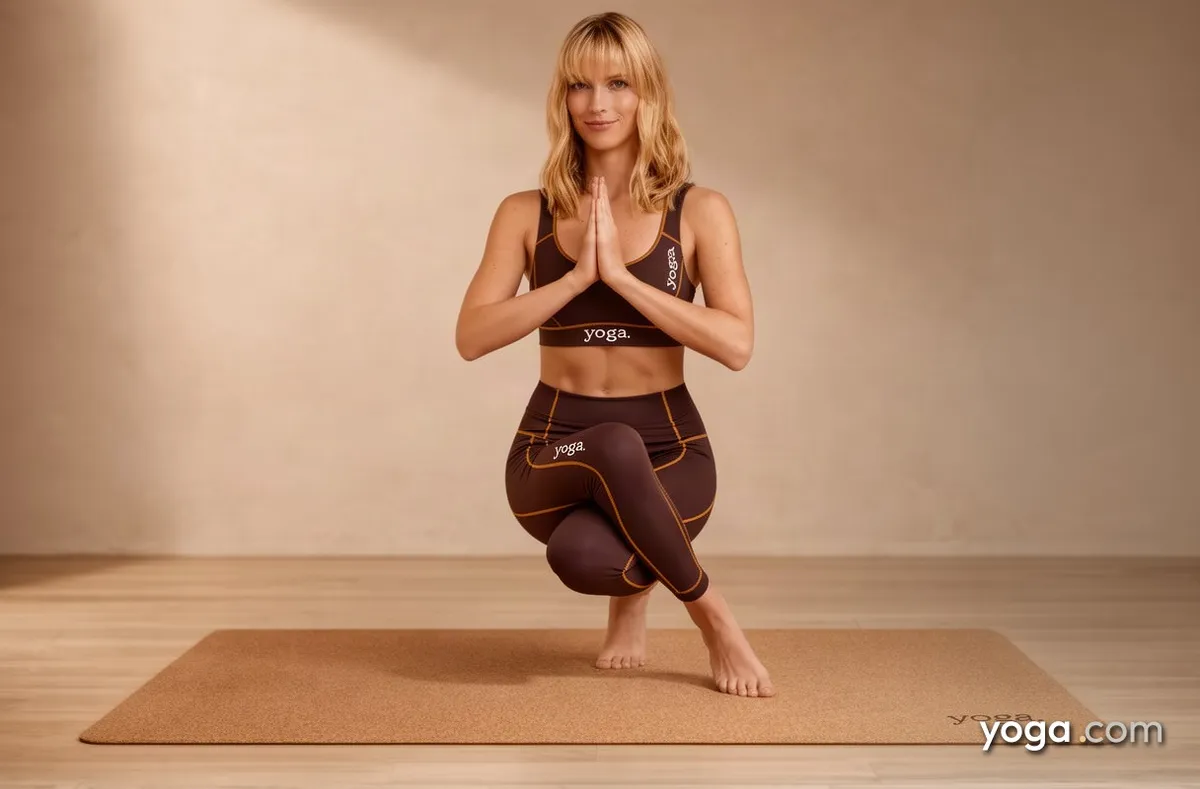
Horse Face Pose (Vātāyanāsana (right side)) is an advanced standing posture that combines a half-lotus leg position with a deep hip-opening squat, creating the wide, grounded silhouette its name evokes - vātāyana translates literally as "horse window" or "horse face" in Sanskrit. In this right-side variation, the right foot is drawn into half-lotus at the hip crease while the left leg provides the standing foundation. The pose typically appears toward the peak of a well-warmed practice, demanding considerable hip-flexor openness, ankle stability, and single-leg balance simultaneously.
At a Glance
- Level: Advanced
- Type: Standing
- Targets: Hips, inner thighs (adductors), standing-leg quadriceps and ankle, outer right hip (external rotators)
- Good for: Building single-leg balance and stability; strengthening the standing-leg quadriceps; deepening external rotation at the right hip joint
How to Do Horse Face Pose (Right)
- Begin in Mountain Pose. Stand with your feet together, spine long, arms at your sides. Take several full breaths to settle your weight evenly through both feet.
- Bring the right foot into half-lotus. Shift your weight onto your left foot. Bend your right knee and, using both hands, draw the right foot high into the left hip crease so the outer edge of the right foot rests against the left groin - the sole faces upward and the knee points down and outward.
- Find your balance on the left foot. Engage the left quadriceps and press down evenly through all four corners of the left foot. Keep a micro-bend in the left knee so the joint is not locked. Fix your gaze on a steady point at eye level.
- Lower into the squat. On an exhale, begin to bend the left knee and descend as though sitting back toward an invisible chair. Keep the left shin as vertical as possible and the left knee tracking over the second toe. Lower until your right knee (the lotus leg) approaches or gently meets the floor - or as far as your balance and hip openness allow.
- Set your arms. Bring your palms together at the chest in añjali mudrā, or extend both arms forward at shoulder height, parallel to the floor, to help counterbalance. Keep the collarbones broad and the shoulders away from the ears.
- Hold the pose. Breathe steadily for three to five breaths. Press the right knee gently toward the floor to encourage external rotation without forcing. Keep the torso upright - resist the tendency to hinge forward at the waist.
- Come out carefully. On an inhale, press through the left foot to straighten the left leg and rise. Use your hands to release the right foot from the hip crease, returning both feet to the floor.
- Rest and repeat on the left side if practicing the full bilateral sequence, or transition through Mountain Pose before moving on.
Benefits
- Stretches the external rotators and hip flexors of the right hip, including the piriformis and iliopsoas.
- Strengthens the quadriceps, glutes, and calf of the standing (left) leg through an extended single-leg squat pattern.
- Builds ankle stability and proprioception in the standing foot and lower leg.
- Lengthens the adductors of both legs through the wide squat position.
- Challenges and develops neuromuscular coordination and single-leg balance.
- Strengthens the muscles of the core that stabilize the pelvis during asymmetrical loading.
Common Mistakes and Alignment Cues
- Mistake: Collapsing the torso forward. Keep the chest lifted and the spine tall. Think of lengthening the crown of the head toward the ceiling as you descend.
- Mistake: Left knee caving inward. Actively press the left knee out over the second and third toes throughout the squat - this protects the knee joint and maintains hip alignment.
- Mistake: Forcing the right knee to the floor. The lotus-leg knee reaches toward the floor organically as the hip opens. Never crank it down with your hand or body weight.
- Mistake: Locking the standing knee at the top of the pose. Maintain a soft bend so the joint stays protected and the muscles stay engaged.
- Mistake: Losing the gaze (drishti). A wandering gaze destabilizes balance. Pick a fixed point at eye level before you begin the descent and keep it throughout.
Modifications and Props
- Block under the right knee: Place a foam block beneath the descending right knee so it has a resting surface. This removes the end-range demand and lets you focus on balance and the standing-leg squat.
- Wall support: Practice close to a wall, fingertips lightly touching for balance feedback. Gradually reduce the contact as your stability improves.
- Raised standing heel: If the left heel lifts during the squat, place it on the edge of a folded blanket or a block to reduce the demand on ankle dorsiflexion.
- Preparatory bound-angle work: If full half-lotus is not yet available, spend several cycles in seated bound-angle pose or figure-four stretches before attempting the full form - the hip opening must precede the balance challenge.
Cautions
- Knee concerns: Half-lotus places significant torque on the right knee. If you feel any sensation in the knee joint (rather than the hip and thigh), release immediately. The rotation must originate from the hip, not the knee.
- Ankle and foot issues: A recent sprain or instability in the left ankle makes the deep single-leg squat risky. Work with wall support or skip the pose until full stability is restored.
- Hip impingement or labral issues: Deep external rotation combined with loaded hip flexion can aggravate impingement. Proceed only with professional guidance.
- Balance conditions: Practice near a wall or with a teacher present if balance is uncertain - the consequences of tipping in this pose are significant.
If you're working with an injury or a medical condition, check with a qualified professional before practicing.
Related Poses
- Chair Pose - builds the standing-leg strength and squat mechanics needed here.
- Warrior Pose with Right Leg Bent - develops hip stability and quadriceps endurance as preparation.
- Mountain Pose - the neutral reference point for entering and exiting the pose.
- Child's Pose - a suitable counter-pose to release the hips and lower back after the deep external rotation.
Looking to build the balance and hip strength this pose demands over time? See A Gentle Yoga Routine for Tired, Low-Energy Days and A 10-Move Chair Yoga Sequence for a Midday Reset for accessible sequencing ideas.