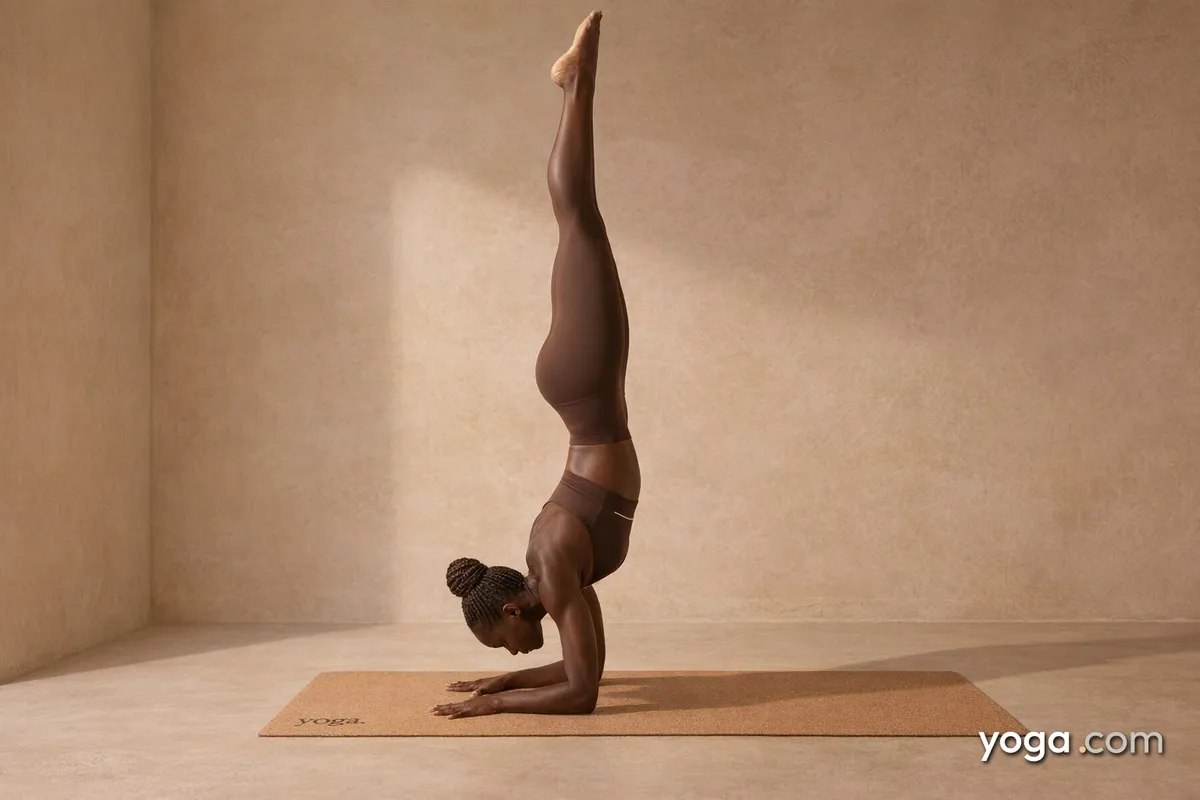
Feathered Peacock Pose - Pīñcha Mayūrāsana in Sanskrit, meaning "feather of the peacock" - is a forearm balance that demands shoulder stability, core control, and the patience to build genuine trust in your upper body. Unlike Handstand, the forearms-down base lowers your center of gravity slightly, but the challenge of keeping the elbows from splaying makes this an honest test of alignment from the ground up.
At a Glance
- Level: Advanced
- Type: Inversion / Arm Balance
- Targets: Shoulder flexors and stabilizers (anterior deltoid, serratus anterior), triceps, core (transverse abdominis, obliques), hip flexors of the lead leg, spinal extensors
- Good for: Building shoulder-girdle strength, developing midline body awareness, training proprioception in an inverted position
How to Do Feathered Peacock Pose
Coming in
- Begin in Dolphin Pose - forearms on the mat, elbows shoulder-width apart, palms flat or fingers interlaced. Press the inner edges of your forearms firmly down and draw the shoulder blades onto the back. Walk your feet toward your elbows until your hips stack over your shoulders as much as possible.
- Decide which leg will lead: this is your raised leg, the one that goes up first and draws the balance point skyward. Lift it high - straight, active, toes reaching toward the ceiling - while the other foot (your pushing leg) remains on the floor.
- Gaze between your forearms or slightly beyond your fingertips. Keep the neck long; do not crank the head up.
- Bend the knee of your pushing leg gently. This slight bend loads the leg so you can spring from it with control rather than a hard kick.
- Press through the ball of your pushing foot and straighten that knee in a smooth, decisive movement, sending the leg upward to meet the raised leg. Let the raised leg lead the momentum - it is already high, pulling the hips over the base. The pushing leg follows and joins it overhead.
- Once both legs are overhead, squeeze them together, flex the feet or point them evenly, and press the floor away through your forearms. Lengthen from elbows to heels in one continuous line.
- Breathe steadily. Maintain active serratus anterior engagement - imagine pushing the ceiling away with your shoulder blades rather than letting them collapse together. Hold for 5-15 breaths, or as long as you maintain clean alignment.
Coming out
- Lower one leg at a time with control, returning the raised leg first, then the pushing leg, to the floor.
- Rest in Child's Pose for several breaths to decompress the spine and let the shoulders release.
Benefits
- Shoulder-girdle strengthening: Sustained forearm pressing develops anterior deltoid, triceps, and serratus anterior, increasing overhead pushing capacity.
- Core integration: Holding both legs vertical requires continuous co-activation of the transverse abdominis and obliques to prevent the lower back from arching.
- Proprioceptive training: Balancing inverted recalibrates your sense of midline and spatial orientation, skills that transfer to many standing and balancing poses.
- Hip-flexor lengthening: The full hip extension of both legs overhead creates an active stretch through the front of the hips and psoas.
- Spinal extension awareness: Maintaining a neutral spine - rather than collapsing into deep backbend - teaches refined control of the spinal extensors under load.
Common Mistakes and Alignment Cues
- Elbows splaying wider than shoulders. Place a block between your thumbs and index fingers, or loop a strap around your upper arms at shoulder width, to train the elbows to stay parallel.
- Dumping into the lower back. If the lumbar collapses into a deep arch, your core is not engaged. Before each attempt, exhale fully and knit the lower ribs down. Think "long spine" rather than "arch up."
- Hard kicking instead of a controlled push-off. A forceful kick makes it nearly impossible to find balance. Practice raising the lead leg high and pausing there before the push-off so that very little momentum is needed from the pushing leg.
- Collapsed shoulders. If the upper back sags between the shoulder blades, press the forearms into the floor and actively protract the scapulae - the ceiling should feel like something you are pushing away.
- Looking too far forward. Straining the neck to see forward compresses the cervical spine. Soften the gaze; let the top of the head point toward the wall in front of you, not upward.
Modifications and Props
- Wall support: Practice with the short edge of your mat a foot from a wall. As the legs come up, allow the heels to lightly touch the wall while you find your balance point and build shoulder endurance.
- Strap and block: A strap around the upper arms prevents elbow splay; a block held between the palms reinforces hand and forearm alignment simultaneously.
- Dolphin Pose holds: Before attempting the inversion, hold Dolphin with feet walked in for 10-20 breaths each session to build the shoulder base the full pose requires.
- One-leg lifts: Stay in Dolphin and simply practice lifting the raised leg high, holding for 5 breaths, then switching. This isolates shoulder stability without the full inversion demand.
Cautions
Avoid or approach with great care if you have shoulder, elbow, wrist, or neck injuries, high blood pressure, a history of vertigo, or are in the first trimester of pregnancy. Do not practice this pose if you have recently had eye or ear surgery, or if you experience head pressure or dizziness in milder inversions. If you're working with an injury or a medical condition, check with a qualified professional before practicing.