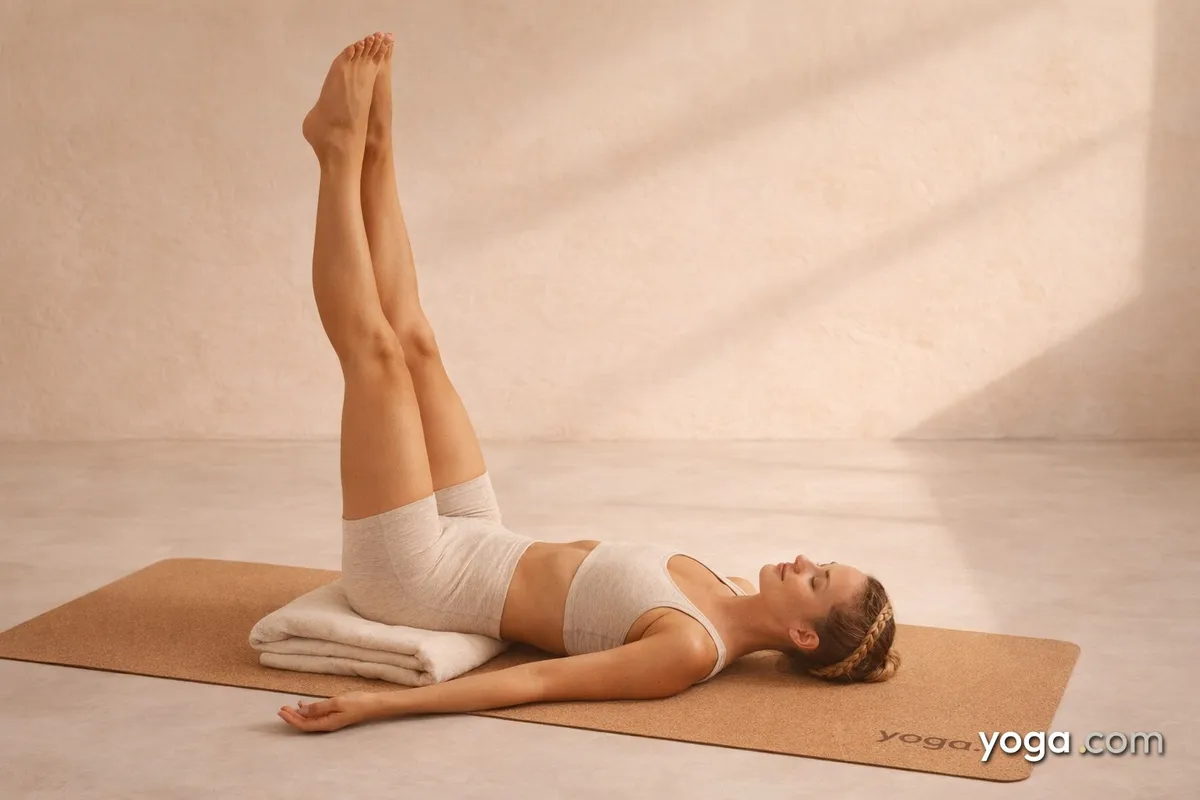
Ūrdhva Prasārita Pādāsana (with support) - literally "upward extended feet pose" - is a gentle supine inversion in which both legs extend vertically toward the ceiling while the pelvis rests on a folded blanket or bolster. The support lifts the hips just enough to ease tension in the lower back and hamstrings, making this a welcoming entry point into the pose family. It works well near the beginning of a restorative sequence or as a quiet, grounding close to an active practice.
At a Glance
- Level: Beginner
- Type: Supine
- Targets: Hamstrings, hip flexors, lumbar spine, calves
- Good for: Lengthening the posterior chain, reducing muscular tension in the legs, calming the nervous system through a mild inversion
How to Do Upward Extended Feet Pose with Support
- Place a folded blanket or low bolster on your mat. Sit on its edge with your knees bent and feet flat on the floor.
- Slowly lower your torso down so your mid-back and shoulders rest on the mat; the blanket should sit beneath your sacrum and lower pelvis, not your lumbar spine.
- Press your feet into the floor and check that your support feels comfortable - shift it forward or back by a few centimetres until your lower back softens.
- On an exhale, draw one knee toward your chest, then extend that leg upward; repeat with the second leg so both feet point toward the ceiling.
- Flex your feet so the heels reach upward and the toes draw back toward your shins - this actively engages the calves and hamstrings.
- Let your arms rest alongside your body, palms turned up, or place your hands lightly on your belly. Soften your jaw, throat, and the space between your shoulder blades.
- Hold for 5-15 breaths, keeping your legs as straight as your hamstrings allow without gripping the hip flexors.
- To come out, bend both knees toward your chest, roll gently to one side, and pause for a breath before pressing up to seated.
Benefits
- Stretches the hamstrings and calf muscles along the full length of the posterior leg.
- Deepens the stretch along the entire posterior chain as the supported pelvis settles into a neutral position.
- The elevated pelvis reduces compressive load on the lumbar vertebrae during the hold.
- Encourages venous return from the lower limbs through mild gravitational reversal.
- Builds awareness of pelvic neutral - a foundational alignment skill carried into standing and seated poses.
- Strengthens the quadriceps isometrically as they work to keep the legs extended.
Common Mistakes and Alignment Cues
- Mistake: Support too far under the lumbar spine. Cue: Slide the blanket so it lifts the sacrum - the bony triangle at the base of the spine - rather than the waist; your lower back should feel broad, not arched.
- Mistake: Legs splayed outward. Cue: Rotate your inner thighs gently toward each other so your toes point straight up; imagine pressing the inner edges of your feet toward the ceiling.
- Mistake: Gripping the hip flexors to hold the legs up. Cue: Engage the quadriceps at the front of the thighs - let them do the work; notice if your belly softens when you stop fighting from the hip crease.
- Mistake: Holding the breath. Cue: Each exhale, let the back of your pelvis release a little heavier onto the support; use the breath to anchor rather than to brace.
- Mistake: Knees locked with excessive force. Cue: Keep a micro-bend available in the knees - straight does not mean rigid.
Modifications and Props
- Tight hamstrings: Keep a generous bend in the knees throughout; the goal is length in the back of the legs, not straight-leg aesthetics.
- Strap: Loop a strap around the balls of both feet and hold one end in each hand; this lets you maintain leg extension without straining the shoulders or neck to reach the feet.
- Wall: Scoot your support close to a wall and rest your heels against it - the wall takes the muscular work out of the hold, shifting the pose toward full restoration.
- Higher support: Stack two folded blankets or use a standard bolster if you need more pelvic lift to feel comfortable in the low back.
Cautions
- Avoid this pose if you have an acute hamstring tear or recent groin strain - the sustained stretch can aggravate newly injured tissue.
- If you have elevated blood pressure or are in the later stages of pregnancy, consult a qualified teacher before practicing any inversion, including mild ones like this.
- Those with sacroiliac joint sensitivity should experiment carefully with prop height; too much elevation can stress the SI joint.
- If you experience any sharp sensation in the knees when straightening the legs, maintain a comfortable bend rather than forcing extension.
If you're working with an injury or a medical condition, check with a qualified professional before practicing.
Related Poses
- Knee Press Both Legs - a natural warm-up that prepares the hips and low back before the legs extend.
- Right Leg Wind Freeing Pose and Left Leg Wind Freeing Pose - single-leg preparatory poses that develop the hip and hamstring mobility used here.
- Corpse Pose - the ideal counter-pose; follow extended feet pose with a full, unsupported rest.
For a practice context, see A Gentle Yoga Routine for Tired, Low-Energy Days and A 10-Move Chair Yoga Sequence for a Midday Reset.