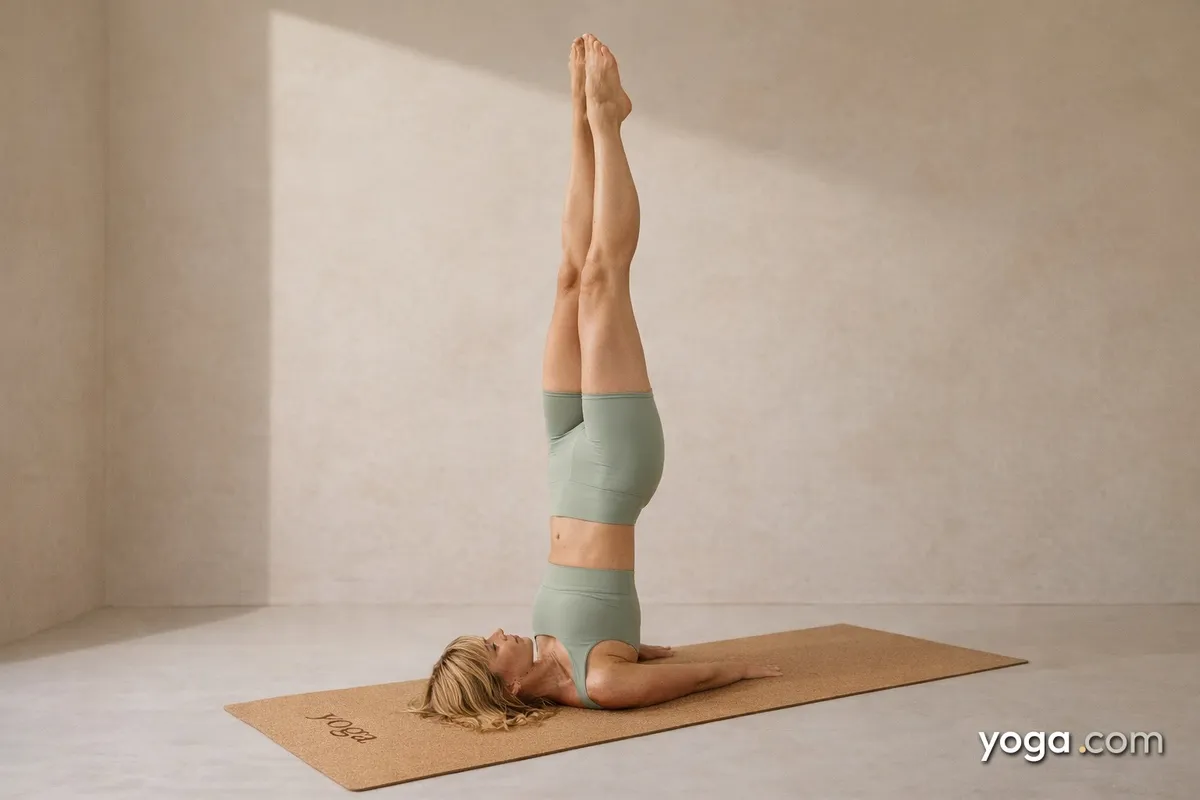
Unsupported Shoulderstand with Hands Behind Back (Nirālamba Sarvāṅgāsana (hands behind back) - literally "all-limbs pose without support, hands behind") strips away the familiar hand-to-back foundation of classical Shoulderstand, demanding that your spine, core, and shoulder girdle maintain vertical alignment entirely through muscular engagement. It belongs to the family of inversions and typically appears near the peak or closing sequence of an advanced practice, after the body is thoroughly prepared.
At a Glance
- Level: Advanced
- Type: Inversion
- Targets: Deep spinal extensors, abdominal stabilizers, posterior shoulder girdle, cervical spine
- Good for: Building full-body axial stability, developing proprioceptive awareness in inversion, strengthening the posterior shoulder and upper back
How to Do Unsupported Shoulderstand with Hands Behind Back
- Begin in Supported Shoulderstand. From Sarvāṅgāsana (Shoulderstand with hands supporting the back), take several breaths to establish a plumb vertical line from shoulders to heels. Confirm that your weight rests on the tops of your shoulders, not the back of your neck.
- Engage the foundation. Root the outer edges of both upper arms evenly into the mat. Draw the shoulder blades toward each other and toward the waist to lift the chest away from the chin. Keep the chin slightly dropped, not pressing into the sternum.
- Activate the core and legs. Firm the thigh muscles, press through all ten toes toward the ceiling, and engage your lower abdominals so the pelvis does not tilt. This full-body activation is what will replace the work of your hands.
- Begin releasing the hands. On an exhale, slowly release one hand from the back and extend that arm alongside the body, palm facing the thigh. Pause and recalibrate your balance before releasing the second hand.
- Bring both hands behind the back. Slide both arms along the floor until they rest behind you, palms facing down, arms active but not gripping. Your torso is now balanced solely on the upper arms and shoulders - without any hand support.
- Hold and breathe. Maintain a long, smooth breath cycle. Keep the gaze straight up toward the ceiling (not side to side). Stay for 5-15 breaths, continuously re-engaging the core and inner legs to prevent the pelvis from tipping.
- To come out: Bend the knees toward the forehead, place the palms back on the floor behind the hips, and slowly roll the spine down vertebra by vertebra. Lower the hips to the mat with control.
- Counter the cervical spine. Rest for several breaths in Corpse Pose, then move gently through a mild backbend such as Bridge Pose before continuing your practice.
Benefits
- Strengthens the deep spinal extensors and multifidus muscles that support axial elongation
- Develops isometric strength through the abdominals, obliques, and hip flexors needed to hold vertical alignment without hand support
- Builds stability and endurance in the posterior shoulder girdle, including the rhomboids and lower trapezius
- Improves proprioceptive sensitivity - you learn to feel spinal alignment rather than relying on tactile feedback from your hands
- Stretches the upper trapezius and posterior cervical muscles through sustained passive lengthening
- Reinforces the neuromuscular coordination developed across the full shoulderstand family
Common Mistakes and Alignment Cues
- Mistake: Collapsing into the neck when the hands release. Cue: Before releasing either hand, over-engage the core and press the upper arms more firmly into the mat - the lift should already feel self-sustaining before the hands leave the back.
- Mistake: Hips drifting toward the head once hands are removed. Cue: Imagine a straight rod running from your ankles through the crown of your head; re-stack the pelvis directly over the shoulders by firming the lower abdominals and pressing the inner thighs together.
- Mistake: Turning the head to check alignment. Cue: Fix your gaze on a single point directly above you - your nose, the ceiling, or your big toes - and keep it there for the duration of the hold.
- Mistake: Arms lying passively on the floor. Cue: Extend energy through the fingertips and press the backs of the arms lightly downward; active arms contribute to overall postural stability even without touching the back.
- Mistake: Holding the breath. Cue: If smooth, full breathing stops, come out of the pose - breath retention is a sign the nervous system is overloaded and risk of strain increases.
Modifications and Props
- Folded blankets under the shoulders: Place two to three firm, folded blankets under the upper back and shoulders (head on the mat below blanket level) to reduce the acute angle at the cervical spine. This is the most important prop for this pose family and is recommended even for experienced practitioners.
- One hand at a time: Practice releasing only one hand to the floor while the other continues to support the back. Hold for five breaths, return the hand, and repeat on the other side before attempting the full bilateral release.
- Wall support: Set up with your shoulders about six inches from the wall. In the full pose, lightly rest the soles of the feet against the wall - it provides enough tactile feedback to help you find vertical without bearing weight.
- Build time in supported Shoulderstand first: If you cannot hold Supported Shoulderstand for at least two minutes with ease, this variation is not yet accessible. Use that pose as your consistent preparation.
Cautions
- Neck or cervical disc issues: Any acute or chronic cervical spine condition contraindicates this pose. The unsupported version places greater compressive demand on the neck than classical Shoulderstand; do not practice it without guidance from a qualified teacher if you have any history of neck injury.
- High blood pressure or glaucoma: Sustained inversions increase intracranial and intraocular pressure. Approach this pose only after establishing a stable, consistent inversion practice and with appropriate professional guidance.
- Pregnancy: Avoid this pose during pregnancy, particularly after the first trimester.
- Shoulder or rotator cuff injury: The weight-bearing demand on the posterior shoulder in this variation is significant; a compromised shoulder joint is at higher risk of strain without hand support.
If you're working with an injury or a medical condition, check with a qualified professional before practicing.
Related Poses
- Bridge Pose - an accessible backbend that warms the posterior shoulder girdle and prepares the cervical spine for the shoulderstand family
- Plow Pose - a direct preparation and counter-pose that shares the same shoulder-base foundation and decompresses the lumbar spine after inversion
- Ear Pressure Pose - a natural progression from Plow Pose that deepens spinal flexion within the same inversion sequence
- Corpse Pose - the essential counter-pose to follow any shoulderstand variation, allowing the nervous system and cervical spine to reset
Looking for gentler ways to build toward inversions? Explore A Gentle Yoga Routine for Tired, Low-Energy Days or try the accessible options in A 10-Move Chair Yoga Sequence for a Midday Reset.