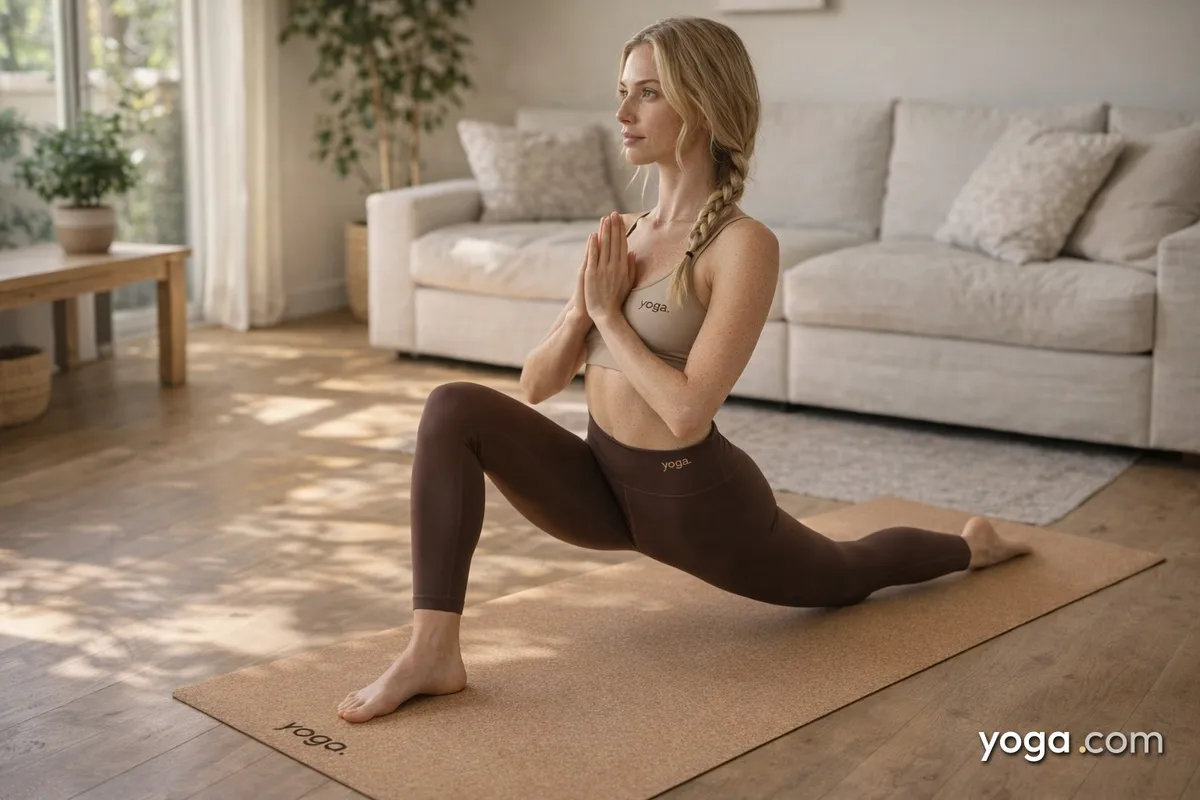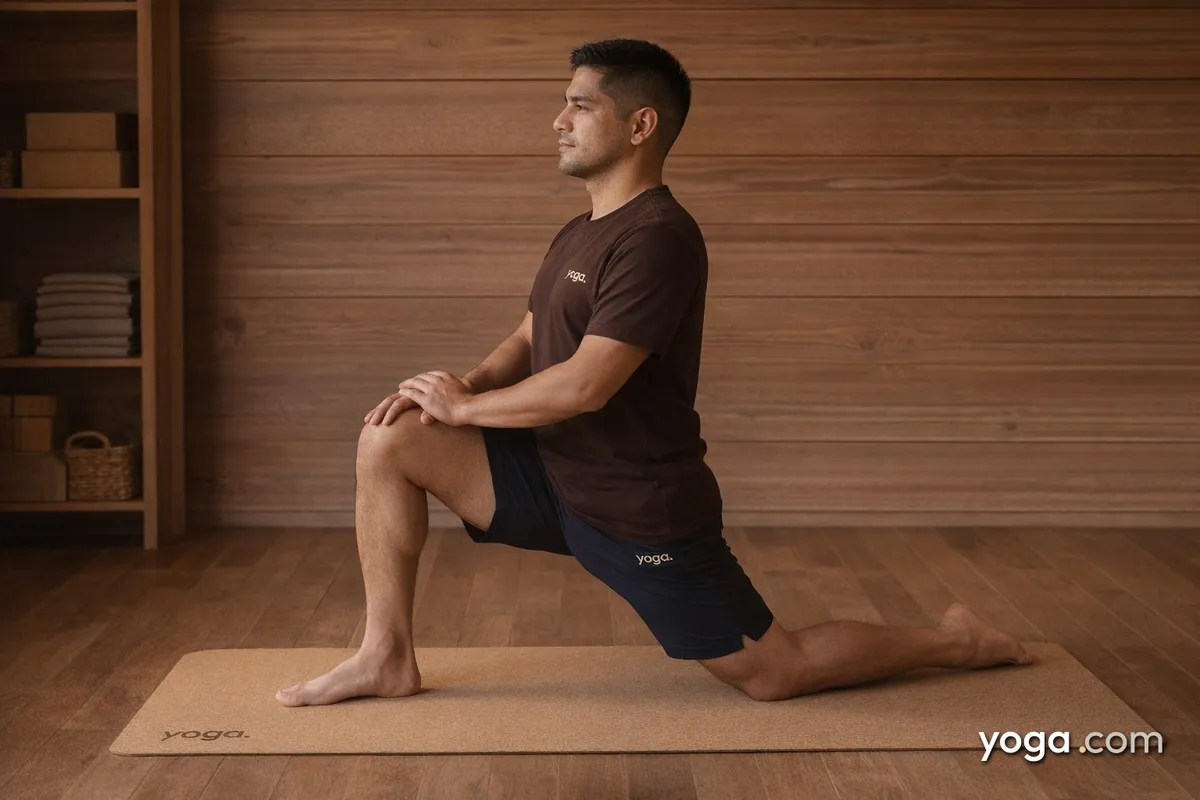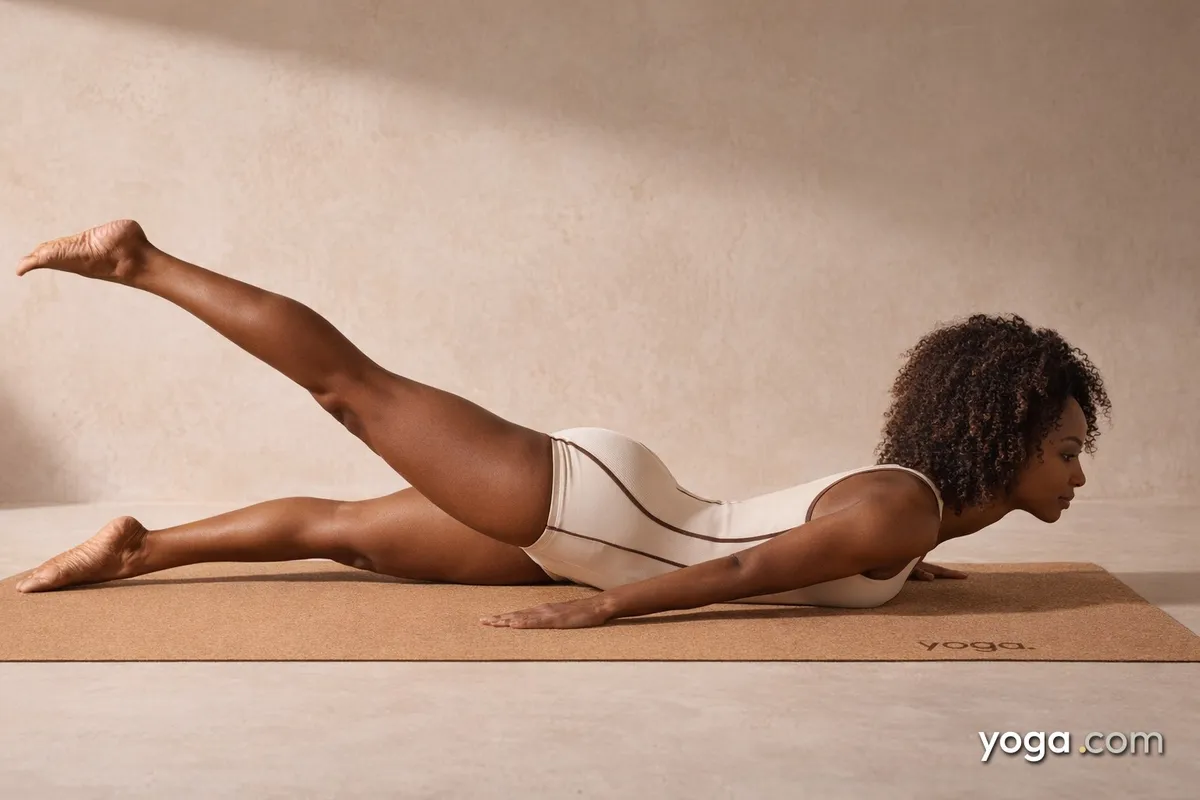
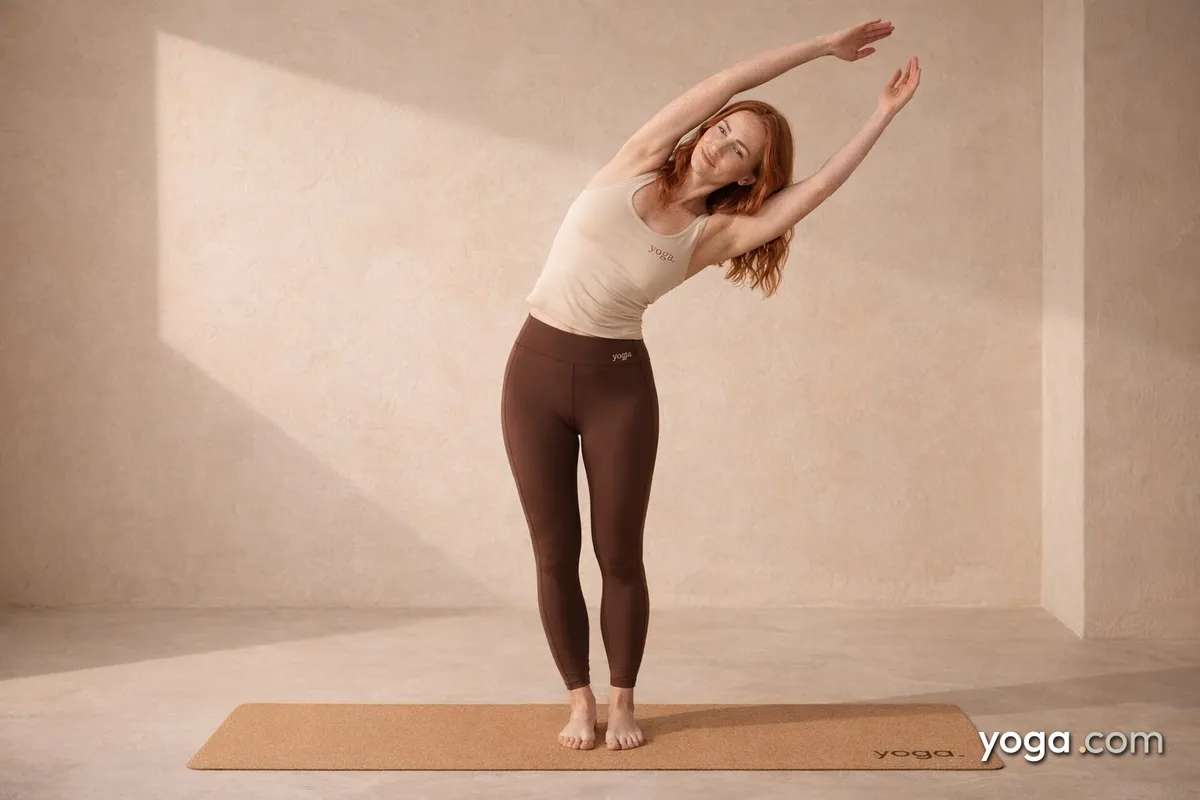
Two Arm Left Bend is a standing lateral flexion pose in which both arms reach overhead as you side-bend the entire torso to the left. Its Sanskrit name is Pārśvāsana (two arms, left bend), from pārśva meaning "side" or "flank." It appears early in standing sequences as a clean way to introduce lateral movement and overhead arm work before progressing to deeper side-body shapes.
At a Glance
- Level: Beginner
- Type: Standing
- Targets: Intercostals, obliques, latissimus dorsi, shoulder girdle
- Good for: Lengthening the side body, building shoulder stability overhead, improving spinal mobility in the frontal plane
How to Do Two Arm Left Bend
- Begin in Mountain Pose - feet hip-width apart, weight evenly distributed across both soles, arms at your sides.
- On an inhale, sweep both arms out to the sides and up overhead, palms facing each other, fingertips reaching toward the ceiling. Press all four corners of both feet firmly into the mat.
- Engage your core lightly - draw the low ribs in without gripping - and lengthen through the crown of your head to create space in the spine.
- On your next exhale, begin to arc both arms and your upper body to the left. Hinge from the waist, keeping the hips level and square to the front. Think of the movement as a long, even curve from tailbone to fingertips - not a collapse.
- Continue to reach actively through both hands as you hold the bend; let the left arm lead the arc while the right arm stretches the right side body fully. Gaze can stay forward or tilt gently upward toward the ceiling - whichever keeps the neck long.
- Hold for 3-5 steady breaths. Each inhale, lengthen the spine a little more; each exhale, allow the arc to deepen slightly without forcing.
- To come out, inhale and draw both arms back to center overhead, restoring a tall spine.
- Exhale and lower your arms to your sides, returning to Mountain Pose. Pause for one breath before practicing the right-side variation.
Benefits
- Stretches the intercostal muscles and the obliques along the right side of the torso when bending left.
- Lengthens the latissimus dorsi and the quadratus lumborum on the side opposite the bend.
- Builds isometric shoulder stability as both arms sustain an overhead load against gravity.
- Promotes frontal-plane mobility in the thoracic and lumbar spine.
- Strengthens the standing leg muscles through sustained weight-bearing and grounding.
- Improves postural awareness of the relationship between the pelvis and ribcage.
Common Mistakes and Alignment Cues
- Mistake: The hips shift to the right as the torso bends left. Cue: Root both feet evenly and keep your hips stacked directly over your ankles - the lower body stays still while only the spine moves.
- Mistake: The chest rotates toward the floor. Cue: Keep both sides of the chest open and facing forward, as if two headlights on your sternum are shining straight ahead.
- Mistake: The arms collapse forward instead of staying in line with the ears. Cue: Draw the outer upper arms slightly back so the biceps bracket your ears, and press through your palms as though pushing the ceiling away.
- Mistake: Over-bending in the lumbar spine while the thoracic spine stays flat. Cue: Initiate the curve from the upper back first; distribute the arc evenly across every vertebra rather than cranking from the lower back.
- Mistake: Holding the breath. Cue: Let the inhale expand the right ribs and the exhale deepen the bend - breathing is your main tool here.
Modifications and Props
- Hands to a wall: Stand one arm's length from a wall, place both palms on the wall at shoulder height, and practice the lateral arc from that supported position to get the shape without full overhead loading.
- Reduce arm height: If lifting both arms fully overhead compresses the neck or strains the shoulders, keep the hands at shoulder height or interlace them at the low back and simply side-bend the torso.
- Feet wider: A slightly wider stance (beyond hip-width) lowers your center of gravity and makes it easier to keep the hips stable as you arc to the side.
- Strap between hands: Loop a yoga strap and hold each end to maintain shoulder-width spacing overhead - useful if the hands tend to drift together and compress the neck.
Cautions
- Avoid forcing the depth of the bend if you feel sharp or pinching sensations in the lower back; work within a comfortable range.
- Those with shoulder impingement or recent rotator-cuff issues may need to lower the arms or skip the overhead position entirely.
- If you experience dizziness with the gaze upward, keep your eyes level with the horizon throughout.
- Practice with care if you have a herniated disc or acute spinal condition - keep the range of motion small and prioritize length over depth.
If you're working with an injury or a medical condition, check with a qualified professional before practicing.
Related Poses
- Mountain Pose - the foundation you start and return to; use it to reset alignment between sides.
- Mountain Pose with Upward Stretch - the direct preparation for this pose; it establishes the overhead arm position before the lateral arc is added.
- Right Triangle Pose - a natural next step that adds a wider stance and greater lateral reach once the basic arc is familiar.
- Child's Pose - an accessible counter-pose that releases the side body and lower back after standing lateral work.
Want to put this pose to work in a sequence? Try it in A Gentle Yoga Routine for Tired, Low-Energy Days or explore the seated counterpart in A 10-Move Chair Yoga Sequence for a Midday Reset.