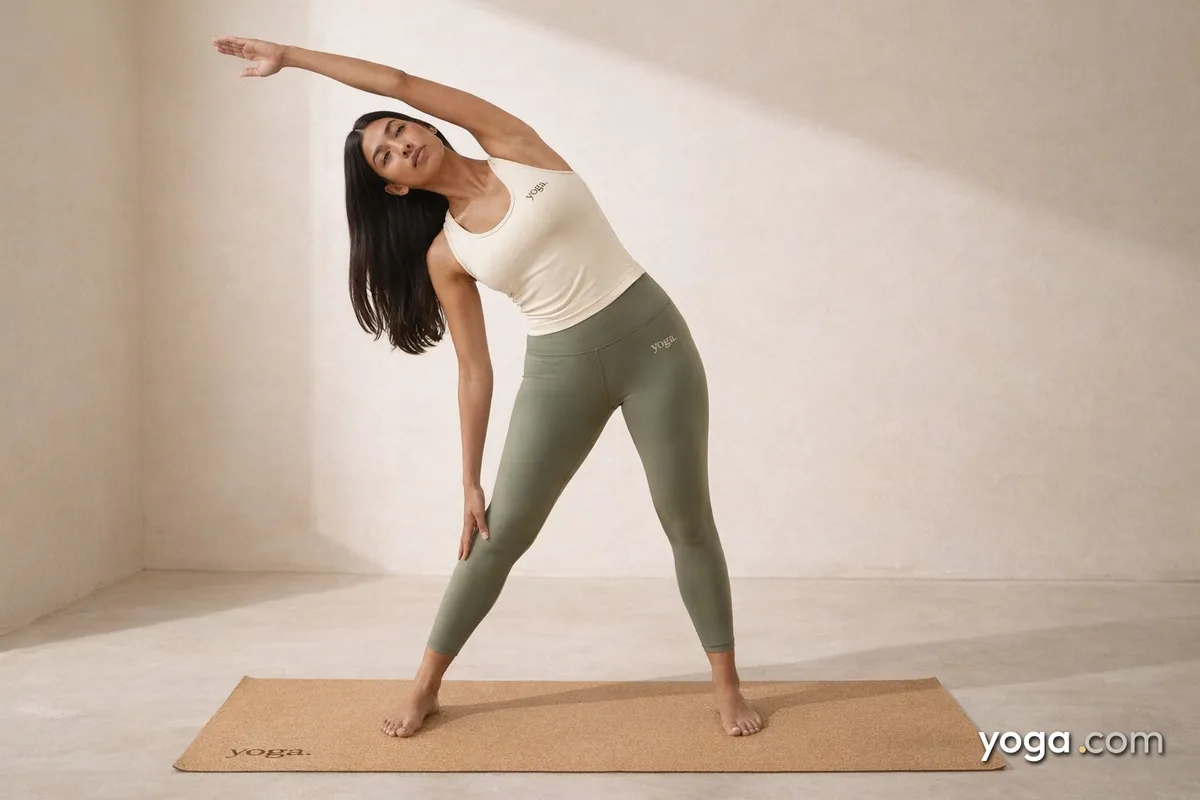
Right Bend is a standing lateral flexion pose known in Sanskrit as Pārśvāsana (right side) - from pārśva, meaning "side" or "flank." It is a gentle arc of the entire torso toward the right, practiced from a tall standing base. Simple enough for new students, it works well early in a standing sequence as both a warm-up for the spine and a preparation for deeper side-body work.
At a Glance
- Level: Beginner
- Type: Standing
- Targets: Lateral spine, intercostal muscles, obliques, hip abductors
- Good for: Lengthening the left side body, building postural awareness, improving spinal mobility in the frontal plane
How to Do Right Bend
- Stand in Mountain Pose with your feet hip-width apart, arms at your sides, and weight evenly distributed across both feet.
- On an inhale, sweep both arms overhead with palms facing each other, or interlace the fingers and press the index fingers toward the ceiling.
- Root firmly through both feet - especially the outer edge of the left foot - and lengthen your spine upward before you move sideways.
- On an exhale, hinge the torso smoothly to the right, leading with the fingertips. Keep both arms alongside your ears and your chest open toward the front wall, not toward the floor.
- Hold the arc for 3-5 steady breaths. Each inhale, lengthen through the left side body; each exhale, deepen the bend slightly without collapsing the right waist.
- Keep both hips level and stacked - resist letting the left hip jut out to the side, and keep the right hip from dropping.
- To come out, press firmly through both feet and use an inhale to draw the torso back to center, arms still overhead.
- Exhale and lower the arms to your sides, returning to Mountain Pose.
Benefits
- Stretches the intercostal muscles and the left-side obliques and quadratus lumborum
- Mobilizes the thoracic and lumbar spine in lateral flexion
- Strengthens the right-side obliques and lateral stabilizers that contract to hold the bend
- Lengthens the latissimus dorsi and the muscles of the left armpit and shoulder
- Builds proprioceptive awareness of bilateral hip alignment in standing
Common Mistakes and Alignment Cues
- Chest rotating toward the floor: Imagine your torso is sandwiched between two panes of glass - keep both sides of the chest facing straight ahead as you arc to the right.
- Collapsing the right waist: Rather than just drooping to the right, actively lengthen both sides of the torso, then bend. Think "up and over" rather than "down."
- Left hip hiking outward: Press the outer left foot firmly into the floor and draw the left hip back toward center so both hip points stay level.
- Arms drifting forward off the ears: Keep the biceps close to the ears throughout the arc to maintain shoulder girdle integrity and a true lateral bend.
- Holding the breath: Let the breath guide the movement - inhale to grow tall, exhale to bend; shallow breathing signals you've gone too far.
Modifications and Props
- Hands to hips: If raising both arms overhead is uncomfortable for the shoulders, place both hands on your hips and bend the torso to the right, using the hands to check that the hips stay even.
- Wall support: Stand with your left side about a foot from the wall. As you bend right, press the left hand lightly into the wall for feedback on how far the hip is drifting.
- Chair support: Seated in a firm chair, root both sitting bones evenly, raise the arms overhead, and practice the lateral arc - useful when balance or standing endurance is limited.
- One arm only: Keep the left arm alongside the left ear overhead and let the right hand trail down the right thigh. This reduces shoulder load while still opening the left side body fully.
Cautions
- Recent or acute spinal injury: Lateral flexion places asymmetrical load on the discs and facet joints - move conservatively and stop if you feel sharp or radiating pain.
- Shoulder impingement or rotator-cuff issues: Avoid the overhead arm position; use the hands-on-hips or single-arm variation instead.
- Balance challenges: Stand near a wall or use the chair modification; a narrow stance increases instability in this pose.
- Rib or intercostal strain: Any pulling sensation at the side ribs that sharpens with breath is a signal to reduce the depth of the bend.
If you're working with an injury or a medical condition, check with a qualified professional before practicing.
Related Poses
- Mountain Pose - the standing foundation this pose grows from
- Mountain Pose with Upward Stretch - the immediate preparation, establishing the arms-overhead position
- Right Triangle Pose - the natural progression, deepening lateral opening with a wide-leg base
- Child's Pose - a restful counter-pose that neutralizes the spine after lateral work
Put this pose to work in a full practice: A Gentle Yoga Routine for Tired, Low-Energy Days or try it seated in A 10-Move Chair Yoga Sequence for a Midday Reset.