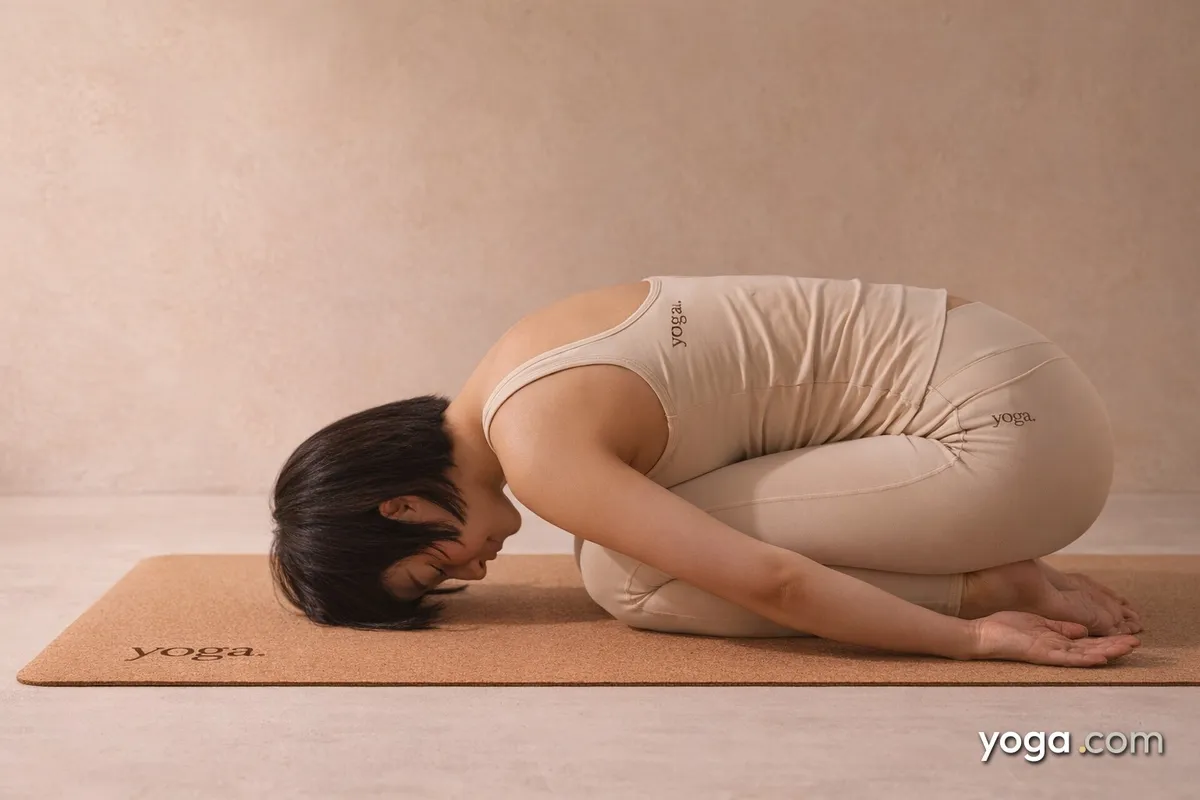
Hare Pose with Thighs Forward and Arms Alongside Legs is a compact, grounded forward fold practiced from a kneeling position with the thighs vertical and the arms resting alongside the body rather than extended overhead. Its Sanskrit name is Śaśāṅkāsana (thighs forward, arms alongside legs) - śaśa meaning hare and aṅka meaning lap or angle - evoking the tucked, restful shape of a hare at rest. This variation fits naturally in the middle or closing portion of a practice, offering a moment of inward attention after more active standing or backbending work.
At a Glance
- Level: Beginner
- Type: Forward Bend
- Targets: Lower back, hips, spine (cervical and thoracic), knees
- Good for: Lengthening the spine, releasing tension across the upper back, calming the nervous system through a mild inversion of the head
How to Do Hare Pose with Thighs Forward and Arms Alongside Legs
- Begin in a kneeling position (Vajrasana) with your knees and feet together, the tops of your feet flat on the mat, and your hands resting on your thighs. Sit tall and take a full breath to lengthen the spine.
- On an exhale, engage your core lightly and begin to hinge forward from the hips, keeping your thighs as vertical as possible - resist the urge to sit your hips back toward your heels.
- Lower your torso toward the mat, letting the forehead or crown of the head come to rest on the floor or a folded blanket in front of your knees.
- Release both arms alongside the body, palms facing up or down, fingers pointing toward your feet. Allow the shoulders to drop away from the ears and the elbows to soften.
- Keep the thighs perpendicular to the floor - think of the front of the thighs maintaining contact with the lower ribs as the torso folds forward over them.
- Soften the muscles of the face, jaw, and throat. Let the weight of the head be fully supported by the mat. Hold for 5-10 breaths, breathing evenly into the back body.
- To come out, press your hands gently to the mat beside your knees and use a slow inhale to rise back up to kneeling, stacking the spine one vertebra at a time from the base.
- Return to Vajrasana and take one or two neutral breaths before moving into your next pose.
Benefits
- Stretches the muscles of the lower back and lengthens the entire posterior spine.
- The deep hip flexion compresses the front hip; the stretch is felt in the lower back and spine rather than in the hip flexors.
- Releases tension across the upper back and between the shoulder blades by allowing gravity to round the thoracic spine gently.
- Brings the head below the heart, encouraging a quieting effect on the breath and a reduction in physical arousal.
- Strengthens passive awareness of diaphragmatic breathing by directing breath into the back ribs.
Common Mistakes and Alignment Cues
- Hips drifting back to the heels: Keep your thighs vertical throughout. If the hips drop back, the distinctive quality of this variation - the compression of the front body against the thighs - is lost.
- Neck craning or head lifting: Let the forehead or crown rest fully on the mat. Place a folded blanket under the forehead if the floor feels far away, rather than holding the neck up under tension.
- Shoulders creeping toward the ears: Consciously roll the shoulders back and down before you fold, and maintain that release as the arms lie alongside the legs.
- Shallow breathing: Direct your breath into the back of the ribcage. Each inhale should gently widen the back body; each exhale lets the torso settle a little more.
- Rushing out of the pose: Rise slowly on an inhale, using the hands on the floor for support. Coming up too quickly can cause lightheadedness because of the mild inversion.
Modifications and Props
- Blanket under the forehead: If your head does not reach the mat comfortably, stack one or two folded blankets on the floor to meet your forehead. This prevents neck strain and allows you to fully release the weight of the head.
- Blanket between thighs and calves: If kneeling is uncomfortable at the knee joint, roll a firm blanket and place it behind the knees before folding. This reduces the degree of knee flexion and eases pressure on the joint.
- Bolster under the torso: Place a bolster lengthwise between your knees and the floor so your torso rests on it as you fold. This makes the pose fully restorative and removes any effort from holding the shape.
- Toes tucked under: If the tops of the feet are tender or the ankles are stiff, try tucking the toes under to lift the heels slightly, which changes the angle at the ankle without altering the essential shape of the pose.
Cautions
- Knee sensitivity: High degrees of knee flexion are required to kneel. If you experience sharp pain (not mild discomfort) in the knee joint, use a rolled blanket behind the knees or skip this pose.
- Recent or acute low-back issues: Forward folding with a rounded spine is contraindicated for some spinal conditions. Approach cautiously and stop if you feel pinching or sharp sensation in the lumbar spine.
- High blood pressure or glaucoma: Because the head drops below the heart, exercise care if you have unmanaged high blood pressure or increased intraocular pressure.
- Pregnancy (second and third trimester): The compression of the abdomen against the thighs is not appropriate as pregnancy progresses; modify with a wider knee position or choose a different forward fold.
- If you're working with an injury or a medical condition, check with a qualified professional before practicing.
Related Poses
- Cat Pose - a gentle spinal warm-up that prepares the back body for forward folding from a similar kneeling base.
- Seated Forward Bend - a natural progression that extends the forward-fold shape with the legs straight, deepening the hamstring stretch.
- Downward-Facing Dog Pose - an effective counter-pose that re-extends the spine and opens the backs of the legs after the rounded, compressive shape of Hare Pose.
- Bridge Pose - a complementary backbend that creates an opening across the front body as a counterbalance to the forward fold.
For practice context, see A Gentle Yoga Routine for Tired, Low-Energy Days and A 10-Move Chair Yoga Sequence for a Midday Reset.