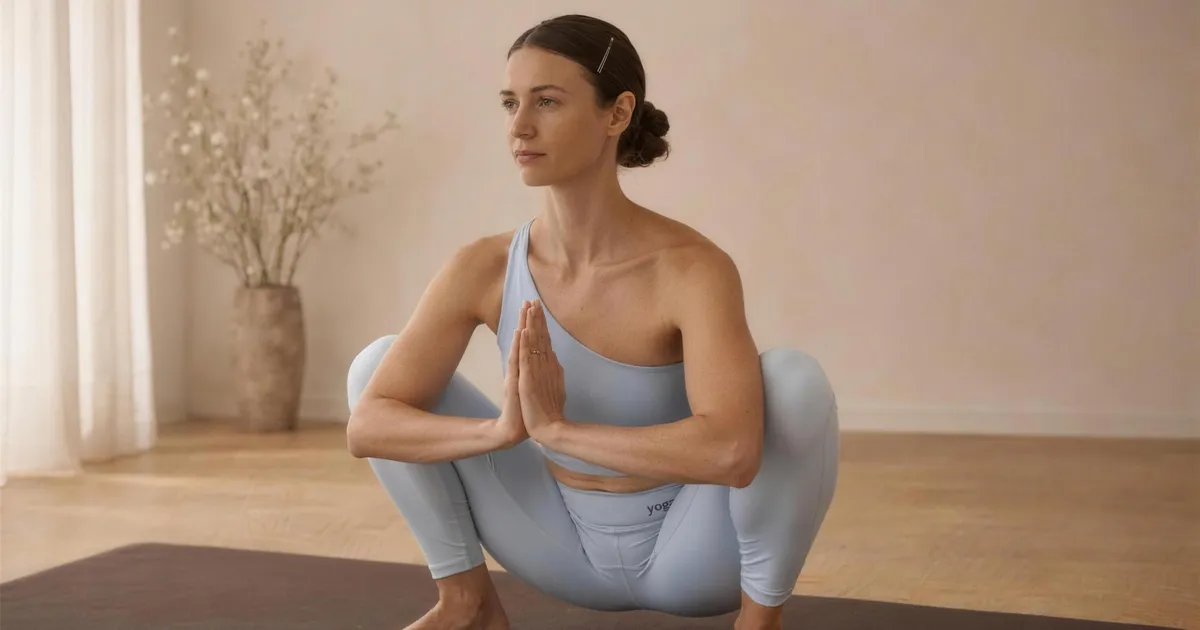
Garland Pose (Mālāsana - from mālā, meaning "garland" or "wreath") is a deep squat that returns your hips to one of the body's most natural resting positions. It appears in both standing warm-up sequences and hip-opening flows, making it a reliable anchor pose at any point in your practice.
At a Glance
- Level: Beginner
- Type: Standing
- Targets: Hips, groin, ankles, lower back
- Good for: Increasing hip mobility, lengthening the inner thighs, building ankle stability
How to Do Garland Pose
- Stand at the top of your mat with your feet slightly wider than hip-width apart. Turn your toes out about 45 degrees, heels in.
- Bring your hands to your heart in Anjali Mudrā (palms pressed together at your chest) and take a full breath in.
- On your exhale, bend your knees and lower your hips toward the floor, coming into a deep squat. Keep your spine long - avoid rounding heavily through the upper back.
- Separate your thighs slightly wider than your torso and lean your upper body gently forward between your knees.
- Press your upper arms against the inner edges of your knees and use that resistance to broaden your chest. Your elbows press out; the knees press back - a two-way action that opens the hips.
- Keep your heels on the floor if possible. Let your gaze soften forward or slightly downward at a comfortable distance on the mat.
- Hold for 5-10 breaths, keeping the breath steady and the spine as upright as your body allows.
- To come out: place your hands on the floor in front of you, press firmly through your feet, and rise back to standing on an inhale. Stand in Mountain Pose for a breath before moving on.
Benefits
- Stretches the hip flexors, inner groin, and adductors through a full range of motion.
- Mobilizes the ankle joint by loading it in dorsiflexion with body weight.
- Lengthens the muscles along the lower back and sacrum.
- Strengthens the intrinsic muscles of the feet and the muscles that stabilize the knee in a flexed position.
- Activates the deep core by requiring the trunk to stay upright against gravity in a low squat position.
Common Mistakes and Alignment Cues
- Heels lifting off the floor: Tight calves or ankles often cause the heels to rise. Place a folded blanket or wedge under both heels to give them a surface to press into while you build ankle mobility over time.
- Knees collapsing inward: The inner knees should track over the second toe. Use the elbow-to-knee contact to gently push the knees wide and firm the outer hips.
- Heavy rounding in the upper back: A slumped spine compresses the front body. Draw the crown of your head upward and broaden across the collarbones to find length from tailbone to skull.
- Weight falling back onto the heels: Spread all four corners of each foot evenly and press the ball of the big toe into the mat to distribute weight forward and back equally.
- Breath held or shallow: The compression of this position can shorten the breath. Consciously direct each inhale into the back ribs and sides of the waist.
Modifications and Props
- Heels raised: Roll a mat, fold a blanket, or use a wedge block under both heels. This reduces the demand on ankle dorsiflexion and lets the spine stay longer immediately.
- Seated on a block: Place a block on its highest setting between your feet and rest your sit bones on it. This reduces the full load through the hips and knees while preserving the hip-opening shape.
- Wall support: Stand with your back a few inches from a wall. Lower into the squat and let the wall lightly support your sacrum to maintain balance.
- Strap around waist: Loop a strap around a sturdy post at hip height, hold both ends, and use your arms to counterbalance as you sink lower - useful when balance is the limiting factor.
Cautions
- Knee discomfort: If you feel pain (not just sensation) in or around either knee joint, come partway out of the squat or sit on a block rather than loading the joint through its full range.
- Recent or chronic ankle injury: Raise the heels and reduce the depth of the squat until strength and stability return.
- Pregnancy (late term): The pose can be practiced with modifications and support, but avoid significant abdominal compression; use props generously and keep the torso more upright.
- Low-back sensitivity: Prioritize a long spine over maximum squat depth; stop well before any pinching or sharp sensation in the lumbar region.
- If you're working with an injury or a medical condition, check with a qualified professional before practicing.
Related Poses
- Mountain Pose - the grounding starting and finishing point for this squat.
- Chair Pose - builds the quad and glute strength that supports a steady Mālāsana.
- Child's Pose - a gentle counter-pose after the deep hip flexion of Garland.
- Downward-Facing Dog Pose - stretches the calves and hamstrings that can limit heel contact in Garland.
Put Garland Pose to work in a full sequence: A Gentle Yoga Routine for Tired, Low-Energy Days or adapt it to A 10-Move Chair Yoga Sequence for a Midday Reset.