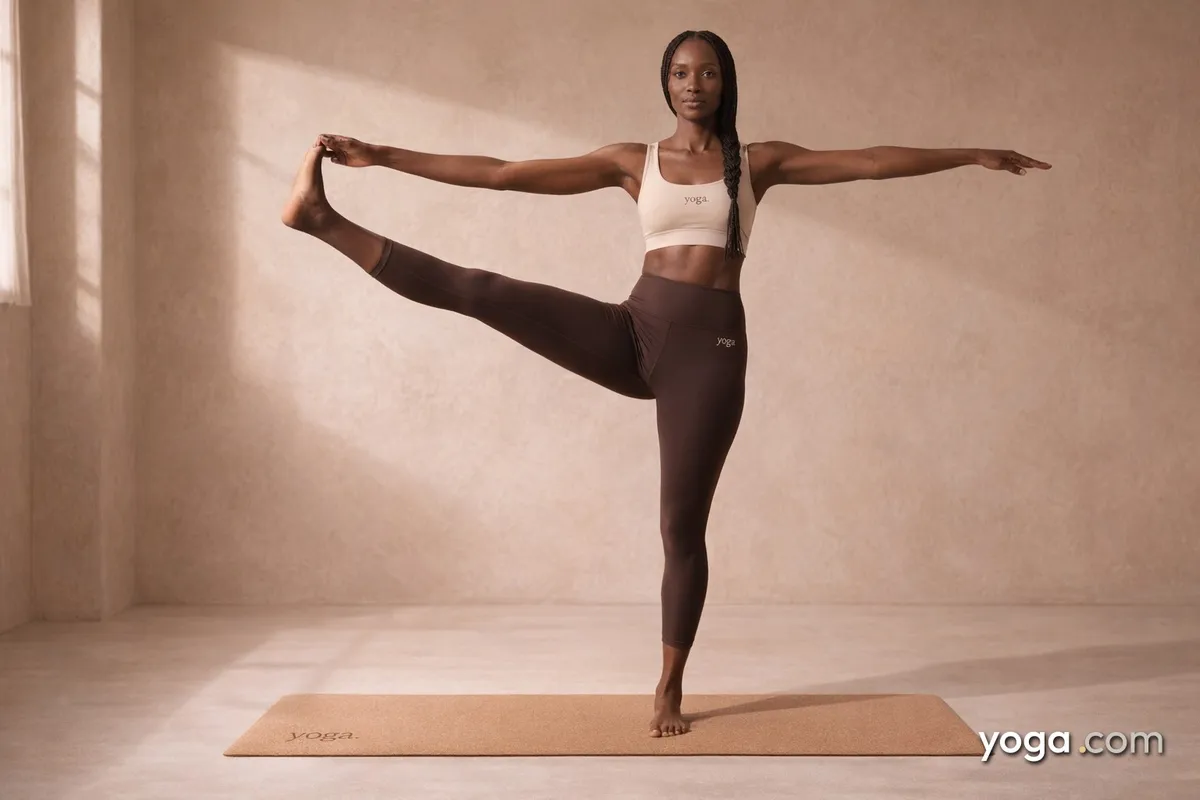
Advanced Extended Right Hand to Big Toe Pose is a demanding standing balance that takes the classic extended-leg hold to its full expression - right leg extended straight out to the side, both arms open wide, and gaze fixed steadily forward. Its Sanskrit name is Utthita Hasta Pādāṅguṣṭhāsana (right, advanced), literally "extended hand to big toe pose," with the advanced form releasing the hand from the foot entirely so the leg floats unsupported. This pose typically appears toward the peak of a standing sequence, after the hips, hamstrings, and hip flexors are thoroughly warm.
At a Glance
- Level: Advanced
- Type: Balance
- Targets: Standing leg hip stabilizers, lifted-leg hamstrings, adductors, core
- Good for: Building single-leg stability, lengthening the hamstrings and inner thigh of the raised leg, developing proprioceptive control
How to Do Advanced Extended Right Hand to Big Toe Pose
- Begin in Mountain Pose. Ground evenly through all four corners of the left foot, engage the left quadricep, and stack your hips level.
- Shift your weight fully onto the left foot. Bend the right knee and draw it toward your chest, clasping the right big toe with the first two fingers and thumb of your right hand.
- Straighten the right leg forward as completely as possible, pressing the heel away. Keep the standing leg firm and the spine tall - resist the urge to lean back to accommodate the lift.
- Once the right leg is stable forward, begin to open it to the right side, rotating from the right hip socket. Move slowly; let the inner thigh lengthen rather than forcing the leg higher.
- When the leg is extended fully to the right at hip height or above, stabilize. Now, with deliberate control, release your right hand from the toe and extend both arms out to the sides at shoulder height, palms facing down.
- Hold the leg in space with no support from the hand. Draw the lower belly in and up, broaden across the collarbones, and fix your drishti (gaze) on a single point at eye level straight ahead - not toward the raised leg.
- Breathe steadily for 5-8 breaths, keeping the lifted foot flexed and the standing ankle stable.
- To come out, re-engage the right hip flexor, bring the leg back to center, bend the knee, and lower the foot with control to the floor. Return to Mountain Pose and pause before switching sides.
Benefits
- Strengthens the gluteus medius and hip abductors of the standing leg, building lateral hip stability.
- Stretches the hamstrings and inner thigh (adductors) of the raised right leg.
- Challenges deep core engagement - the transverse abdominis works continuously to maintain an upright torso.
- Trains proprioception and neuromuscular coordination through sustained single-leg balance without hand assistance.
- Builds hip flexor endurance and strength in the lifted leg.
- Strengthens the intrinsic muscles of the standing foot and ankle.
Common Mistakes and Alignment Cues
- Hiking the standing hip: If the left hip rises as you open the right leg, lower the raised leg until the pelvis can stay level. Hip stability matters more than leg height.
- Collapsing the torso sideways: Keep length through both sides of the waist equally. Think of lifting the crown of the head straight up, not tilting toward the raised leg.
- Locking or hyperextending the standing knee: Maintain a micro-bend in the left knee to keep the joint safe and the leg muscles actively engaged.
- Rushing the hand release: Only remove the hand from the toe once the leg is fully extended and the balance is stable. Premature release causes the leg to drop and the spine to pitch.
- Gaze drifting toward the raised leg: Keep your drishti forward and level. Turning the head disrupts the vestibular system and destabilizes the balance.
Modifications and Props
- Strap around the right foot: Loop a strap around the right arch and hold both ends with the right hand. This keeps the leg extended while you develop hamstring length before attempting the unsupported version.
- Hand remains on the toe: Practice the full side extension with the hand still holding the big toe. This is the standard (non-advanced) variation and a valid stopping point until the hip flexors are strong enough to hold the leg independently.
- Wall for the standing hip: Stand with the left side of your body an inch from the wall. If the standing hip drifts outward, the wall gives tactile feedback without bearing weight.
- Lower the leg height: Extend the right leg to the side at a 45-degree angle rather than parallel to the floor. Working with gravity at a smaller angle builds the necessary hip abductor and flexor strength progressively.
Cautions
- Hamstring or groin strain: Avoid forcing the leg higher than your current flexibility allows. Any sharp pulling sensation at the back of the thigh or inner groin is a signal to lower the leg or use a strap.
- Hip, knee, or ankle injury on the standing leg: The single-leg load in this pose is significant. Practice near a wall until you are confident in the joint's stability.
- Recent low-back injury: The unsupported leg creates a strong lever that loads the lumbar spine. Keep the core firmly engaged and avoid any extension or compression in the lower back.
- Vertigo or inner ear conditions: The prolonged, unassisted balance challenge can be disorienting. Reduce hold time and keep a wall within reach.
If you're working with an injury or a medical condition, check with a qualified professional before practicing.
Related Poses
- Tree Pose on Right Foot - a foundational single-leg balance that trains the standing foot and hip stability needed here.
- Advanced Extended Left Hand to Big Toe Pose - the direct counterpart on the opposite side; practice both to balance strength and flexibility.
- Standing Lord of Dance Pose with Right Foot Near the Head - the natural next progression in single-leg standing balance, demanding even greater hip mobility and core control.
- Mountain Pose - the essential reset between standing balance poses, where you reestablish even footing and breath before transitioning sides.
For gentler standing balance work, see A Gentle Yoga Routine for Tired, Low-Energy Days. If you prefer a seated approach to building body awareness, try A 10-Move Chair Yoga Sequence for a Midday Reset.