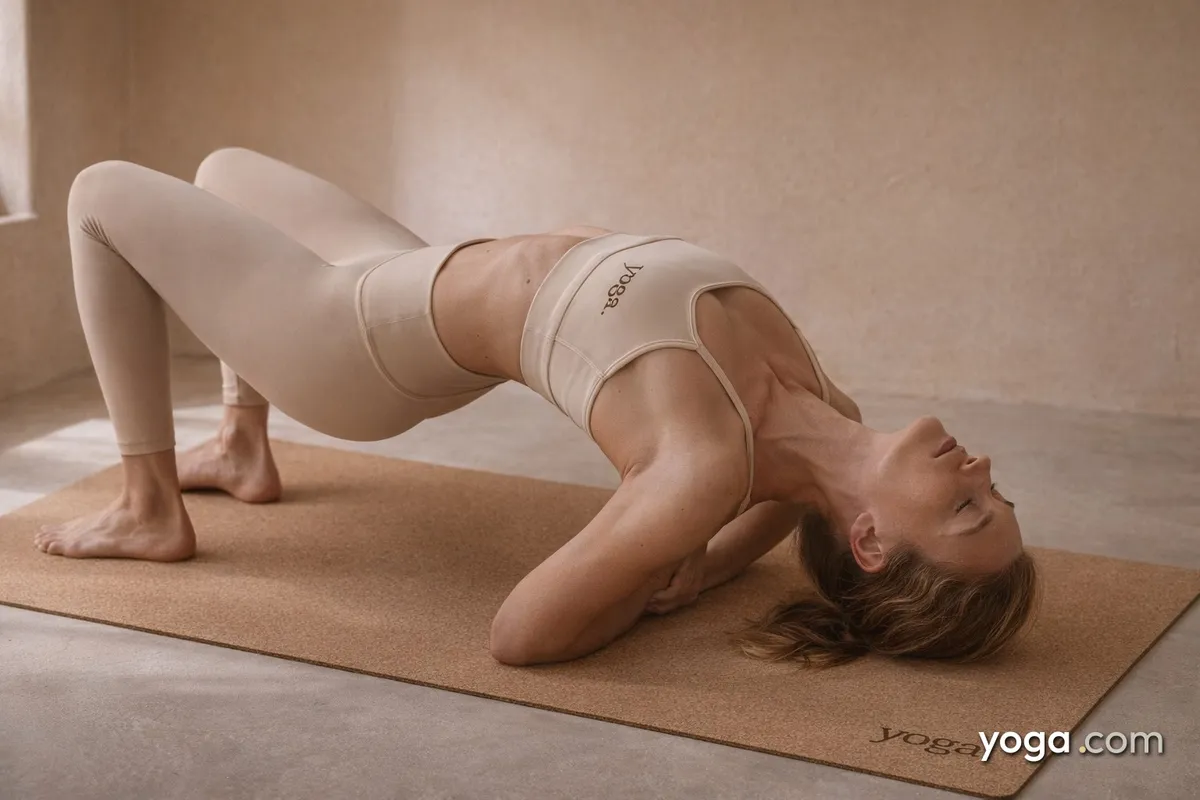
Bridge Pose on Elbows with Head Hanging is a supported backbend in which your elbows press into the mat to lift and arch the spine while the crown of the head releases freely toward the floor - a distinct variation of Setu Bandha Sarvāṅgāsana (elbows, head hanging), meaning "bridge-forming all-limbs pose." The elbow support shifts the arch higher into the thoracic spine and opens the front of the chest and throat in a way the standard bridge variation does not. Practice it toward the peak of a backbend sequence, after the spine is thoroughly warmed.
At a Glance
- Level: Intermediate
- Type: Backbend
- Targets: Thoracic spine, hip flexors, chest and shoulders, cervical spine
- Good for: Building spinal extension through the mid-back, stretching the front body from throat to hip, developing shoulder and elbow stability under load
How to Do Bridge Pose on Elbows with Head Hanging
- Lie on your back with knees bent, feet flat on the mat hip-width apart, and arms resting alongside your body.
- Press both elbows firmly into the mat beneath your shoulders, fingertips pointing toward the ceiling. Your upper arms and forearms form roughly a 90-degree angle.
- On an inhale, press down through the elbows and feet simultaneously to lift the pelvis and arch the spine upward. Let the thoracic spine dome toward the ceiling.
- Walk the shoulder blades toward each other and draw the chest open. The weight is distributed between both elbows, both forearms, and both feet - your head does not bear load.
- Allow the head to release back freely so that the crown hangs toward or lightly touches the mat. Keep the throat long; do not crunch the back of the neck.
- Hold for 5-8 steady breaths, pressing the elbows down to maintain the lift and breathing into the front of the chest.
- To come out, tuck the chin slightly toward the chest, lower the spine vertebra by vertebra back to the mat, and release the arms alongside the body.
- Rest in Corpse Pose for several breaths before continuing.
Benefits
- Stretches the hip flexors, abdomen, and intercostals along the entire front body.
- Strengthens the spinal extensors and gluteal muscles as they hold the pelvis elevated.
- Builds stability and load-bearing capacity in the shoulders and elbows.
- Increases extension through the thoracic spine, a region that tends toward stiffness.
- Lengthens the anterior cervical muscles as the head hangs freely.
- Encourages fuller, three-dimensional breathing by expanding the chest and rib cage.
Common Mistakes and Alignment Cues
- Elbows splaying outward: Press the inner edges of the elbows down and draw them toward each other to keep the forearms parallel and the chest broad.
- Weight dumping into the head: The head releases passively - it should feel weightless, not pressed into the floor. If you feel compression in the neck, lower the hips slightly until the head can hang free.
- Hips sinking unevenly: Keep both hip points lifting equally; don't let one side drop lower than the other.
- Feet rolling outward: Root down through all four corners of each foot and keep the inner ankles from collapsing, which stabilizes the knees and lower back.
- Shallow arch staying only in the lumbar: Actively broaden the collarbones and lift the sternum to encourage the curve to travel into the upper back, not just the lower.
Modifications and Props
- Folded blanket under the elbows: If the elbows or forearms are uncomfortable on a hard floor, place a folded blanket beneath them for cushioning without reducing stability.
- Block under the sacrum: For less range of motion or more support, place a block at its lowest height under the sacrum and rest there before adding the elbow lift; this lets you feel the chest-opening without full muscular demand.
- Feet to the wall: Press the soles of the feet against a wall at a comfortable distance to add a stable anchor if the hips tend to shift or the feet slide.
- Strap around the upper arms: Loop a strap just above the elbows to prevent them from sliding apart, making it easier to concentrate on the thoracic lift.
Cautions
- Avoid or significantly reduce the depth of this pose if you have an acute neck injury or recent cervical disc issue - the free-hanging head position puts the cervical spine in passive extension.
- Use care with elbow, wrist, or shoulder injuries; the forearms bear substantial load in this variation.
- During pregnancy, especially in the second and third trimesters, supine poses that compress the vena cava are not recommended - consult a prenatal yoga specialist.
- If you experience sharp pain, tingling, or numbness anywhere during the pose, come out slowly and rest.
- If you're working with an injury or a medical condition, check with a qualified professional before practicing.
Related Poses
- Bridge Pose - the foundational version to master before adding the elbow variation
- Upward Bow Pose - the next progression in deep backbending
- Camel Pose with Palms Set Against Feet - a kneeling backbend that similarly opens the throat and thoracic spine
- Corpse Pose - the essential counter-pose and rest after any deep backbend
For a gentler way to work spinal mobility into your day, see A Gentle Yoga Routine for Tired, Low-Energy Days or A 10-Move Chair Yoga Sequence for a Midday Reset.