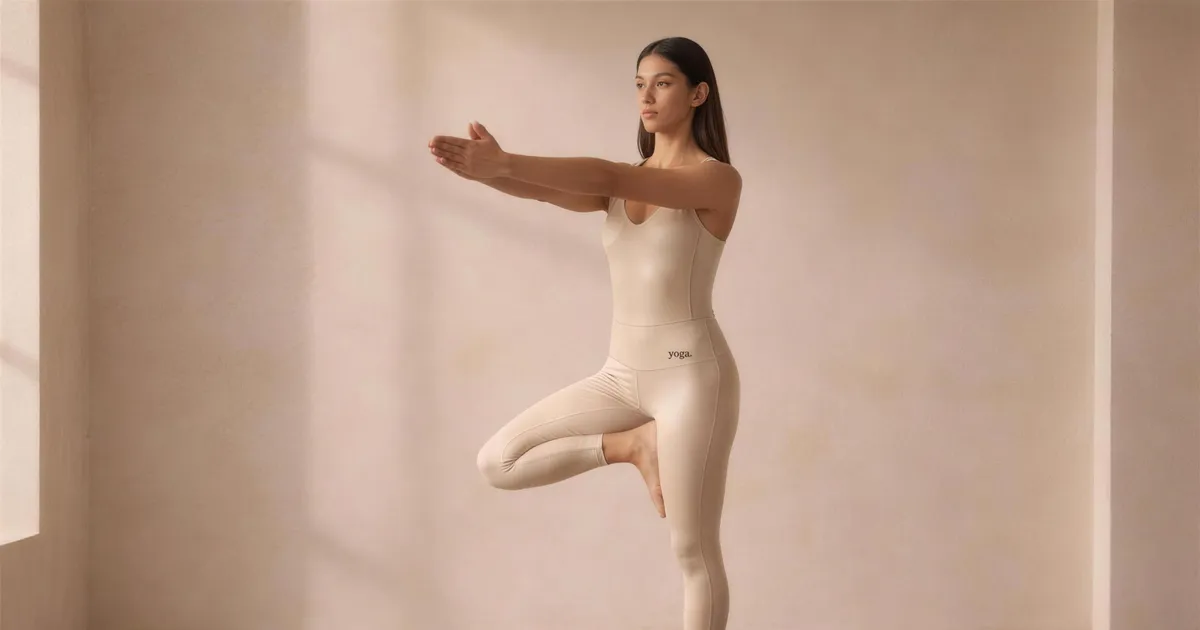
Tree Pose with Hands in Namaste Extended Forward (Right Support) is a standing balance pose in which you root through the right foot, draw the left foot to the inner right thigh, and extend both arms forward with palms pressed together at heart height or beyond. Its Sanskrit name is Vṛkṣāsana (namaste forward, right support) - vṛkṣa meaning "tree" and āsana meaning "seat" or "posture." The added forward reach of the namaste hands shifts your center of gravity and deepens the demand on hip stability, making it a natural intermediate progression within a standing balance sequence.
At a Glance
- Level: Intermediate
- Type: Balance
- Targets: Right hip and ankle stabilizers, inner left hip rotators, thoracic extensors, shoulder girdle
- Good for: Building single-leg stability on the right side, improving postural awareness through the spine, training proprioception under a shifting load
How to Do Tree Pose with Hands in Namaste Extended Forward (Right Support)
- Begin in Mountain Pose. Stand with your feet hip-width apart, arms at your sides. Distribute weight evenly across all four corners of both feet and establish a steady breath.
- Shift your weight onto the right foot. Press evenly through the ball of the foot, the outer heel, and the base of the big toe. Engage the right quadriceps and draw up through the inner arch without gripping the toes.
- Place the left foot on the inner right thigh. Bend the left knee and turn it out to the side, resting the sole of the left foot against the inner right thigh above the knee. Press the foot and thigh firmly against each other to create a stable platform. Avoid placing the foot directly on the knee joint.
- Square and lengthen the pelvis. Level your hip points so the left hip does not hike upward. Draw the low belly gently in and up, and lengthen the tailbone toward the floor.
- Bring the palms together at the heart in namaste. Press the heel of each hand lightly into the sternum, draw the shoulder blades together and down, and lift the chest.
- Extend the namaste forward. Maintaining the palms pressed together, reach the arms straight out in front of you at shoulder height, keeping the elbows slightly soft rather than locked. Continue to broaden across the collarbones and keep the shoulders away from the ears. Direct your drishti - your gaze - to a single unmoving point at eye level to steady your balance.
- Hold for 5-10 steady breaths. With each inhale, grow taller through the crown of the head; with each exhale, press the left foot more firmly into the right thigh and root through the standing foot.
- Come out with control. Draw the palms back to the heart, then lower the left foot to the floor and return to Mountain Pose. Pause for two breaths before switching sides.
Benefits
- Strengthens the ankle, knee, and hip stabilizers of the right (standing) leg.
- Stretches the inner-thigh adductors and hip external rotators of the raised left leg.
- Builds isometric strength through the shoulder girdle and upper back as the arms extend forward against gravity.
- Trains the deep spinal extensors to maintain an upright thoracic position under a forward-loaded arm position.
- Develops proprioception and fine neuromuscular coordination through the right foot and ankle.
- Improves concentration and the ability to sustain focused attention through the extended drishti.
Common Mistakes and Alignment Cues
- Mistake: Left hip hiking upward. Cue: Actively draw the left hip down so both hip crests remain level; think of the pelvis as a bowl you don't want to spill.
- Mistake: Right knee rotating inward. Cue: Keep a micro-bend in the standing knee and press it toward the pinky-toe side of the foot to maintain alignment over the second toe.
- Mistake: Shoulders creeping toward the ears as the arms extend. Cue: Slide the shoulder blades firmly down the back before and throughout the forward reach.
- Mistake: Holding the breath to maintain balance. Cue: Soften the jaw, keep the exhales complete - balance comes from breath, not from bracing.
- Mistake: Gaze wandering. Cue: Fix the eyes on one still point at eye level before you extend the arms; moving the gaze is usually the first thing that breaks the balance.
Modifications and Props
- Wall support: Stand with your right shoulder a few inches from a wall. Lightly touch the fingertips to the wall as needed, reducing the contact as your balance improves.
- Lower foot placement: Rest the left foot on the inner right calf (below the knee) rather than the thigh to reduce the demand on hip external rotation while maintaining the balance challenge.
- Block under the lifted foot: Place a block against the inner right ankle at the desired height and press the left foot into it for extra tactile feedback without wall dependency.
- Namaste at chest, not extended: If extending the arms forward shifts the center of gravity too much, keep the palms pressed together at the sternum until single-leg stability is more established, then gradually begin to reach forward over several sessions.
Cautions
- Ankle or knee instability: If the standing right ankle rolls or the knee feels unstable under load, work with wall support or reduce the height of the foot placement.
- Hip replacement or hip joint concerns: The deep external rotation of the lifted leg may not be appropriate; consult a qualified professional before attempting this variation.
- Recent shoulder or wrist injury: The extended arm position places sustained demand on the shoulder joint and wrist; modify by keeping hands at the heart instead.
- Vertigo or acute balance disorders: Practice near a wall or seated chair variation until symptoms are fully resolved.
If you're working with an injury or a medical condition, check with a qualified professional before practicing.
Related Poses
- Mountain Pose - the foundational standing pose and the starting point for every Tree variation.
- Tree Pose on Right Foot - the direct preparation; establish standard Tree before adding the forward arm extension.
- Eagle Pose (Right) - a complementary standing balance on the right foot that trains similar hip and ankle stability from a different angle.
- Standing Lord of Dance Pose with Right Foot Near the Head - a natural next progression for advanced single-leg balancing on the right foot.
Explore this pose in context: A Gentle Yoga Routine for Tired, Low-Energy Days and A 10-Move Chair Yoga Sequence for a Midday Reset.