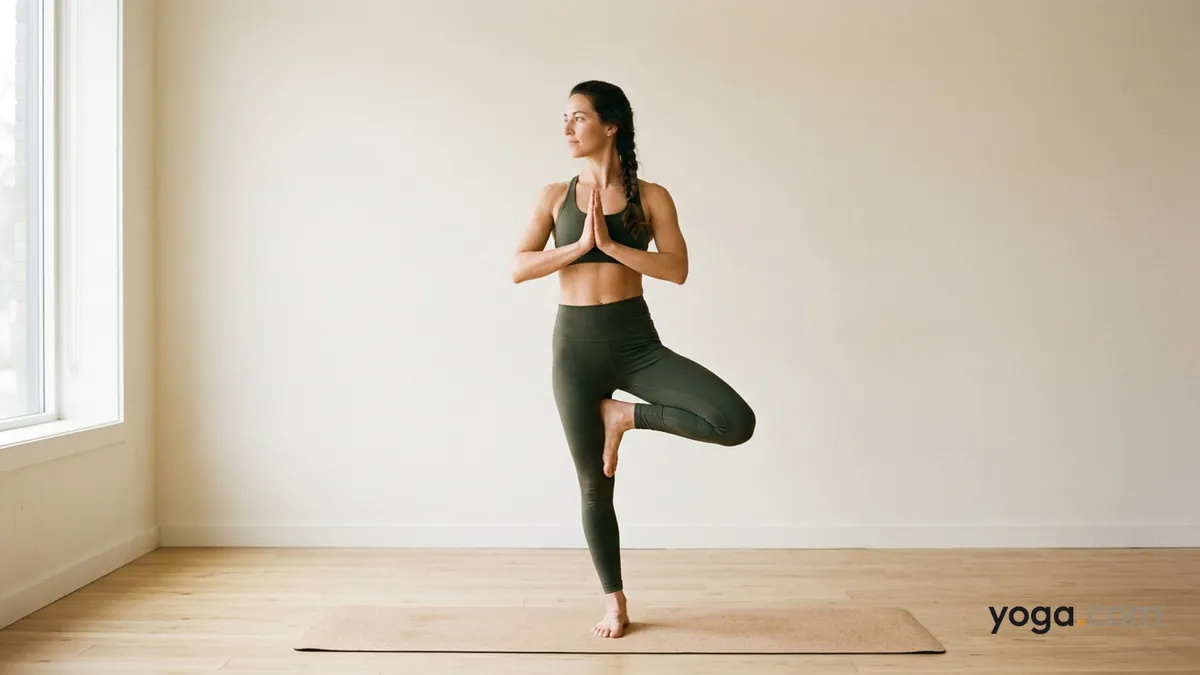
Tree Pose on Left Foot is a standing balance that asks you to root through your left leg while the right foot rests against the inner left thigh, calf, or ankle. Its Sanskrit name, Vṛkṣāsana (on left foot), translates literally as "tree posture," evoking the steady, upward reach of a rooted tree. It appears naturally in the standing sequence of a practice, either as a moment of focused stillness or as preparation for more demanding one-legged poses.
At a Glance
Level: BeginnerType: BalanceTargets: Left ankle and lower leg, left hip abductors and adductors, right hip external rotators, core stabilizersGood for: Building single-leg stability, improving upright posture, training focused attentionHow to Do Tree Pose on Left Foot
Begin in Mountain Pose, feet hip-width apart, arms at your sides. Take a breath to settle your weight evenly across both feet.Shift your weight into your left foot. Press all four corners of the foot - big-toe mound, little-toe mound, inner heel, outer heel - firmly into the mat.Bend your right knee and turn it out to the right. Lift your right foot and place the sole against your left inner thigh, calf, or inner ankle - never directly against the knee joint.Press your right foot and left inner thigh actively into each other to stabilize the hip. Draw your right knee back in line with your right hip, rather than letting it drift forward.Bring your palms together at your chest in a prayer position, or extend your arms overhead with palms facing each other. Lengthen through the crown of your head.Fix your gaze (drishti) on a single, still point at eye level - a spot on the wall or floor a few feet ahead of you. Keep your breath steady and your left standing leg strong but not locked.Hold for 5-10 breaths, maintaining length through both sides of the waist and a gentle lift through the lower belly.To come out, exhale and lower your right foot back to the mat with control. Return to Mountain Pose for a breath before switching sides.Benefits
Strengthens the intrinsic muscles of the left foot and ankle, building the capacity for single-leg support.Activates the left gluteus medius and other hip stabilizers required for lateral pelvic control.Stretches the right hip external rotators and inner groin as the right knee opens to the side.Engages the deep core - particularly the transverse abdominis - to maintain an upright, stable torso over one leg.Trains focused, steady gaze (drishti), which directly supports balance and concentration.Reinforces vertical alignment through the spine and the standing leg when practiced with attention to posture cues.Common Mistakes and Alignment Cues
Placing the foot on the knee: The knee has no muscular support against lateral compression. Place your right foot above or below the joint - inner thigh or inner calf only.Gripping the standing-leg toes: Clenching the toes narrows your base and tires the foot quickly. Spread the toes wide and press the whole sole into the mat.Tilting the pelvis to the right: If the right hip hikes up, the spine bends rather than stands tall. Keep both hip points level and think of stacking them evenly.Locking the left knee: Hyperextending the standing knee shifts load into the joint. Maintain a micro-bend - enough to activate the quadriceps without locking.Letting the gaze wander: A moving focal point disrupts the vestibular system and destabilizes the pose. Choose one fixed spot and commit to it for the full hold.Modifications and Props
Wall support: Stand an arm's length from a wall and place your fingertips lightly on it. This gives proprioceptive feedback without fully removing the balance challenge.Lower foot placement: Rest the right foot on the inner ankle with toes touching the mat - a kickstand position - to reduce the demand on the hip and standing leg.Block under the lifted foot: Place a block against the inner left calf and rest the right foot on it for a supported version that still opens the right hip.Arms variation: If raising the arms overhead strains the shoulders or neck, keep the palms at the chest or rest the hands on the hips to simplify the upper-body task.Cautions
Ankle instability or recent ankle sprain: Single-leg standing places significant demand on the ankle. Use wall support and a lower foot placement until the joint is fully stable.Inner-knee sensitivity: Confirm your right foot is above or below the left knee, never resting on it. Even light pressure against the joint is inadvisable.Hip or groin strain: The external rotation of the raised leg may be uncomfortable with an active groin or hip injury. Keep the lifted foot lower and reduce the range of rotation.Vertigo or balance disorders: Perform the pose with fingertips on a wall or seated chair variation until you have clearance to practice freestanding balance work.If you're working with an injury or a medical condition, check with a qualified professional before practicing.Related Poses
Mountain Pose - the foundational starting point; teaches the upright alignment and foot engagement that Tree Pose builds on.Tree Pose on Right Foot - the complementary side; practice both to balance single-leg training evenly across the body.Warrior Pose on Left Foot - another left-leg standing pose that develops the hip and leg strength useful for deepening Tree.Lord of the Dance Pose (Left) - a natural next progression from Tree on the left leg, adding a backbend and greater balance challenge.Tree Pose on the left foot fits well in a standing balance sequence. See it in context in A Gentle Yoga Routine for Tired, Low-Energy Days and A 10-Move Chair Yoga Sequence for a Midday Reset.