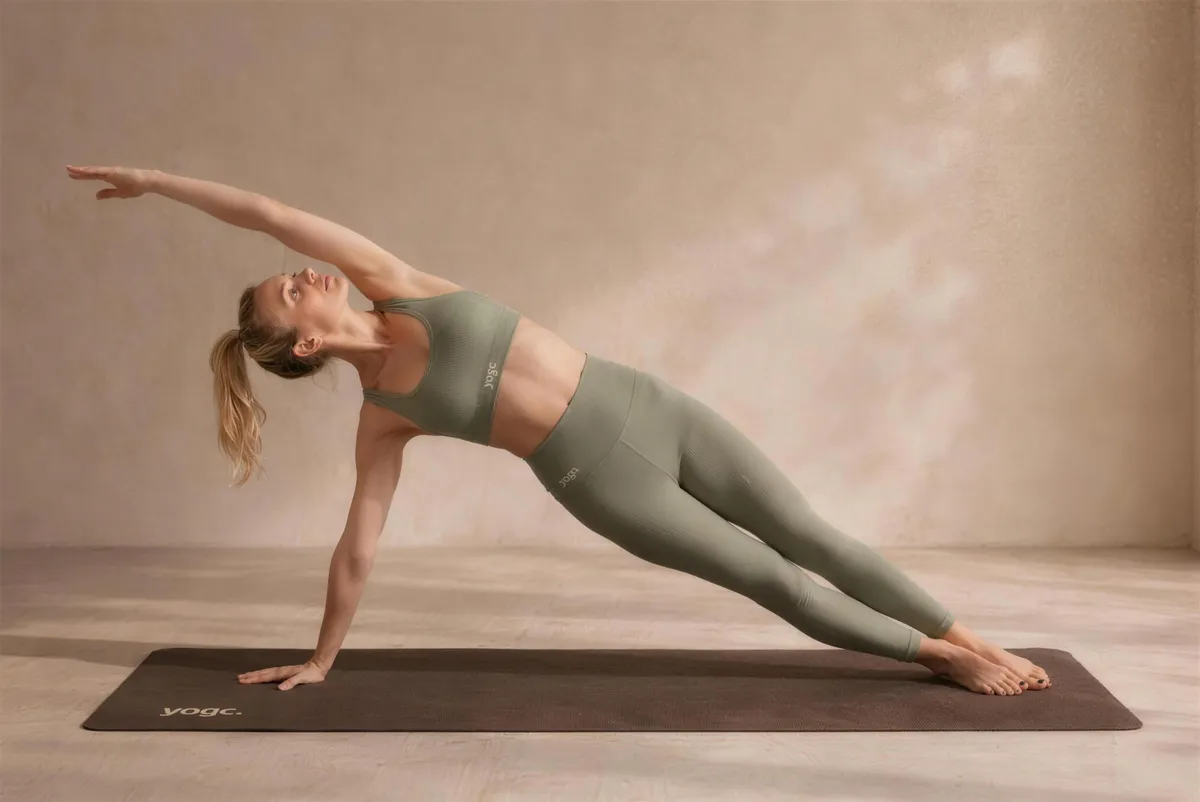
Side Plank on Left Arm with Side Bend is a demanding arm balance that takes the classic side-plank family to its outer edge, demanding full-body tension, precise stacking, and bold lateral flexion. Its Sanskrit name is Vasiṣṭhāsana (one arm, advanced left bend) - Vasiṣṭha was a revered Vedic sage, and the name honors the pose's quality of unwavering steadiness. In a well-sequenced advanced practice, it appears after the body is thoroughly warm and the wrists, shoulders, and obliques have been prepared.
At a Glance
- Level: Advanced
- Type: Arm Balance
- Targets: Wrist and shoulder girdle, lateral core (obliques), hip abductors, thoracic spine
- Good for: Building single-arm weight-bearing strength, developing lateral spinal mobility, training full-body tension and coordination
How to Do Side Plank on Left Arm with Side Bend
- Begin in Side Plank on the left hand. From a full Plank Pose, rotate onto the outer edge of your left foot, stacking the right foot on top of the left. Press the left palm firmly into the mat, fingers spread wide, middle finger pointing forward. Extend the right arm toward the ceiling and find your balance here for several breaths.
- Set your foundation. Root through the entire left palm - not just the heel of the hand. Draw the left shoulder blade toward your spine and press the head of the humerus back into its socket. Engage your legs fully: squeeze the inner thighs together and press out through both heels.
- Activate the lateral body. Lift your hips so the body forms one long diagonal line from heel to crown. Contract the obliques to prevent the hips from sagging. Breathe into the right side of the ribcage to open space there.
- Introduce the lateral bend. On an exhale, arc the right arm overhead and to the left, reaching the fingertips toward the floor in front of your left hand or beyond. Keep the hips stacked and lifted as the torso arcs, so the body curves into a long lateral arc to the left. The left side of the body remains strong and lifted; this is a side bend, not a collapse.
- Refine the shape. Stack the right hip directly above the left and keep both hip points facing the same wall. Roll the top (right) shoulder gently back to open the chest toward the ceiling. Let the gaze travel upward toward the right armpit or the ceiling - wherever the neck feels long and free.
- Hold and breathe. Maintain the pose for 3-5 steady breaths, keeping the core braced and the left shoulder actively pressing away from the ear.
- Come out with control. On an inhale, sweep the right arm back up to vertical to neutralize the spine, then return to full Side Plank. Lower the hips, step or shift back to Plank Pose, and take a brief rest in Downward-Facing Dog before switching sides or transitioning onward.
Benefits
- Strengthens the wrist extensors and flexors under significant single-arm load
- Builds stability in the rotator cuff and shoulder girdle
- Stretches the right-side intercostals, obliques, and lateral hip musculature
- Develops eccentric control of the right-side obliques as they lengthen under load and resist the leftward arc; left obliques contract concentrically
- Trains proprioception and full-body neuromuscular coordination in a unilateral position
- Increases active range of motion in thoracic lateral flexion
Common Mistakes and Alignment Cues
- Sinking into the supporting shoulder: If the left shoulder creeps toward the ear, actively push the mat away and draw the scapula toward the spine to restore a stable shoulder girdle.
- Hips dropping rather than arcing: A passive hip drop collapses the pose. Keep the obliques engaged throughout so the lateral bend is an active curve, not a sag.
- Wrist rolling to the outer edge: Distribute weight across all four corners of the palm. Pressing the index-finger knuckle firmly down takes excess load off the outer wrist.
- Top hip rotating forward: Stack both hip points facing the same wall and think of lengthening the right side of the waist rather than twisting the pelvis.
- Holding the breath: Gripping the breath signals excess effort. Soften the jaw, keep the exhale long, and use breath rhythm to gauge sustainable effort.
Modifications and Props
- Forearm variation: If the wrist cannot bear full load, lower the left forearm to the mat, elbow under the shoulder. Practice the lateral bend from this base to build oblique strength before adding wrist load.
- Wall support for the feet: Place the outer edge of the left foot against a baseboard or wall to reduce the balance demand and let you focus on the lateral arc.
- Block under the left hand: A block at its lowest height reduces wrist extension angle and raises the floor slightly, making the initial weight-bearing more accessible.
- Staggered feet: Instead of stacking the feet, place the right foot in front of the left on the mat (feet hip-width apart). This widens the base significantly and allows beginners to the one-arm variant to explore the bend without the balance challenge of stacked feet.
Cautions
- Wrist pain or recent wrist injury: Single-arm balances place concentrated load on the carpals and wrist joint. Use the forearm modification or avoid the pose until the wrist is fully recovered.
- Shoulder instability or rotator cuff issues: The supporting shoulder works at its limit here. Prioritize shoulder stability exercises before attempting this variant.
- Lateral neck discomfort: If reaching the gaze toward the ceiling compresses the cervical spine, keep the head neutral or look straight ahead.
- Hypermobility: Extreme flexibility in the shoulder or elbow can mask instability. Engage the muscles actively and avoid locking the elbow joint.
- If you're working with an injury or a medical condition, check with a qualified professional before practicing.
Related Poses
- Plank Pose - essential preparation for wrist and core loading
- Side Plank Pose on Left Hand, Legs Together - the direct predecessor; master this before adding the bend
- Downward-Facing Dog Pose - ideal counter-pose to decompress the wrists and rebalance the shoulders
- Upward-Facing Dog Pose - complements the lateral work with a spinal extension counter-stretch
For accessible movement practices, see A Gentle Yoga Routine for Tired, Low-Energy Days and A 10-Move Chair Yoga Sequence for a Midday Reset.