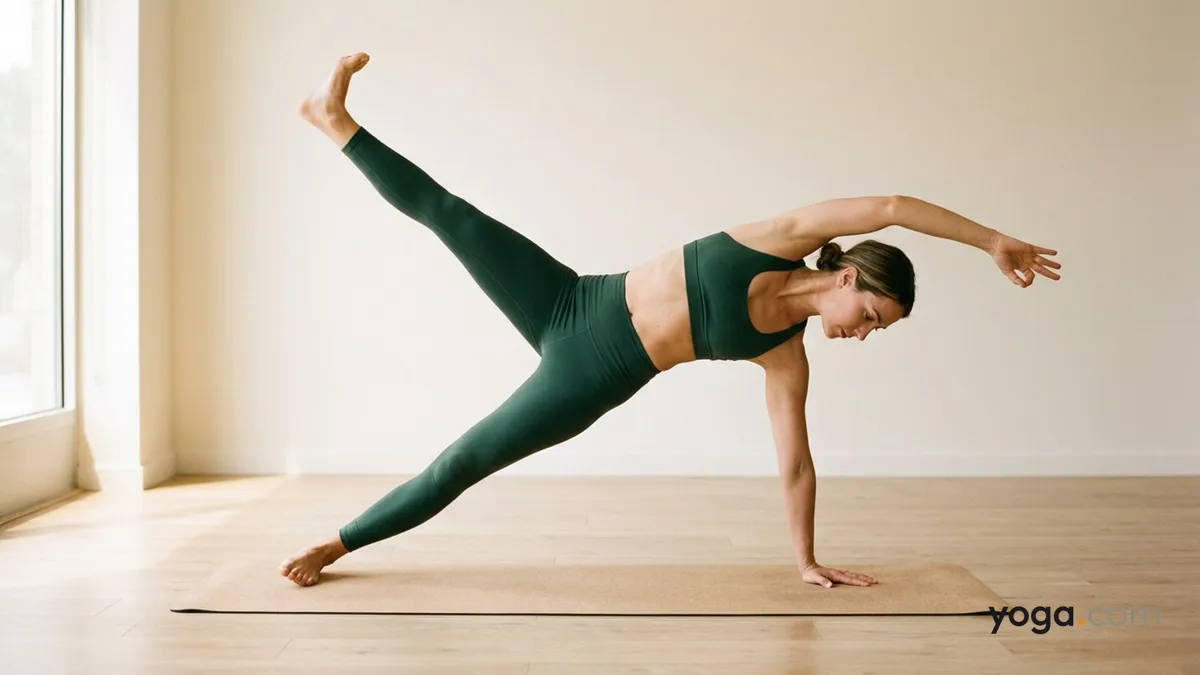
One Arm Advanced Right Bend is a demanding arm balance that takes the classic side plank to its furthest expression — one hand on the mat, the body stacked and cantilevered, while the top leg lifts and the torso bends laterally toward the right. Its Sanskrit name is Vasiṣṭhāsana (one arm, advanced right bend), referring to the sage Vasiṣṭha, whose name translates roughly as "most excellent" or "best." This peak pose typically appears near the apex of a strong vinyasa or power practice, after the wrists, shoulders, and lateral chain are thoroughly warmed.
At a Glance
Level: AdvancedType: Arm BalanceTargets: Wrist and shoulder girdle, lateral core (obliques and quadratus lumborum), hip abductors, hamstrings of the lifted legGood for: Building single-arm load-bearing strength, developing lateral spinal stability, improving balance and proprioceptionHow to Do One Arm Advanced Right Bend
Start in Plank Pose. Stack your shoulders over your wrists, spread your fingers wide, and press the floor away so your chest doesn't sink between your arms.Rotate onto the outer edge of your right foot. Pivot onto the right hand and right foot, stacking your left foot on top of the right (or just behind it for more stability). Lift your left arm toward the ceiling, coming into a standard Side Plank on the right hand.Establish your base. Press actively through the right palm — especially the index finger mound — and firm the right shoulder blade against your back ribs. Keep the right elbow straight but not hyperextended.Stack and square the hips. Lift your right hip so your body forms one long diagonal line from crown to heels. Engage the right obliques and right glute to prevent the hip from sagging.Raise the top leg. On an exhale, lift your left leg to hip height or above, holding the outer edge of the left foot with your left hand (or using a strap around the arch). This is the foundation of the advanced variation.Introduce the right bend. Keeping your left arm extended and your left leg lifted, exhale and arc the upper body gently to the right — bending the spine laterally so the crown moves toward the right side. Your gaze can follow the bend, looking down and slightly right, or remain forward. The bend is controlled and comes from the torso, not from the shoulder collapsing.Hold and breathe. Stay for 3–5 slow breaths. Maintain active pressing through the supporting hand and continuous engagement of the obliques and hip abductors throughout.Come out safely. Straighten the torso back to neutral Side Plank first, then release the top foot, lower the left arm, and return to Plank Pose. Rest in Child's Pose for several breaths before repeating on the left side.Benefits
Strengthens the wrist flexors, extensors, and the muscles stabilizing the shoulder girdle under single-arm loadBuilds lateral core strength in the obliques and quadratus lumborumStretches the hamstrings and inner thigh of the raised legDevelops full-body balance and proprioceptive coordinationIncreases lateral spinal mobility when the right bend is introducedTrains the scapular stabilizers — serratus anterior in particular — in a lengthened, loaded positionCommon Mistakes and Alignment Cues
Shoulder dumping: If the right shoulder creeps toward the ear, actively depress and protract the shoulder blade — press the floor away rather than hanging into the joint.Sinking hip: If the right hip drops, fire the right glute and right obliques more decisively. Imagine someone has a hand under your hip and you're pressing into it.Bending from the lower back only: The lateral bend should travel through the whole torso. Initiate the arc from the mid-thoracic spine, not just the lumbar region, to distribute the load evenly.Gripping the foot with a bent elbow: Keep the top arm long and the elbow straight when holding the raised foot — a bent elbow shortens the lever and reduces balance challenge, but it also lets the shoulder round forward.Holding the breath: The tendency is to brace and freeze. Keep exhaling steadily; the exhale deepens the oblique engagement and supports the bend.Modifications and Props
Strap for the raised foot: Loop a strap around the arch of the left foot and hold the strap rather than the foot directly. This keeps the arm extended even with tighter hamstrings.Lower knee on the mat: Place the right knee down (right shin parallel to the front of the mat) to reduce the load on the wrist and shoulder while you practice raising the top leg and introducing the bend.Block under the right hand: A block at its lowest height under the supporting palm reduces wrist extension and makes the base more manageable for practitioners with tight wrists.Skip the lateral bend: Practice the one-arm side plank with the top leg lifted but hold the torso upright before adding the right bend. Build the component parts before combining them.Cautions
Wrist discomfort: This pose places substantial compressive and shear force on the right wrist. If you feel sharp pain (not just the burn of effort), come out immediately and consider the block modification.Shoulder instability or rotator cuff issues: The single-arm load demands significant rotator cuff integrity. Approach with care and build shoulder stability in Plank and standard Side Plank first.Neck strain: When introducing the right bend and the gaze shift, move slowly. If the neck feels compressed, keep the gaze forward and minimize the cervical component of the bend.Hamstring strain: Lifting the top leg with force can strain an already fatigued hamstring. Use a strap and never yank the leg up.If you're working with an injury or a medical condition, check with a qualified professional before practicing.
Related Poses
Plank Pose — builds the wrist and shoulder foundation this pose demandsSide Plank Pose on Left Hand, Legs Together — the direct preparatory and counter-side variationDownward-Facing Dog Pose — an effective transitional reset between sides and a shoulder-opening counter-poseUpward-Facing Dog Pose — a complementary backbend that counters the lateral flexion and rebalances the spineLooking to build toward arm balances progressively? See A Gentle Yoga Routine for Tired, Low-Energy Days for recovery sequencing, or reset mid-session with A 10-Move Chair Yoga Sequence for a Midday Reset.